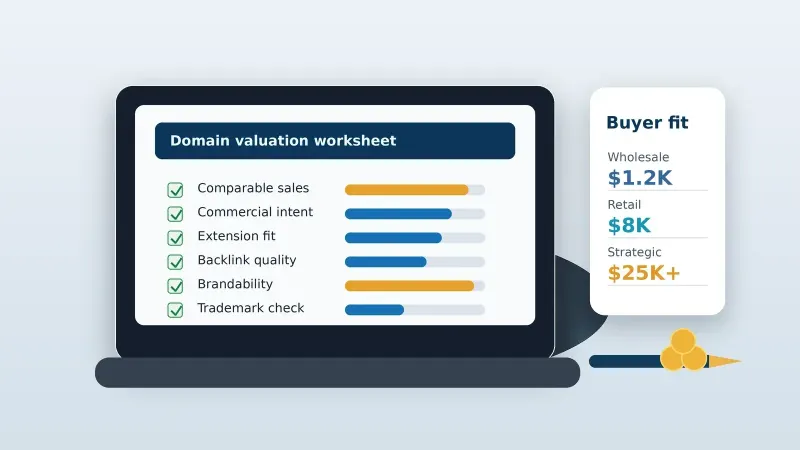
Expired domain flipping is popular because the financial statements can look impressive. You purchase a domain for under $100. Then you sell the same domain name to a company for thousands of dollars.
There is real money in the middle, but flipping success is not automatic. The investor must find a valuable domain, win the auction without overbidding, renew the domain while awaiting buyer interest, pick a sales channel, and transfer the domain securely. Many purchased domains will never sell. Others sell after years of renewals and opportunity cost.
Wholesale-to-retail flipping works best when investors understand the difference between price versus value.
Wholesale price refers to what someone else is willing to pay now. Retail value refers to what a business may pay for a domain when that name solves their naming problem. The potential margin between wholesale cost and retail value creates the opportunity.
First, what is an expired domain flip?
An expired domain flip is the resale of a domain name after someone else registered it and allowed it to expire.
How does a name reach this stage? Not every dropped name becomes available on day one. The route may include redemption periods, expired auctions, closeouts stages, redemptions, and more. Cloudflare says the domain may ultimately be auctioned off by its registrar when registration expires. Its overview of expired domains covers important basics for beginners.
GoDaddy has a helpful expired auction timeline. Domains eligible for auction through GoDaddy usually land on GoDaddy Auctions between 26 and 29 days after expiration. If there is no winner, a closeout period may occur before release.
Now there are three ways to source these domains.
You could win the auction and buy it from the registrar. You might also place a back order with a domain drop catching service. Finally, you could register the domain on day-one availability for the standard registration fee.
Expense and asset management rules still apply. You control that domain via WHOIS either way.
Why Domain Investors Like Expired Domains
Registration history matters. A domain straight from registration has zero history. An expired domain name might already be signalling value.
Perfect seo domains for sale
Expired domains might have historic traffic, brandable domain names that sound like business, memorable one-word domains, keywords, backlinks, or several of these characteristics. The positive aspects need examination.
A domain with traffic is not necessarily valuable. Ancient backlinks might originate from hacked sites, spam pages, unpaid directories, or unrelated material. Past traffic often disappears when websites shut down. Keywords often feel popular but lack commercial buyers.
Subjective attributes matter less when the metrics are strong. The best dropped names typically combine several advantages:
1. Easy spelling
2. Commercial keyword
3. Preferred extension
4. Clean background
5. Several obvious buyers
6. Low renewal price
7. Reasonable resale value
Investors buy domains that other people want. They are not buying a statistic.
The Auction Sourcing Baseline
A common reader question is how much money do investors pay at auctions?
TLDR; Sell Today
There is no single answer. Go Daddy claims that over 50,000 names enter its auction platform every day. Some have zero resale value. Others work well for local businesses. Rare names trigger bidding wars.
DropCatch, NameJet, registrar auctions, and closeouts work differently. One investor may register names for below $100 after the current owner drops it. A common word .com might sell for hundreds. Sexy keywords, powerful backlink assets, or domains under ten characters rise much higher.
New investors should apply 3 working tiers to auctions:
Auction buyer segments
|
Buyer Segment |
Wholesale Cost Range |
Domains That Fit This Tier |
|
Entry level |
Under $100 |
Distinctive terms, undiscovered brandables, closeout auctions |
|
Selective mid range |
$100 to $1,000 |
Solid brandables, high profile 2-word domains, local terms with business utility |
|
Competitive premium |
Above $1,000 |
Dictionary terms, short domains, strong commercial terms, undeniable backlink assets |
Rules apply. Remember to calculate expected resale value before you pay your bid amount.
Track Profit Margins Of Dropped Domain Names
Liquidation value refers to what one investor is willing to accept when another investor needs liquidity.
It is typically less than your ideal retail price because you account for renewal fees, the holding period, and uncertainty of resale. That $2,500 name might only have $750 in investor resale value.
This plays a role during auctions.
A savvy investor risks ruin if they believe every domain will reach its projected retail price. Approach the auction with two numbers in mind:
1. What is the conservative liquidation value?
2. What is the realistic retail price I expect?
Number 1 safeguards you from overpaying. Number 2 lets you define your maximum bid.
Resources like NameBio
exist but are incomplete. NameBio has over $3 billion dollars of historical
sale data. Visit their website for historic sales data. But privately
negotiated sales and private party sales may not be reported.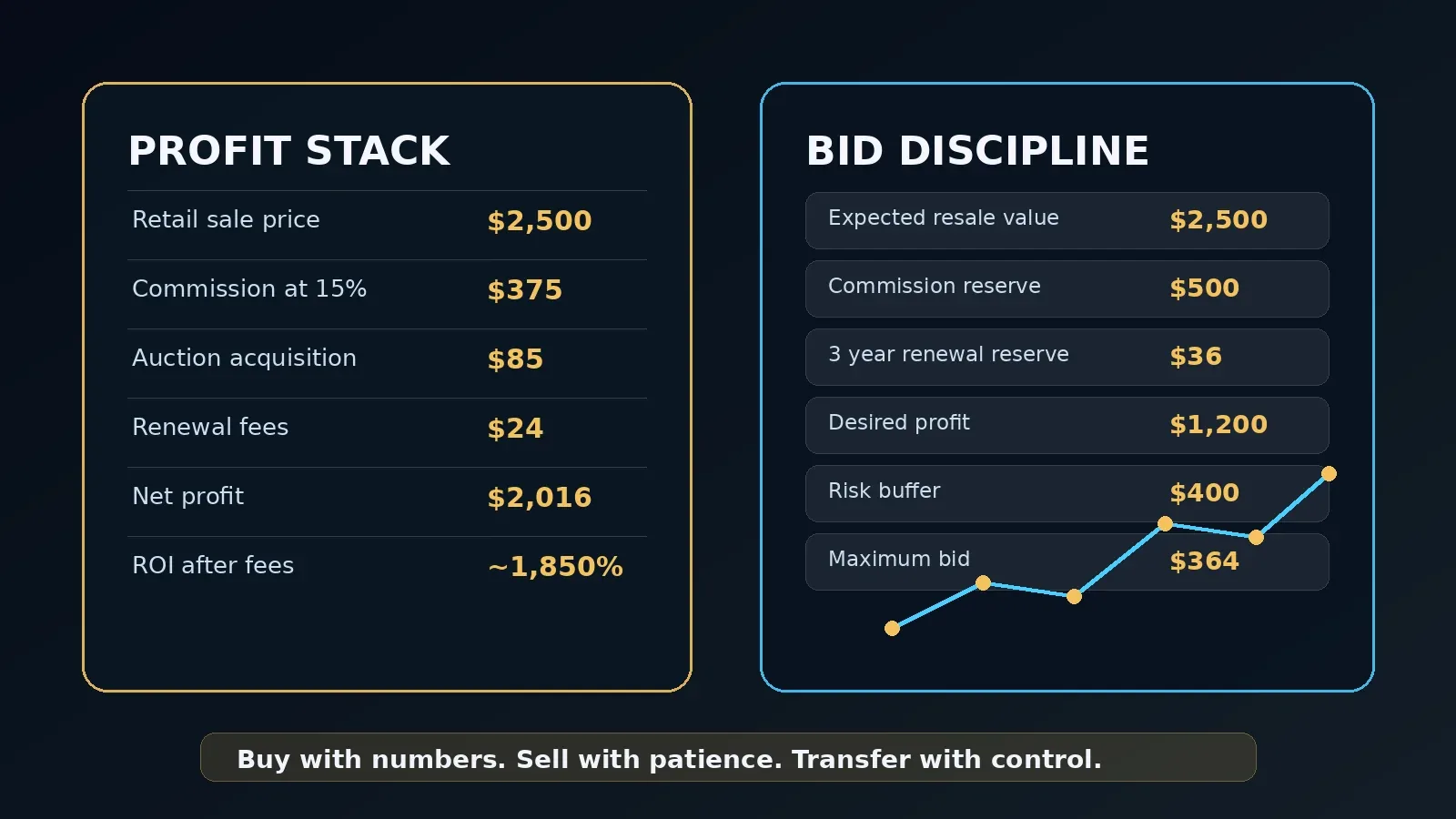
Know the Retail Upside: Industry Benchmarks for Markup Margins
The average expired domain sale does not convert into a single profitable margin.
Some names languish for years. A few sell instantly. A rare few pay for the mistakes of unpurchased names in your portfolio.
Net profit is your actual sale price minus acquisition cost minus renewal fees minus marketplace commissions minus payment provider fees.
Take your net profit number and divide by your total invested cost before commissions.
Multiply by 100 and you have your ROI%.
Example:
An investor wins an auction with a $85 bid. Two years later, the domain sells for $2,500 with a marketplace charging 15% commission. The investor paid $24 in total renewal fees. Here’s how that math breaks out:
Example profit calculation
|
Metric |
Amount |
|
Retail Sales Price |
$2,500 |
|
Marketplace commission at 15% |
$375 |
|
Auction acquisition price |
$85 |
|
Renewal fees |
$24 |
|
Net profit |
$2,016 |
|
Total Cost before commissions |
$109 |
|
Net ROI after commissions |
~1,850% |
A 1,850% markup is wonderful. But this is just an example. The name must sell first.
Now imagine your portfolio floods with names that never sell. Continuing with the previous example. Here are the potential outcomes when factoring in average holding periods.
Holding period impact
|
Amount Held |
Auction Price |
Rental Charge |
Total Investment Before Commission |
|
30 days |
$85 |
$0 |
$85 |
|
2 years |
$85 |
$24 |
$109 |
|
5 years |
$85 |
$60 |
$145 |
Long-term holds eat into your margins. A worthwhile sale will overcome holding costs. Poor names will dip into your profits.
Portfolio accounts magnify this effect. An expired name portfolio holding 500 domains with an average renewal cost of $12 per year will spend $6,000 on renewals before the first sale.
Domain investors love low-cost storage. Highly selective buyers understand why resale value matters more than buying volume.
How Much Should You Bid? Formula for Calculating Your Max Bid
Beginners should bid with logic, not emotion.
Calculate desired resale value, subtract commissions, subtract renewal fees, add a buffer, and consider your desired profit target.
Maximum Bid = Expected Retail Price – Commission Reserve – Holding Cost Reserve – Desired Profit – Risk Buffer
Example:
Let’s use the following expected sale price of $2,500.
Maximum bid example
|
Metric |
Amount |
|
Expected resale value |
$2,500 |
|
Commission reserve (20%) |
$500 |
|
Three year renewal reserve |
$36 |
|
Desired profit |
$1,200 |
|
Risk buffer |
$400 |
|
Maximum Bid |
$364 |
$364 is not a mandate to DROP $364 at auction. If the auction pushes past $364, reconsider your upside. For example, if your number was $2500, why are you bidding on a name that might only sell for $1500?
Beginner Guide To Flipping Domains: 5 Steps To Help You Sell Quickly and Securely
1) Analyze expiring domains daily
Use a research tool like ExpiredDomains.net. Bookmark it. Make daily habit.
expired domains for sale
ExpiredDomains.net harvests domains on delete and deleted status. The tool supports hundreds of extensions and has filters for age, backlink popularity, keyword metrics, and auction history. Focus on exporting your potential winners to a spreadsheet for deeper analysis. Do not buy yet.
Step 2: Evaluate History
Any domain can change. Examine Archive.org pages, current rankings, previous content, backlinks, possible trademark conflicts, and common searches.
A typo domain may sell without a link. A domain name with backlinks is not intrinsically good or bad. Pinpoint why these links exist.
3) Determine Maximum Bid Price
Reserve funds for commissions. Reserve money for renewal fees. Factor in risk. Know your numbers. Write your max bid amount on paper before the auction ends.
Step 4) Create your own sales page
As soon as someone visits your domain, they should know it is for sale.
Afternic Sales Landers let you place a sale banner on a listed domain. Afternic also claims names on its platform land in millions of monthly searches across partnered registrars.
Sedo is another option. Sedo has multiple commission tiers based on whether your sale occurs from a parked Buy Now page, a direct Sedo sale, or SedoMLS.
Atomhelp.com, formerly Squadhelp might be ideal for certain brandable names. The site promotes a vetted marketplace, payment flexibility, and secure transactions.
Domain Names For Sale
Step 5) Securely complete the transaction
Follow the procedure of whatever sales channel you choose or work with a trusted escrow service.
Escrow.com breaks down its own process in five steps. Agreed upon terms get set. Buyers pay Escrow. Sellers release domain to buyer. Buyer verifies control. Escrow releases funds.
Never hand over a domain to anyone who only provides a screenshot or “verified” PayPal email.