
A global website lives in multiple markets at once.
Customers want different things in each country. Payment methods differ.
Delivery networks differ. Consumer protection laws differ. Search engines also
rely on signals that indicate a page targets a regional market.
Accommodating all of those audiences becomes easier with country code top level
domains.
A ccTLD is a country-code extension like .de, .ca, .jp, or .uk. The extension itself can quickly signal geographic intent to users and search engines. Site visitors that encounter Brand.de could reasonably expect German language pages, local euro pricing, and service options for Germany. Brand.com implies a wider, international audience and experience.
Website visitors could still find localized content on Brand.com just as European customers can find an Irish or German version of .com.
The key difference with a local extension is expectation paired with appropriate web design. European customers will anticipate continental differences when deciding to click through on a .fr or .it domain.
Does That Local Extension Come With Built-In Trust?The actual question of why do European consumers trust local ccTLDs more than dot com needs more nuance.
Europe does not equal 1,000% German ccTLD adoption. That statistic might apply to certain product categories in Germany but not retail shoppers. French website traffic could surpass Belgian traffic even though geographic domains are equally popular in both countries.
Each market needs individual testing.
Australia is often mentioned as a country where .com.au is preferred. auDA cited research that 50% would not
purchase from a website without a .au domain.
It would be unethical to take that number and insert it into a forecast for European market potential. Google clearly recommends testing a local domain’s impact by running experiments across brand.com and a regional extension.
Conversion rate, cart abandonment rate, branded search, direct traffic, and support requests are real signals that can influence multi-year architecture decisions.
Can a Country Code Domain Boost Local Search Engine Rankings?Google does believe a ccTLD can offer stronger country targeting.
International SEO Guidelines for Google
explicitly state that geotargeting can give websites a ranking advantage in
that territory at the expense of other countries.
Instead of fully ranking for Australia, a brand.au website might rank highly only within Australia.
Localized domains are not a magic solution for granular market targeting.
Language, on-page signals, technicalSEO, user experience, content relevance, and backlink credibility still matter on every domain. Search engines crawl websites rather than extensions.
It ultimately comes down to website governance and organizational alignment:
|
Structure |
Example |
Main Advantage |
Main Limitation |
|
ccTLD |
Brand.de |
Clear regional identity |
Separate registry and operational overhead |
|
Subdirectory |
Brand.com/de/ |
Centralized management |
Regional signal depends more heavily on implementation |
|
Subdomain |
de.Brand.com |
Operational separation |
More complex governance and analytics |
Both page markup and server configuration factor into Google’s evaluation of locale signals:
Use distinct URLs for each language version of your website. For example, if your English site is mysite.com and your Spanish site ismysite.es, include hreflang annotations so search results can direct users to the appropriate version.”
ICANN also recommends filing localized Google Search Console accounts for each extension.
Local Presence Rules for Global BrandsWho can register international domains is decided by each regional
registry.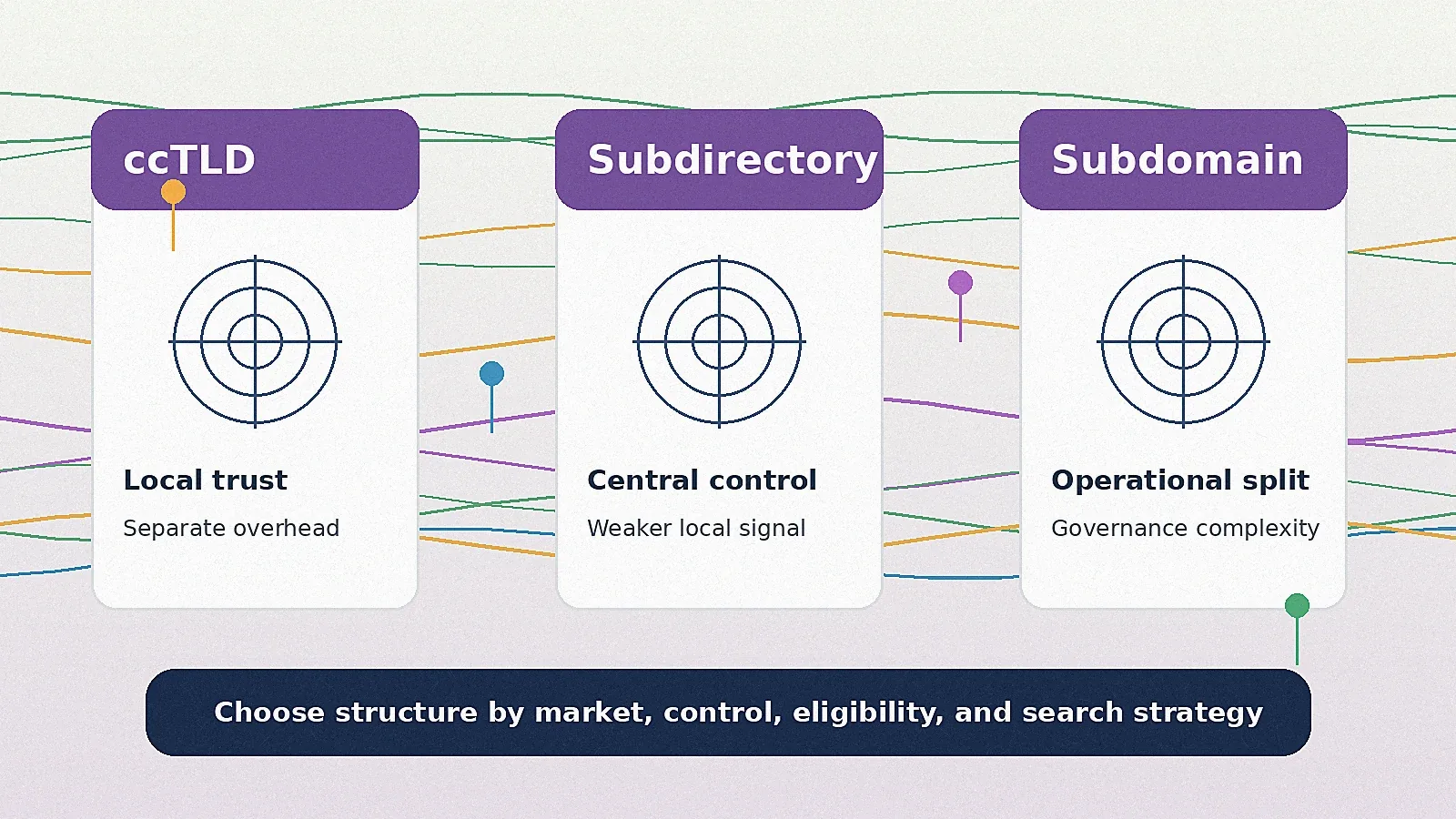
Canada’s CIRA requires .ca registrants to specify their Canadian Presence Requirements level of connection to Canada. Options include Canadian citizens, Canadian corporations, permanent residents, and owners of Canadian trademarks.
Australia’s auDA says registrants must prove they are a commercial entity with a connection to Australia. Connecting to Australia could mean possessing an Australian Business Number or Australian Company Number.
EU trademarks can qualify European domain registrations through EURid. Citizens and businesses in the EU or EEA enjoy European residency for .eu domains whether they live in Germany or India.
Domain registrants never answer those questions for a registry. A responsible corporation does.
Multi regional domains pose control risks when the responsible party at registrars and registries is a marketing consultant, third party agency, or jurisdiction with lax ownership requirements. Corporations need internal control over their domain purchases to protect brands and consolidate renewal reminders.
Building a Regional Website Platform for Ecommerce BrandsImagine planning a global expansion but registering dozens of domains based purely on username availability.
Using ccTLDs signals strong local intent. If that fits with brand strategy then region separation, independent applications at the registry, and separate Google Search Console profiles become worthwhile.
Centralized management with a .com subdirectory falls in the opposite spectrum. Site owners run a single site on one codebase serving multiple languages from brand.com/de/.
Something in between could use brand.de with subdomains for nation-specific adaptations like marketing.de or events.de. Implementations will vary based on customer needs.
Each approach should standardize the following steps:
1.
Confirm eligibility to register
with the target ccTLD
2. Screen for registered trademarks that could conflict with the desired domain
name
3. Create pages in the local language
4. Adjust pricing to local units and add local payment methods
5. Map international url’s with hreflang annotations
6. Monitor each regional extension in Google Search Console
7. Configure a CDN that supports regional hosting
8. Show visible region or language selectors for user initiated transfers
9. Assign clear owners for renewal notifications
10. Identify incident response contacts abroad
International website visitors do not appreciate being force redirected to their region without a visible way to change languages or countries. Google expressly says automatic redirects can hurt your ability to target multiple languages in one country.
Language-based subdirectories should keep hreflang tags instead of redirection when targeting countries like India where users speak many languages.
Don’t Fragment Your Domain Portfolio Without ControlToo many websites register new ccTLDs because their competitors do. Local domains should not distract from the brand.com asset.
dns holdings create budgetary obligations, renewal reminders, trademark risks, and more work for SEO teams. Every additional domain locks the organization into managing DNS for another public resource.
Marketplaces like Atom provide views into registered domain names but should not replace visits to each registry or consultations with legal advisors.
Lessons Learned About Global Brand DomainsRegister the country-code extensions your business plans to serve independently. Stick with a .com subdirectory if you prefer a single centralized CMS.
Global namespace fragmentation is not inherently bad when each domain clearly supports the company’s international growth strategy.