
A domain upgrade can appear simple from the outside.
The company purchases a shorter domain, sets up a redirect from the old website, updates the logo, and promotes the new name. The public-facing transition could take a single afternoon.
The actual decision is more serious.
A growing brand is trading a diluted naming convention for a cleaner digital foundation. The legacy domain might use a prefix: get, try, join, use, or shop. It might rely on a suffix: app, group, global, or tech. It might use an alternative extension because the .com root was not available during the company’s early years.
Compromise can be reasonable during the product validation phase.
It becomes less comfortable as the company grows.
The domain name begins appearing in paid media, conference presentations, podcasts, customer support messages, contracts, investor decks, employee email addresses, app store listings, and partner documentation. A name that once felt temporary starts to acquire permanent infrastructure.
The exact match domain upgrade is the deliberate migration from that workaround to the root commercial identity.
The Brand company trading up from GetBrand.com.
The Brand company trading up from BrandApp.io.
The Brand company trading up from BrandGlobal.net.
The upgrade does not guarantee revenue growth. It does not automatically improve search rankings. It does not turn a weak product into a strong one.
It does something more practical.
It removes friction from a brand that has become important enough to justify cleaner infrastructure.
The Scale Inflection Point
Early stage companies make sensible compromises.
The preferred .com is likely to be owned by an investor, a dormant business, or an unrelated company. The seller might be difficult to reach. The asking price might be far above the startup’s available capital.
A founder chooses an alternative and keeps moving.
That decision is often correct.
The problem appears later when the company becomes more valuable but the workaround remains embedded in the business.
The marketing team is spending heavily to teach customers a modified domain. The sales team is sending email from an address that prospects may mistype. The legal team is reviewing contracts containing a longer name that no longer matches the company’s ambitions. The finance team is evaluating whether the cost of a premium .com is excessive without measuring the annual cost of the workaround.
This is the point where domain procurement becomes a corporate strategy question.
The relevant question is not:
Is the domain expensive?
The relevant question is:
What is the lifetime cost of continuing without it?
The Friction Elimination Factor
A strong root domain reduces the number of instructions required to communicate the brand.
That matters because every additional instruction introduces failure risk.
Consider the difference between these two statements:
Visit Brand.com.
Visit GetBrand.com. Remember to include “Get” before the company name.
The second version is not catastrophic.
It is simply less efficient.
A prefix, suffix, or alternative extension creates one extra detail for the customer to remember. That detail must survive audio advertising, word of mouth, telephone conversations, event signage, social posts, and hurried mobile typing.
The effect is cumulative.
A single forgotten prefix may not matter. Thousands of customer interactions create a measurable operational question.
How many visitors typed the root domain instead?
How many prospects opened the wrong website?
How many podcast listeners remembered the brand but forgot the workaround?
How many vendor contacts assumed the email address followed the root .com pattern?
A company should not invent an answer.
It should measure the leakage.
Why Companies Drop Prefixes From Their Domain Name
Prefixes are useful during the startup phase because they create availability.
A new company can register TryBrand.com or UseBrand.com quickly and launch without entering a long acquisition process.
The prefix becomes harder to defend as the brand matures.
The company does not want customers to remember the acquisition verb.
It wants customers to remember the name.
A root domain improves visual compression.
It looks cleaner inside a browser, email signature, investor presentation, advertising creative, and mobile screen. It also creates a more natural verbal identity.
A company called Brand should be able to say:
We are Brand. Visit Brand.com.
The root address aligns the company name, website, and email identity.
That alignment reduces explanation cost.
Direct Navigation and Unprompted Traffic
Direct navigation is one of the most important but least understood parts of the upgrade analysis.
A customer may type the brand into a browser without using a search engine. The customer may remember a podcast mention. The customer may see a billboard, hear a radio advertisement, or receive a verbal recommendation from a colleague.
When the business operates on a modified domain, some of those visits may travel to the root .com.
The size of that effect varies.
A short consumer brand promoted heavily through audio channels may experience more leakage than an enterprise software company whose customers usually click tracked links from email campaigns. A generic category word may receive more incidental traffic than an invented brand.
The company should inspect its own data.
A useful baseline includes:
Metric Measurement Purpose
|
Metric |
Measurement Purpose |
|
Direct visits to the current domain |
Measures unprompted navigation |
|
Branded search queries |
Shows how customers search for the company |
|
Paid clicks containing the brand |
Shows whether users rely on ads to reach the company |
|
Referral traffic |
Identifies common discovery channels |
|
Misspelled domain traffic |
Reveals typing errors where defensive names are controlled |
|
Customer support tickets |
Reveals naming confusion |
|
Sales call notes |
Reveals whether prospects ask for the correct URL |
|
Podcast and event campaigns |
Identifies audio heavy channels |
A domain upgrade should be evaluated against real customer behavior.
The company may discover that leakage is material.
It may also discover that the current address is working well enough for now.
Both findings are useful.
Search Visibility Requires Caution
A cleaner domain can improve branding.
It should not be sold internally as an automatic search engine shortcut.
Google documents an exact match domain system designed to prevent websites from receiving excessive ranking credit merely because the domain matches a query. A category domain may still help human users understand the website, but the name alone does not replace useful content, relevant pages, technical performance, links, and product authority.
The same caution applies during migration.
A domain move changes URLs.
Google provides a formal site move process for changing domains while minimizing negative search impact. The process includes mapping old URLs to new URLs, implementing permanent redirects, verifying the new site, monitoring indexing, and maintaining the redirects long enough for users and search engines to adjust.
A domain upgrade can improve the brand while creating temporary migration risk.
That risk needs engineering discipline.
The Email Perimeter Problem
The marketing benefit is visible.
The email risk is easier to miss.
A company operating on BrandGroup.com may receive messages from customers, vendors, employees, and partners who assume the address is Brand.com.
Someone may send:
finance@Brand.com
instead of:
finance@BrandGroup.com
Someone may copy:
legal@Brand.com
instead of:
legal@BrandApp.io
Someone may type:
firstname.lastname@Brand.com
because that is the pattern they expect from a mature company.
The root domain owner controls whether those messages bounce, disappear, or reach a configured mail server.
That does not mean the root owner is acting maliciously.
It means the company has an exposure it does not control.
An MX record directs email toward a mail server. A domain owner can configure receiving infrastructure for the root name. When the company does not control the root domain, it cannot control how messages addressed to that domain are handled.
This is a governance issue.
Misdirected Email Is Not the Same as Spoofing
The distinction matters.
Misdirected email occurs when a sender addresses the message to the wrong domain.
Spoofing occurs when an attacker attempts to send a message that appears to come from a trusted domain.
Owning the root .com helps with the first problem because the company controls the receiving domain.
It does not solve the second problem automatically.
Email authentication controls need to be configured separately.
SPF records identify authorized sending infrastructure.
DKIM applies a cryptographic signature to help receiving systems validate message integrity.
DMARC tells receiving systems how to handle messages that fail authentication checks and provides reporting.
A company acquiring the root domain should include email security in the transition plan rather than treat the domain purchase as a complete security solution.
Root Domain Ownership as a Defensive Control
The root .com can become part of the enterprise perimeter.
It may reduce customer confusion.
It may reduce the risk of misdirected email.
It may prevent a third party from using the most intuitive version of the brand.
It may simplify defensive registration strategy because the company controls the address customers are most likely to assume.
The security value depends on the company.
A regulated financial business, healthcare platform, enterprise software provider, or payments company may place more weight on email routing and customer trust than a small content website.
The procurement memo should reflect that difference.
A domain upgrade is not merely a marketing line item.
It may be a brand protection asset, a customer safety control, and an infrastructure investment at the same time.
Real World Case Study 1: SumoMe.com to Sumo.com
Noah Kagan’s acquisition of Sumo.com remains one of the clearest public examples of a company paying heavily to remove naming friction.
Kagan publicly wrote about spending $1.5 million on Sumo.com. He described a long acquisition process involving more than seven years, three brokers, and more than 200 emails.
The company had previously operated around the SumoMe identity.
The shorter domain removed the suffix.
That does not prove that every business should pay seven figures for a naming upgrade. It shows the logic behind the decision.
The root domain was easier to communicate.
It was more flexible.
It positioned the company as the principal Sumo brand rather than one variation among several possible names.
The acquisition also demonstrates a procurement lesson.
Strong domains can take years to acquire.
A company should not wait until the launch deadline to begin negotiations.
Real World Case Study 2: Nas.io to Nas.com
Nas.com provides a more recent example.
In April 2026, Nuseir Yassin publicly stated that he spent $1.25 million of his personal money to acquire Nas.com.
The platform moved from Nas.io to Nas.com.
Nas.com later published a detailed migration article explaining that existing accounts, storefronts, products, and links moved automatically and that old Nas.io links redirect to Nas.com.
The timing is significant.
Nas.com also announced a $27 million Series A round led by Khosla Ventures during the same period.
The acquisition and funding round should not be treated as proof that the new domain caused the investment.
The strategic relationship is still visible.
The company was expanding its ambitions.
The product was moving beyond its earlier positioning.
The shorter .com supported a broader identity.
The case study also shows what a controlled migration should look like from the customer’s perspective: old links continue working, account access remains intact, and the new name becomes the primary public address.
Real World Case Study 3: Monaco to Crypto.com
Crypto.com shows the category identity version of the same strategy.
The business began under the Monaco name.
GQ reported that Kris Marszalek acquired the Crypto.com domain from Matt Blaze in 2018 and rebranded the company. The transaction terms remained private.
The new domain did more than shorten the name.
It changed the market position.
Crypto.com is a category defining identity. It describes the industry rather than one narrow product. It gave the company room to expand beyond its original prepaid card model and build a broader ecosystem.
The domain purchase did not guarantee business success.
It created a platform for a larger brand strategy.
The company later placed significant marketing resources behind the identity, including major sponsorships and arena naming rights.
The case illustrates an important point for procurement teams.
A root domain can support a broader corporate narrative when the current name limits expansion.
Three Types of Premium Domain Upgrade
Not every domain acquisition serves the same purpose.
A company should identify the upgrade category before discussing budget.
Upgrade Type Example Pattern Strategic Purpose
|
Upgrade Type |
Example Pattern |
Strategic Purpose |
|
Prefix removal |
GetBrand.com to Brand.com |
Reduce explanation and improve recall |
|
Extension upgrade |
Brand.io to Brand.com |
Move to a broader commercial identity |
|
Category acquisition |
ProductName.com to Category.com |
Expand authority and positioning |
|
Suffix removal |
BrandApp.com to Brand.com |
Create a cleaner root identity |
|
Defensive acquisition |
Acquire Brand.com while keeping current name |
Reduce confusion and protect email routing |
The financial model should reflect the chosen purpose.
A prefix removal may focus on direct traffic, advertising clarity, and email routing.
A category acquisition may focus on strategic flexibility, authority, and long term positioning.
A defensive acquisition may never become the public website. Its value may come from risk reduction.
Calculating the Financial Impact of Upgrading to a Premium Dot Com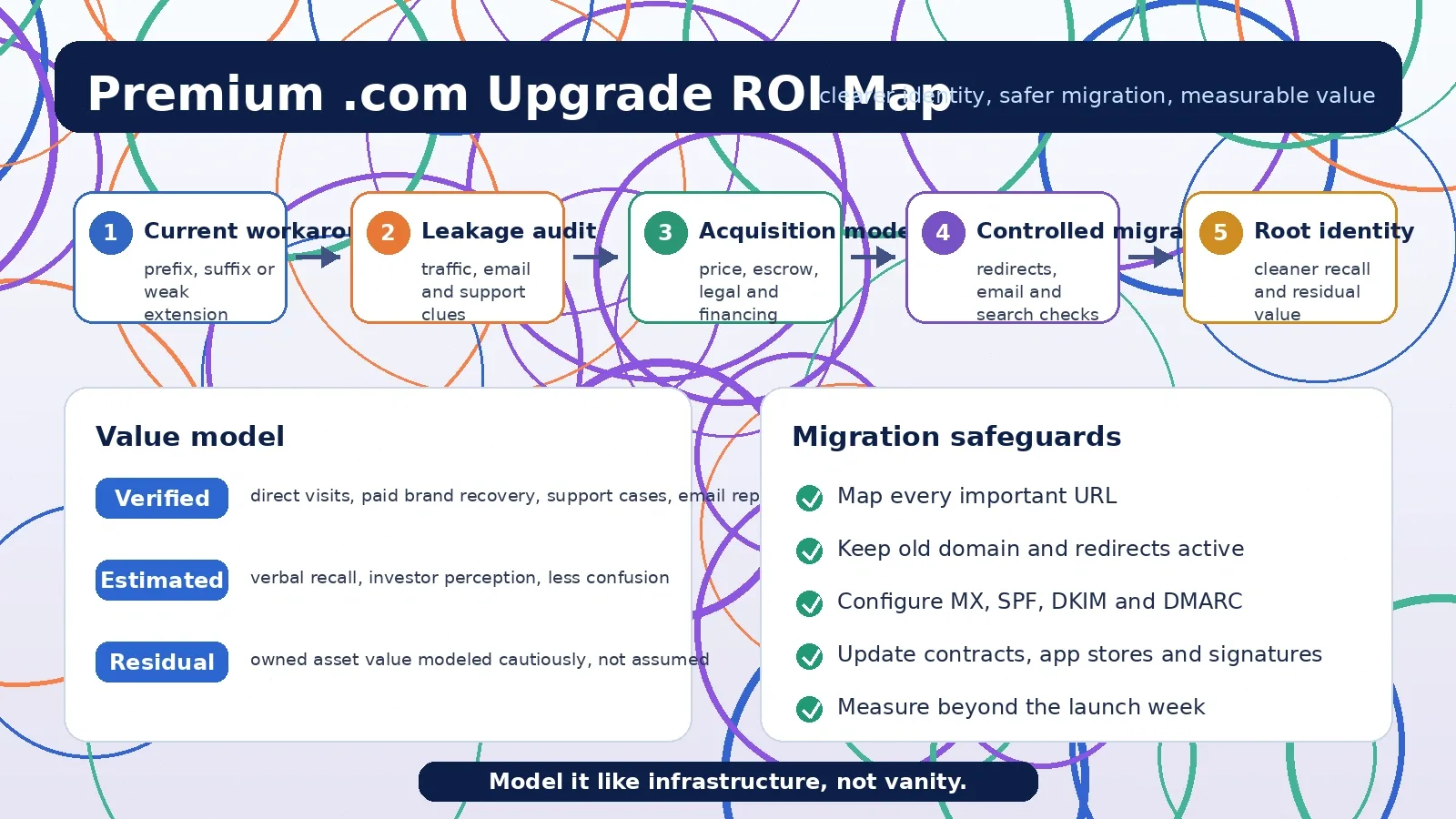
A premium domain should be evaluated as a multi year asset.
The purchase price is only one input.
Use this total cost model:
Total Upgrade Cost = Domain Purchase Price + Brokerage Fees + Escrow Fees + Legal Review + Trademark Review + Migration Engineering + Email Migration + Creative Updates + Internal Staff Time
Then evaluate measurable return:
Measured Annual Benefit = Recovered Direct Traffic Value + Reduced Paid Recovery Spend + Email Risk Reduction Value + Avoided Future Migration Cost + Brand Asset Residual Value
The hardest variables are not perfectly measurable.
That does not make them irrelevant.
It means the company should separate verified value from estimated value.
Verified Value
This category contains benefits supported by actual data:
1. Direct visits reaching the old or new domain
2. Paid clicks on brand queries
3. Customer support tickets involving the wrong URL
4. Misdirected email reports
5. Migration project costs
6. Defensive registration costs
7. Broker, escrow, legal, and engineering costs
8. Qualified inquiries received on the root domain after acquisition
9. Changes in branded search volume
10. Changes in email bounce rates
Estimated Value
This category contains benefits that require scenario analysis:
1. Improved verbal recall
2. Stronger investor perception
3. Lower future naming friction
4. Reduced customer confusion
5. Avoided reputational risk
6. Expanded product naming flexibility
7. Reduced chance of competitor acquisition
A corporate business case should identify the confidence level for each item.
Do not combine every optimistic assumption into one headline ROI figure.
A Practical ROI Scenario Model
Consider a company evaluating a $250,000 root domain acquisition.
The company currently operates on GetBrand.com.
Its marketing team spends heavily on audio campaigns and paid branded search. The company also expects a larger enterprise launch during the next three years.
An internal model may look like this:
Cost or Benefit Conservative Scenario Base Scenario Strategic Scenario
|
Cost or Benefit |
Conservative Scenario |
Base Scenario |
Strategic Scenario |
|
Domain acquisition |
$250,000 |
$250,000 |
$250,000 |
|
Brokerage and escrow |
$15,000 |
$15,000 |
$15,000 |
|
Legal and trademark review |
$10,000 |
$10,000 |
$10,000 |
|
Migration and creative work |
$35,000 |
$35,000 |
$35,000 |
|
Total upgrade cost |
$310,000 |
$310,000 |
$310,000 |
|
Annual recovered traffic value |
$20,000 |
$50,000 |
$90,000 |
|
Annual paid brand recovery savings |
$10,000 |
$30,000 |
$60,000 |
|
Annual operational savings |
$5,000 |
$15,000 |
$30,000 |
|
Three year measurable benefit |
$105,000 |
$285,000 |
$540,000 |
|
Residual domain asset value |
Excluded |
$250,000 |
$350,000 |
The table is illustrative.
The company should replace every value with evidence from its own business.
The conservative scenario excludes residual value.
The base scenario recognizes that the company still owns the domain after three years.
The strategic scenario gives more weight to brand value, but it should not be presented as audited revenue.
Residual Value Changes the Analysis
A domain differs from many rebranding expenses because the company retains the asset.
A logo redesign may become obsolete.
A media campaign ends.
A domain can remain useful for years.
It may retain resale value even if the company changes strategy later.
That does not make the domain risk free.
A company can overpay.
A category can weaken.
A naming decision can fail.
The residual value should be modeled cautiously.
Use comparable sales.
Review extension quality.
Review word quality.
Review buyer demand.
Do not assume that the future resale value equals the purchase price.
Corporate Identity Platforms and Procurement Channels
Premium domain procurement can be difficult.
The desired domain may not be listed.
The owner may not respond.
The seller may increase expectations after identifying the buyer.
The parties may disagree on price, payment structure, timing, or transfer method.
A specialized platform can reduce friction.
Atom, formerly known as Squadhelp, describes itself as a premium marketplace, registrar, and brand platform. Its inventory can help corporate teams review available premium identities and compare naming structures.
Atom also provides domain brokerage for acquisition work.
For buyers seeking anonymity, GoDaddy’s Domain Broker Service states that the domain owner will not know the buyer’s identity during the process.
Anonymity can help preserve negotiating discipline.
It should not be used to bypass due diligence or normal compliance requirements.
Financing the Upgrade
A growing business may prefer to preserve cash rather than pay the entire purchase price immediately.
Payment plans can make a domain upgrade easier to fund.
Atom’s buyer payment plan terms explain that the domain is placed inside an Atom managed registrar account after the initial payment. The buyer can update DNS settings while Atom retains custody until the purchase price is paid in full.
This structure may allow the company to begin using the domain while spreading the purchase cost over time.
The accounting treatment requires professional advice.
A payment plan does not automatically convert a capital asset into an operating expense for every accounting or tax purpose.
The legal, finance, and tax teams should determine the correct treatment.
The commercial point is simpler.
Financing can reduce the immediate cash burden.
Secure Settlement
A premium domain should not move on the basis of an informal email or payment screenshot.
Escrow.com explains a five step domain transaction process:
1. Buyer and seller agree to terms.
2. Buyer pays Escrow.com.
3. Escrow.com verifies and secures the payment.
4. Seller transfers the domain.
5. Buyer accepts the domain and Escrow.com pays the seller.
This protects both sides.
The seller should not release control before verified funding.
The buyer should confirm the registrar, domain spelling, lock status, transfer route, and receiving account before accepting the asset.
Trademark Clearance Before Purchase
A domain can be available for sale and still be a poor acquisition.
The legal team should review trademark risk before committing capital.
Use the WIPO Global Brand Database and relevant national or regional trademark databases.
WIPO states that its database covers international trademarks under the Madrid System and trademarks from participating national and regional offices. It also advises users to search national and regional registers where appropriate.
In the United States, use the USPTO Trademark Search system.
The review should consider:
1. Exact matches
2. Similar spellings
3. Similar pronunciations
4. Related products and services
5. Existing common law use
6. Regional conflicts
7. App listings
8. Company names
9. Social handles
10. Planned expansion categories
A database search is an initial screen.
Important acquisitions require qualified legal counsel.
Step by Step Corporate Rebrand and Domain Migration Playbook
Step 1: Define the Strategic Problem
Write down the limitation created by the current domain.
Is the problem a prefix?
A weak extension?
A long suffix?
Customer confusion?
Email routing risk?
Future product expansion?
The acquisition memo should identify the exact friction being removed.
Step 2: Measure the Existing Leakage
Collect direct traffic, branded search, paid brand campaigns, customer support cases, email routing reports, sales call feedback, and typo domain activity.
Create a baseline before the migration.
Without a baseline, the company cannot measure the outcome.
Step 3: Build the Acquisition Range
Research comparable sales.
Model the domain as an asset.
Estimate the value of alternatives.
Set a preferred price, a negotiation range, and a firm walk away number.
Do not reveal unnecessary urgency to the seller.
Step 4: Use Anonymous Representation Where Appropriate
A broker can approach the owner without disclosing the buyer’s identity immediately.
This can reduce the risk that the seller prices the name according to the buyer’s perceived budget rather than the asset itself.
Step 5: Complete Legal and Security Review
Check trademarks, prior domain disputes, registration status, registrar locks, DNS configuration, email routing, nameservers, historical use, and transfer restrictions.
Document the findings.
Step 6: Close Through a Verified Process
Use an established escrow provider or marketplace transaction workflow.
Verify funds before transfer.
Confirm receipt before payout.
Keep the closing file.
Step 7: Map Every URL
Create a one to one redirect map.
Each important old URL should point to the closest corresponding URL on the new domain.
Avoid redirecting every page blindly to the homepage.
Use permanent HTTP 301 redirects.
Step 8: Preserve Search Signals
Follow Google’s site move guidance.
Verify the new domain in Search Console.
Submit the new sitemap.
Update canonical references.
Update internal links.
Monitor indexing.
Keep the old domain renewed and the redirects active.
Step 9: Migrate Email Carefully
Inventory every mailbox, alias, forwarding rule, group address, support queue, automated sender, vendor integration, and authentication record.
Configure MX records.
Configure SPF, DKIM, and DMARC.
Keep the old email domain active during the transition.
Monitor bounce reports and authentication reports.
Step 10: Update the Corporate Surface Area
Change the website, app listings, social profiles, employee signatures, invoices, contracts, help documentation, advertising accounts, analytics properties, customer portals, partner pages, press materials, and printed collateral.
The domain is one asset.
The rebrand touches the entire company.
Step 11: Measure the Outcome
Compare the new data with the baseline.
Track direct traffic.
Track branded search.
Track paid brand campaigns.
Track customer support cases.
Track email bounces.
Track wrong domain reports.
Track qualified inbound inquiries.
Track conversion rates by channel.
The measurement period should extend beyond the launch week.
The Correct Board Level Framing
A premium .com upgrade should not be presented as a vanity purchase.
It should not be presented as guaranteed growth either.
The board needs a disciplined argument.
The company is buying a scarce digital asset.
The asset may improve naming efficiency.
It may reduce customer confusion.
It may reduce one class of email routing risk.
It may support a broader product identity.
It may retain residual value.
It also creates purchase, migration, legal, and operational costs.
The decision should be modeled like any other strategic infrastructure investment.
The company should define the problem, measure the baseline, negotiate carefully, migrate correctly, and review the outcome honestly.
Final Perspective
A root .com domain is not necessary for every startup.
A modified address can be perfectly adequate during the early years.
The financial case becomes stronger when the business has reached the point where naming friction affects marketing, customer trust, email routing, or expansion strategy.
The best acquisitions are not made because a founder wants a shorter URL.
They are made because the company has outgrown the compromise.
A premium corporate domain can become the stable digital core of the brand.
Its value is highest when the business knows exactly which problem it is buying the domain to solve.