
A liquid domain is not a cash equivalent. It is a domain that can typically draw serious investor interest more quickly than a generic name when priced near a realistic wholesale value. The distinction matters because descriptive and brandable domains depend on finding a specific end user. A short .com domain can reach multiple buyers simultaneously: investors, brokers, acronym seekers, companies seeking a corporate upgrade.The strongest short .com categories are LL.com, LLL.com, NN.com, and NNN.com. Their power derives from finite supply.
There are only 676 two letter combinations:
|
Category |
Finite supply calculation |
|
26 × 26 = 676 |
There are only 17,576 three letter combinations: |
|
26 × 26 × 26 = 17,576 |
Numeric stock is even tighter. There are only 100 two digit combinations and 1,000 three digit combinations. |
That paucity exists inside a much larger namespace. According to The Domain Name Industry Brief Q1 2026, .com registrations totaled 163.6 million as of March 31, 2026.
Scarcity Creates Liquidity Potential, Not a Guaranteed Floor
Short domains are easier to compare because the supply is structurally limited.
A three letter .com might stand for an acronym, a geographic abbreviation, a product code, a personal identity, or a condensed brand. Numeric domains have cross language utility. These functions create a broader buyer base than many descriptive long domains.
The market is not uniform.
A pronounceable LLL.com with common letters is not equal to a weak letter string with narrow acronym demand. A memorable NNN.com with repeated digits or commercial association is not equal to a random number.
Current wholesale value of 3 letter .com therefore cannot be reduced to one permanent value.
A usable floor is an observed range based on repeated transactions over a set period of time. It should be calculated separately for each category and quality tier.
Tracking the Bid Ask Spread
The bid ask spread is the difference between the price an investor wants and the price another investor is willing to pay for a fast sale.
A narrow spread can indicate higher liquidity. A wide spread can indicate poor price discovery, low quality assets, or unrealistic seller expectations.
Short domain price floors should be tracked using multiple data sources.
ShortNames pulls together auctions, fixed price listings, sales and drops across all short domain categories, including LL, LLL, NN, and NNN. The platform’s disclaimer matters: it says that the sales figures are believed to be accurate but that not every transaction has been verified as completed successfully.
NameBio has a historical database with over $3 billion in reported domain sales. It is a valuable tool for comparable research, but reported sales do not represent the entire market.
Escrow.com Domain Investment Index Reports add another data point. Escrow.com says that its quarterly reports are based on actual verified sales and are intended to identify valuation trends and price patterns.
No one data source can produce a perfect liquidity index for tracking premium digital real estate.
The practical answer is to merge them.
Building an Observable Liquidity Index
A portfolio manager is able to compute a meaningful internal index without assuming complete market transparency.
For each category, maintain:
1. Number of reported sales
|
No. |
Metric to maintain |
|
2 |
Median reported price |
|
3 |
Lower quartile price |
|
4 |
Upper quartile price |
|
5 |
Lowest repeated clearing range |
|
6 |
Number of active listings |
|
7 |
Auction volume |
|
8 |
Time to sale where observable |
|
9 |
Sale type (investor vs end user) |
|
10 |
Renewal and transaction costs |
One low number may reflect urgency, poor venue selection, legal risk, or weak letter quality. A repeated cluster signals a stronger floor.
The same rule
applies to outliers. A corporate buyer may pay far above wholesale to match a
strategic identity. That sale is useful information, but it should not become
the assumed liquidation value for the entire category.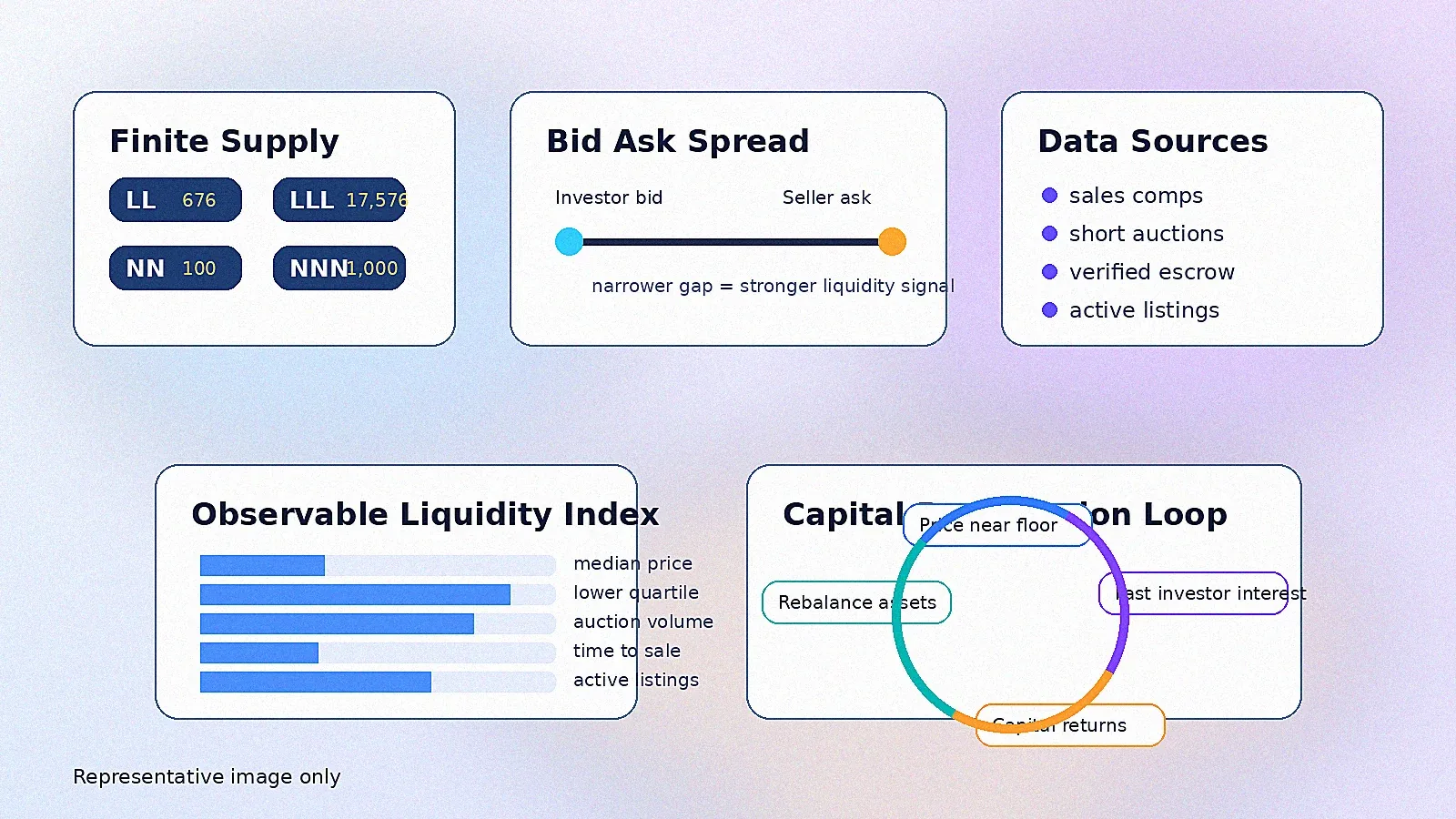
The Capital Reclamation Loop
The core benefit of a short domain portfolio is optionality.
A weak multi word domain might sit unsold for years because only one narrow buyer type wants it. A liquid LLL.com or NNN.com may pull fast investor interest when the seller prices it near the observable wholesale range.
Fast liquidation typically requires a discount.
The seller trades upside for speed.
This produces two different values:
|
Value type |
Meaning |
|
Wholesale Value |
Likely Fast Investor Exit Price |
|
Retail Value |
Potential End User Acquisition Price |
The gap between those values is the holding opportunity.
A smart portfolio recognizes that not all assets command a price suitable for an end-user. It retains enough liquid inventory to reclaim capital when a stronger acquisition appears.
Marketplace Infrastructure
Short domains now move through several channels
Public auctions offer visible price discovery. Private brokers handle strategic acquisitions. Landing pages collect direct buyer inquiries. Escrow services support controlled settlement.
Atom, formerly Squadhelp, runs a premium marketplace for short domain and three letter domain portfolios. The service’s value is in distribution and presentation, not a guaranteed liquidation floor.
For high value direct sales, Escrow.com outlines a five step process where the buyer secures funds before the seller transfers the domain.
Liquidity without settlement discipline is not liquidity.
Institutional Portfolio Allocation Protocol
|
Protocol step |
Action |
|
Step 1: Separate the Categories |
Track LL.com, LLL.com, NN.com, and NNN.com independently. Do not use one as a substitute for another. |
|
Step 2: Segment Quality |
For LLL.com assets, examine pronunciation, acronym utility, letter frequency, visual balance and buyer count. For numeric assets, review repetition, cultural meaning, memorability and commercial use. |
|
Step 3: Build a Rolling Data Window |
Apply a 90 day and 12 month view. Remove obvious corporate outliers when estimating wholesale floors. |
|
Step 4: Measure Exit Readiness |
Record the likely investor exit price, expected retail price, renewal cost, transfer cost, and secure settlement route. |
|
Step 5: Rebalance Carefully |
Prune weak descriptive inventory when renewal costs exceed realistic demand. Reallocate only when the replacement asset has a clearer liquidity signal. |
The Real Meaning of Liquid Digital Assets
Liquid domain investments are not risk free instruments.
They are scarce digital assets with comparatively stronger resale potential.
The market is fragmented. Reported sales are incomplete. Price floors are not fixed. Quality tiers matter. A fast exit normally requires a discount.
The disciplined investor does not treat a short .com like a bond.
The disciplined investor treats it like an asset with measurable scarcity, observable demand, and a clearer path back to capital than most ordinary domains.