A high-value domain name can be just the right fit for a business and still be unaffordable.
The founder might see the value. The startup could be finalizing a product launch. The domain name might solve a branding challenge where cheaper options fall short. But a one-time payment of $25,000 or $50,000 extinguishes working capital that could be used for engineering, marketing, hiring, or customer service.
Lease to Own domains address that problem by adjusting the economics.
Buyers make payments over time and can typically start using the domain on their website and email while the platform or escrow service maintains control. The seller receives payments until the contract completes and full ownership transfers to the buyer.
This Lease to Own model presents advantages for both buyer and seller.
How Lease to Own Works
There are practical differences between an ordinary domain purchase and a payment plan.
When purchasing a domain name, the buyer typically pays a cash price and receives full control of the asset after escrow secures the payment. On Lease to Own platforms, where the domain is sold on installment, escrow often holds the domain until the contract completes.
“With Escrow.com standard transactions,” this article from Escrow.com notes, “we hold the Domain Name for your buyer once payment has been secured and released directly to them.” For held domains, Escrow.com “accept[s] the down payment and place[s] the domain name into our controlled custody for the agreed term.”
Atom uses a similar approach for certain marketplace purchases. On Atom, sellers agree to a Buyer Payment Plan by placing the domain in an Atom managed account after the initial payment. Buyers may modify DNS, but “Atom maintains custody and control of the domain until the total price has been paid.”
These services let startups operate under a premium domain without paying the entire purchase price upfront.
Why Financing Can Raise the Asking Price
Installment payments create flexibility that some buyers will pay extra to receive. The monthly payment feels less expensive than buying outright.
Afternic published part of the story in an article called Lease to Own Has a 35% Higher Average Sales Price. Analyzing millions of domains listed on GoDaddy between January and June 20x4, Afternic found that average sales prices were 35 percent higher for domains enabled for Lease to Own than Buy Now purchases.
The bigger number deserves context.
Afternic clarifies that its 35 percent figure includes the service fee assessed by its Lease to Own implementation to contracts lasting more than 13 months. There are no guarantees that increasing every asking price by 35 percent will generate more revenue. Domain quality, list price, contract length, buyer interest, and platform fees all vary.
The takeaway is narrower: when used strategically, domain financing has the potential to increase overall sale prices.
If the domain costs $50,000, buyers might not afford or want to pay the entire amount even if it’s perfect for their business. But what if a seller lists the domain with financing enabled?
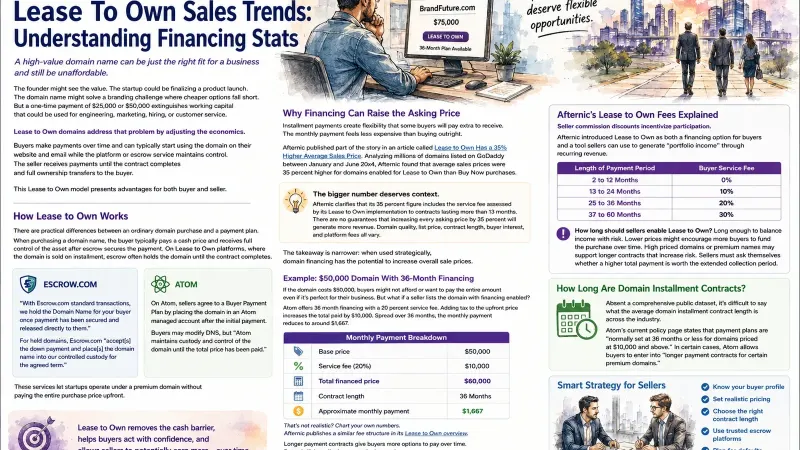
Atom offers 36 month financing with a 20 percent service fee. Adding tax to the upfront price increases the total paid by $10,000. Spread over 36 months, the monthly payment reduces to around $1,667.
Monthly Payment Breakdown
|
Metric |
Amount |
|
Base price |
$50,000 |
|
Service fee (20%) |
$10,000 |
|
Total financed price |
$60,000 |
|
Contract length |
36 Months |
|
Approximate monthly payment |
$1,667 |
That’s not realistic? Chart your own numbers. Afternic publishes a similar fee structure in its Lease to Own overview.
Longer payment contracts give buyers more options to pay over time. But only if the seller increases the base price.
The buyer
spends more money. The seller receives more total cash than if they accepted a
discount for all-cash payment. The buyer retains more cash for growth.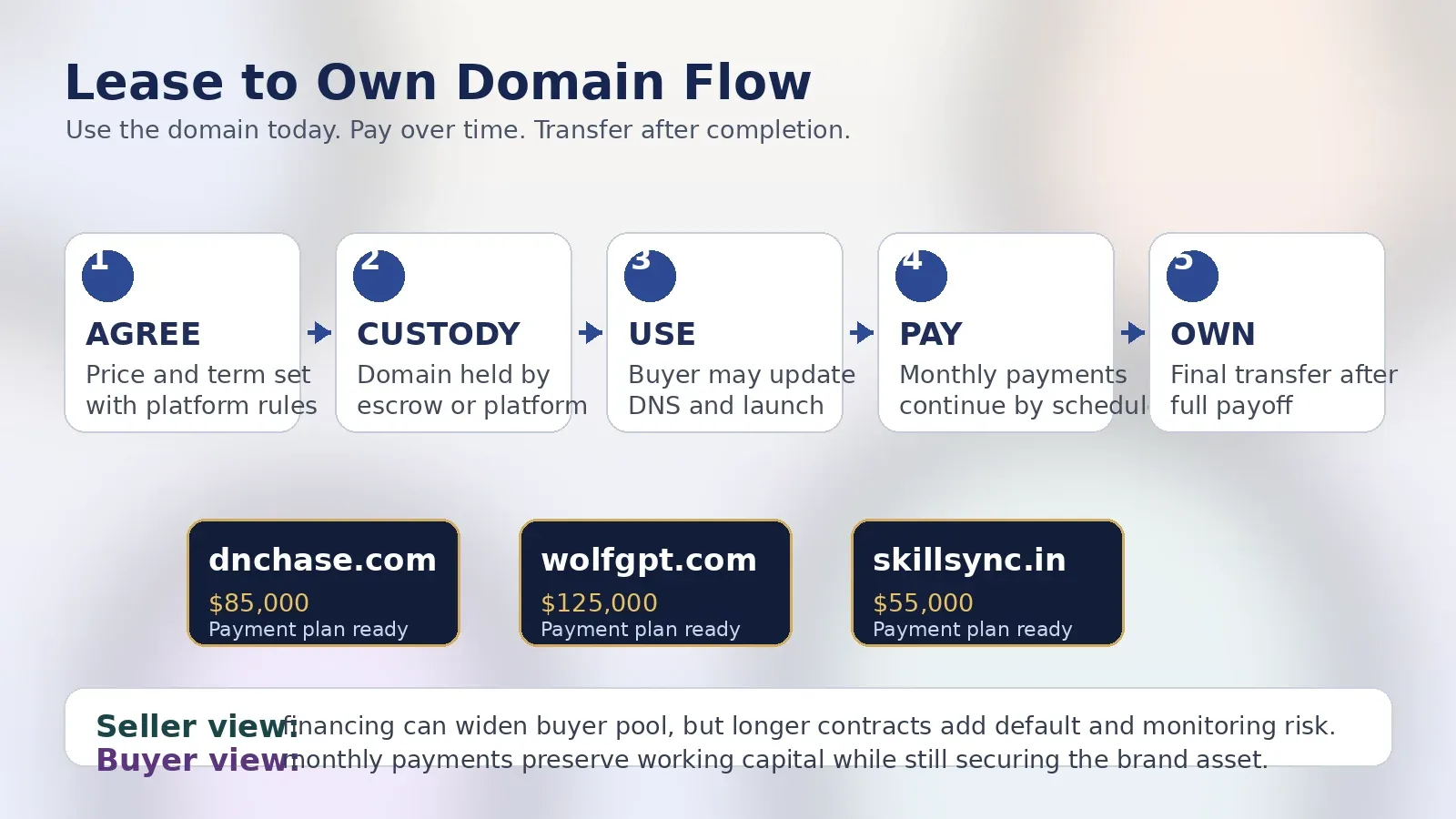
Afternic’s Lease to Own Fees Explained
Seller commission discounts incentivize participation.
Afternic introduced Lease to Own as both a financing option for buyers and a tool sellers can use to generate “portfolio income” through recurring revenue. In its announcement article, Afternic published a tiered service fee structure that decreases the seller’s commission for longer term purchases:
|
Length of Payment Period |
Buyer Service Fee |
|
2 to 12 Months |
0% |
|
13 to 24 Months |
10% |
|
25 to 36 Months |
20% |
|
37 to 60 Months |
30% |
How long should sellers enable Lease to Own? Long enough to balance income with risk.
Lower prices might encourage more buyers to fund the purchase over time. High priced domains or premium names may support longer contracts that increase risk. Sellers must ask themselves whether a higher total payment is worth the extended collection period.
How Long Are Domain Installment Contracts?
Absent a comprehensive public dataset, it’s difficult to say what the average domain installment contract length is across the industry.
Domainsellernews spoke to Afternic about how many customers use Lease to Own but did not receive data we could share publicly. Individual platforms may have stronger insights than we do because they publish installment terms but do not necessarily disclose transaction metrics.
Atom’s current policy page states that payment plans are “normally set at 36 months or less for domains priced at $10,000 and above.” In certain cases, Atom allows buyers to enter into “longer payment contracts up to 48 months.”
Escrow.com takes a different approach. Sellers using its Domain Holding Service choose the contract length when they create a new sale. “Your payments can range from three months up to five years,” Escrow.com reports, “and can be monthly, quarterly or yearly.”
New sellers should experiment with a range of contract lengths.
|
Interval |
Seller Benefits |
Seller Considerations |
|
12 Months |
Quicker sale. Easier to track. |
High monthly payment might limit buyer pool. |
|
24-36 Months |
Medium length. Starts to balance affordability with total price. |
Seller must wait longer for lump sum payment. |
|
48-60 Months |
Provides lowest monthly payment to buyers |
Uncertain longevity. Higher exposure to renewal fees and long term account monitoring. |
A perfect term length does not exist.
Buyers can pay off their contracts early.
Atom’s current Lease to Own agreement for sellers includes language that encourages early payoff. “Buyers have the ability to pay remaining balances early,” Atom tells sellers. “As an incentive for early payoff, you may give your buyers a discount.”
Escrow.com highlights the option in its agreement for buyers. Buyers “may pay off your balance early,” Escrow.com tells buyers. “If you decide to pay off your balance early, simply contact Support.”
Escrow.com and Atom empower buyers to close installment contracts early. Both sellers and buyers should consider the implications.
The buyer owns the domain outright. The seller collects the remaining payments and can put the money to use. The platform closes the account and releases the domain.
Recording the contract length offers valuable context when reviewing historical sales data. Was the buyer motivated to wait? Did something change between the contract date and the early payoff?
Are Domain Payment Plans Ever Defaulted?
At some point, a buyer will default.
Afternic told Domainsellernews that defaults “do occur from time to time.” Unfortunately, we found no reliable public estimate showing the percentage of buyers who default on domain installment contracts. Rather than guess, sellers should encourage buyers to read and understand the terms of their agreements.
Every platform provides a slightly different buyer experience.
Atom says buyers have ten days to update their payment method before Escrow automatically cancels the installment. “If the installment amount is not paid within ten days,” Atom warns, “your purchase will be automatically canceled. All payments made will be forfeited and this domain will become available for sale again.”
Domains held by Escrow.com encounter different terms. When buyers miss a payment, Escrow.com “will attempt to collect payment from the buyer.” If the issue remains unresolved, “the domain will be returned to you and this transaction will be canceled.”
The domains don’t revert to seller ownership overnight.
“The domain will not be transferred back to you until the end of the transaction cancellation period,” Escrow.com explains. Sellers should monitor accounts with at-risk payments for suspicious activity.
Payment plans are warrants against default.
Like most financing options, defaults are possible. But the Lease to Own model is beneficial for sellers because the escrow service maintains control until the contract completes. Most platforms prohibit buyers from transferring custody unless certain conditions are met.
How Defaults Affect Sellers
When buyers stop paying, sellers should prepare for an influx of returned domains.
A domain that has been active for sale on a website causes red flags for prospective buyers. If the buyer built out a website during their ownership period, the seller must remove any existing content.
Escrow.com vs. Atom on Lease to Own Defaults
Seller commission is one major difference between Escrow.com and Atom.
Atom explicitly states that previous payments are forfeited after cancellation. Escrow.com includes no language about partial payments in the segment above. By commenting below, readers can help complete this guide.
Financing Leaves a Trackable Record
Domains might change hands frequently.
Sedo shares a Lease to Own success story about Desktop.com.
“At Idealab, we had been using Desktop.com for our company headquarters webpage for nearly a decade,” the purchaser said. “When it came time to build a new website for our company, we started looking around at available domain names.”
The founder used Sedo to facilitate payments. “We ended up working with Sedo.com to structure a two-year payment plan with a sizable down payment up front to purchase Desktop.com.”
Desktop.com was a one-word .com transferred after an agreement with the previous owner. Financing made the deal possible.