A short .com domain occupies a unusual position in the domain aftermarket. The value of most domain names is based on a specific use case, a particular industry, or a founder who sees a brand opportunity that other buyers missed. A short .com domain can compress that story, so the value impact is larger and the wait for a strategic buyer is shorter. The mathematical supply of these assets is fixed, so scarcity alone does not move the price. The buyer has to exist and the domain has to meet a specific need. A great short domain receives multiple bids fast and therefore has liquidity. A good short domain may take a few weeks but still has a strong investor floor. A bad short domain never sells, no matter how cheap the asking price. Tracking that floor is a key skill for high value liquid asset investors.
A short .com domain occupies a unusual position in the domain aftermarket.
Most domain names require patience. A seller may wait months or years for the right buyer. The value depends on a specific use case, a particular industry, or a founder who sees a brand opportunity that other buyers missed.
Short .com domains behave differently.
A 2 letter .com can represent a company abbreviation, a personal identity, a product line, a regional code, or an international brand. A 3 letter .com can function as an acronym, a pronounceable word, or a compact corporate upgrade. Numeric domains can cross language barriers entirely.
This does not make every short domain instantly saleable at a predictable price. It does create a market structure with more repeat buyers, more comparable transactions, and a clearer relationship between scarcity and value.
The phrase liquid domain sales should therefore be used carefully. Liquidity is relative. A domain is liquid when it can usually attract bids from investors more quickly than an ordinary name, even if the seller must accept a discount to complete the sale fast. The likely wholesale price may be materially lower than the retail price available from a corporate buyer.
That gap is where the market becomes interesting.
What a Liquid Domain Floor Actually Means
A price floor is not one fixed number published by a central exchange.
Domain sales are fragmented. Transactions occur through marketplaces, brokers, private negotiations, investor forums, auctions, registrar distribution networks, and direct landing pages. Some prices are disclosed. Many are not.
A practical floor is the lower boundary at which credible buyers are repeatedly willing to transact within a defined category and time period.
The key words are defined category.
AI.com, Nas.com, QXZ.com, 88.com, and 360.com are all short .com domains. They do not belong in one valuation bucket. Their prices respond to different forces:
Asset Type Example Structure Primary Value Driver
LL.com AI.com Extreme scarcity, acronym demand, category relevance
LLL.com word Nas.com Brand identity, pronunciation, corporate upgrade
LLL.com acronym ABC.com style structure Acronym demand, letter quality, buyer fit
NN.com 88.com style structure Absolute scarcity, memorability, cultural meaning
NNN.com 360.com Brand use, numeric meaning, global recognition
Random LLL.com QXZ.com style structure Scarcity, investor demand, acronym possibility
A serious floor analysis should not take the lowest public sale and call it the market price.
The lowest transaction might involve a distressed seller, a weak venue, a legal problem, a payment issue, or a domain with poor letters. A more useful model looks at the bottom range of several verified transactions over a defined period, removes obvious outliers, and separates investor sales from corporate purchases.
This is why the current floor prices for liquid two letter domains cannot be reduced to one universal figure. A strong LL.com asset can attract a corporate buyer at a price far above a fast investor exit.
Why Scarcity Matters
The mathematical supply is fixed.
There are only 676 possible 2 letter combinations using the English alphabet:
26 × 26 = 676
There are only 17,576 possible 3 letter combinations:
26 × 26 × 26 = 17,576
There are only 100 possible 2 digit numeric combinations:
10 × 10 = 100
There are only 1,000 possible 3 digit numeric combinations:
10 × 10 × 10 = 1,000
That supply cannot expand.
The wider .com namespace is large. The Domain Name Industry Brief for Q1 2026 reported 163.6 million .com registrations as of March 31, 2026.
Against that enormous registration base, the number of possible LL.com and NN.com assets is microscopic.
Scarcity alone does not create a guaranteed price. A rare object still needs buyers. Short .com domains benefit because the demand is broad. Companies in different countries can use the same acronym. Investors understand the category quickly. Brokers can explain the asset without a long sales pitch.
The name does not need a complicated story before it receives attention.
LL.com Domains: The Smallest Alphabetic Supply
The 2 letter .com category is the narrowest alphabetic market.
Only 676 combinations exist. Many are already used by corporations, institutions, products, and private investors. A matching 2 letter acronym can compress a long company identity into a domain that is easy to remember, easy to type, and easy to place inside email addresses.
The market is not uniform.
Some combinations carry obvious value because the letters form a widely recognized abbreviation. AI is the strongest recent example. Other pairs match major corporate initials. Some are visually clean and easy to pronounce. Others have narrower uses.
Letter order also matters. Two common letters may support more buyers than a combination built around rare initials. A pair that means something in several languages may have wider appeal than a pair with no obvious interpretation.
This creates a broad wholesale versus retail spread.
An investor buying a 2 letter .com wants margin. The investor must allow for holding time, transaction costs, and uncertainty. A corporate buyer may pay much more because the domain solves a specific identity problem immediately.
AI.com: A Retail Outlier, Not a Floor Benchmark
The $70 million AI.com transaction is the most important modern example of the retail ceiling.
The Financial Times reported in February 2026 that Kris Marszalek, cofounder and chief executive of Crypto.com, acquired AI.com for $70 million from an undisclosed seller. The publication described it as the highest publicly disclosed domain sale and reported that the payment was made entirely in cryptocurrency.
AI.com is a LL.com domain, but it should not be used to estimate the ordinary LL.com floor.
The name has a category defining quality that most 2 letter combinations do not possess. It represents artificial intelligence, one of the largest technology narratives of the decade. It works internationally. It needs no explanation. It can support consumer software, enterprise products, media coverage, advertising, and future product expansion.
This is a retail transaction driven by strategic fit.
The public story also illustrates a recurring problem in domain sales reporting. The confirmed sale price is known. The seller’s original acquisition cost is not part of the reliable public record. The complete wholesale to retail pipeline remains private.
A responsible
analysis records the $70 million endpoint without inventing the seller’s basis.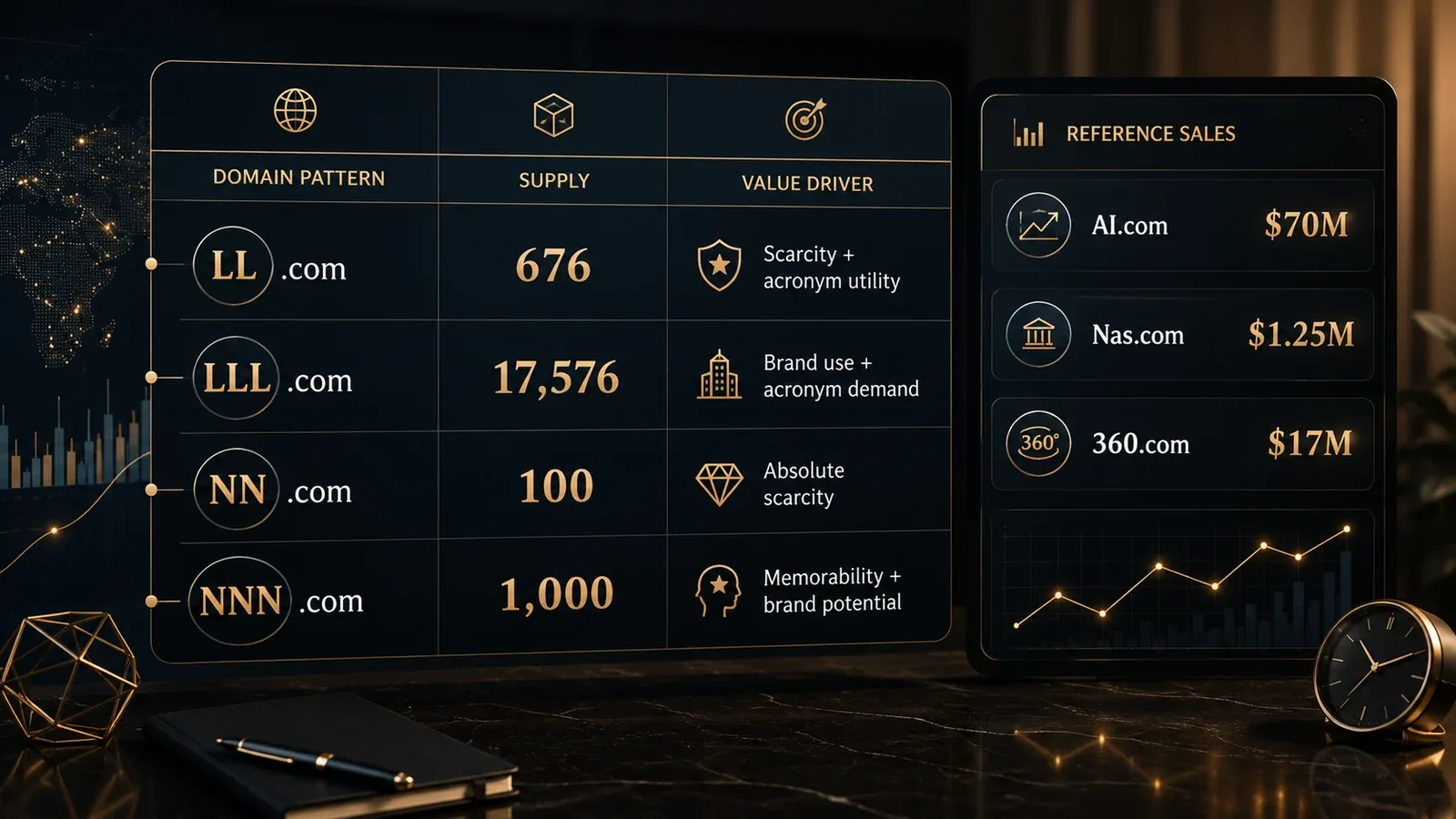
How to Measure LL.com Floors Properly
The correct method is observational.
Build a rolling database of verified LL.com sales. Separate auction outcomes from brokered end user deals. Record the date, venue, price, letter quality, current use, prior use where known, and whether the buyer appears to be an investor or an operating company.
Then calculate several views:
1. Lowest verified transaction
2. Median verified transaction
3. Lowest quartile
4. Highest quartile
5. Corporate outlier range
6. Investor liquidation range
7. Days between listings and completed sales where available
The observed floor should come from repeated market clearing events, not from one headline.
Short domain trackers can help. ShortNames aggregates auctions, listings, sales, and drops across several marketplaces and separates categories such as LL, NN, LLL, and NNN. Its own disclaimer states that sales figures are believed to be accurate but cannot all be verified as completed transactions.
That caveat is essential.
A tracker is a research tool. It is not a regulated exchange and should not be treated as one.
LLL.com Domains: Scarcity With More Internal Variation
The LLL.com category is larger and more complicated.
There are 17,576 possible combinations. Every 3 letter .com has scarcity value because the supply is fixed, but the quality spectrum is wide.
A pronounceable word such as Nas.com is different from a random letter sequence. A common corporate acronym differs from a pattern containing rare letters. A three letter term with meaning in several languages may attract more buyers than a combination with only one plausible use.
This is why the average sales price of 3 letter domains can mislead readers.
The average changes dramatically when one major corporate transaction enters the dataset. A median may be more useful for investor analysis. A segmented median is better still.
An LLL.com market report should separate at least four classes:
Category Description Typical Buyer Logic
Pronounceable word Reads naturally as a word or name Brand launch or corporate upgrade
Common acronym Matches many organizations or concepts Broad end user demand
Strong visual pattern Clean letter structure or repetition Investor liquidity and branding
Lower demand combination Limited pronunciation or rare letters Scarcity value with narrower buyer pool
The market does not treat every LLL.com equally.
Nas.com: A 3 Letter Corporate Upgrade
Nas.com is a strong example of a LLL.com domain moving from private ownership into active corporate use.
In April 2026, Nuseir Yassin announced on LinkedIn that he had paid $1.25 million of his personal money for Nas.com after pursuing the domain for years.
The transaction tells a useful story.
Nas was already the public identity behind Nas Daily and Nas.io. The shorter .com was not purchased as a random investment. It was acquired to consolidate an existing brand and support expansion.
The company later explained the operational shift in its article on the move from Nas.io to Nas.com. Existing accounts, storefronts, products, and old links were migrated to the shorter .com address.
This is what a high value LLL.com retail transaction looks like in practice.
The buyer had a clear reason to pay above an investor floor. The shorter domain reduced friction. It improved brand consistency. It created a more universal address. It gave the company a cleaner identity for long term growth.
The prior owner’s acquisition cost was not disclosed publicly. The marketplace route was not disclosed either.
Again, the retail endpoint is visible. The full wholesale to retail path remains private.
Character Quality Inside LLL.com Domains
The domain market has developed informal quality tiers for 3 letter combinations.
One category values pronounceable structures. A consonant vowel consonant pattern can create a short word or name that people remember easily. Another category values common Western initials. These may correspond to corporate names, professional associations, locations, or product abbreviations.
A separate investment category became prominent during periods of strong Chinese demand. So called Chinese premium combinations generally avoid vowels and the letter V because certain consonant patterns were considered more useful for initials and trading preferences.
That framework can still help describe historical demand, but it should not be used mechanically.
A domain such as QXZ.com may be scarce, yet its end user pool is narrower than a clean acronym or pronounceable word. A domain such as NAS.com can attract a strategic buyer because it matches an established identity. A pattern label cannot explain the whole price.
The most useful LLL.com analysis asks five questions:
1. Can the letters be pronounced?
2. Do the letters match common company initials?
3. Do the letters form a recognized word, name, or abbreviation?
4. Does the domain have active corporate prospects?
5. Is the seller evaluating wholesale liquidity or retail potential?
A short domain can be liquid at one price and strategically valuable at a much higher price.
Wholesale Versus Retail Price Gaps in Short Domains
The wholesale market rewards speed.
An investor selling quickly accepts a lower price in exchange for certainty and faster capital recycling. Another investor buys because the asset appears resaleable and scarce.
The retail market rewards fit.
A business pays more when the domain solves a branding problem that alternatives cannot solve as cleanly. The buyer may have a matching acronym, a funding event, a rebrand plan, a product launch, or an international expansion strategy.
These are different pricing systems.
Imagine a theoretical LLL.com domain that attracts immediate investor bids. Its wholesale liquidity may be strong because other investors understand the scarcity. A corporate buyer with matching initials may later justify a much higher price because the domain reduces marketing friction for years.
The gap is not an error. It is the core economic feature of the aftermarket.
The same principle applies to LL.com and numeric domains. A fast sale tests liquidity. A strategic acquisition tests utility.
Numeric Domains: Small Supply, Global Recognition
Numeric domains operate through another form of compression.
A number does not require translation in the same way as an English word. It can work across languages, industries, and geographies. A short numeric address is visually simple, mobile friendly, and easy to place inside advertising.
The supply is even smaller than the alphabetic market.
Only 100 NN.com combinations exist. Only 1,000 NNN.com combinations exist.
Certain digits and sequences carry additional value. Repetition can improve memorability. Cultural associations can increase demand. Some numbers are linked to luck, prosperity, identity, or familiar commercial concepts in specific markets.
Numeric demand has been particularly visible in East Asian domain trading, but the use case is not limited to one region. Gaming platforms, financial services, consumer brands, media companies, and technology firms can all use short numbers.
360.com: A Numeric Domain With Strategic Meaning
The sale of 360.com remains one of the clearest numeric case studies.
A GoDaddy review of major domain sales lists 360.com at $17 million. The domain was acquired for a business identity connected to Qihoo 360.
This is not merely a numeric rarity story.
The number 360 communicates completeness. It can suggest a full circle, total coverage, or an all around product. That gives the domain semantic value beyond scarcity.
The transaction also shows why historical short form domain sales charts need context.
360.com is a NNN.com domain. It cannot be used as the ordinary floor for every NNN.com combination. A random 3 digit domain may still be scarce, but 360 carries a meaning that many other sequences do not.
The correct lesson is not that every NNN.com should be priced near $17 million.
The correct lesson is that a numeric domain can achieve a premium retail price when scarcity, memorability, and corporate meaning converge.
The Difference Between LL, LLL, NN, and NNN Markets
The categories are related, but they do not move in lockstep.
Category Maximum Possible Supply Main Strength Main Valuation Risk
LL.com 676 Extreme scarcity and acronym utility Outlier sales distort floor estimates
LLL.com 17,576 Broad corporate use and investor activity Letter quality varies sharply
NN.com 100 Absolute numeric scarcity Cultural meaning affects price strongly
NNN.com 1,000 Global memorability and brand potential Specific sequences dominate attention
An investor should avoid using one category as a substitute for another.
A weak LLL.com does not automatically rise because AI.com sold for $70 million. A NNN.com domain should not be valued from 360.com alone. A NN.com asset may be scarce but still require careful analysis of the digits and the likely buyer pool.
Price floors must remain category specific.
Historical Sales Data and Its Limits
Historical data is essential, but it is incomplete.
NameBio provides a searchable database of reported transactions. Its all time sales page states that the database contains 6.8 million sales totaling $3.2 billion.
This scale makes NameBio valuable for research.
A portfolio manager can filter sales by extension, length, keyword, pattern, venue, date, and price. The data can reveal comparable sales, changes in market activity, and high value outliers.
The limitations still matter.
Not every private sale is reported. Some marketplace transactions are confidential. Some public records may be incomplete. A venue label does not always tell the reader where the buyer first discovered the domain. A domain sold through a private broker may never appear in a public database.
Historical data should therefore guide judgment rather than replace it.
The most accurate historical short form domain sales charts include a visible disclaimer: they track disclosed transactions, not the entire market.
A Better Way to Calculate a Floor
A professional portfolio report should use a structured method.
Choose a category, such as LLL.com. Select a rolling period, such as the last 90 days or the last 12 months. Gather reported transactions from NameBio, ShortNames, auction platforms, and broker disclosures.
Then clean the dataset.
Remove obvious retail outliers if the goal is wholesale analysis. Remove legal dispute sales, payment failures, bundled transactions, and unclear records where possible. Separate words from random letter combinations. Separate investor auctions from direct corporate acquisitions.
Calculate:
1. Transaction count
2. Total disclosed volume
3. Median sale price
4. Lower quartile sale price
5. Upper quartile sale price
6. Lowest repeated clearing range
7. Largest outlier
8. Venue concentration
9. Average holding period where known
10. Estimated wholesale to retail spread where both prices are disclosed
The lowest repeated clearing range is usually more useful than one isolated minimum.
This method does not create a perfect live floor. It creates a defensible observable floor based on available evidence.
Where Marketplaces Fit
Short domains can move through several channels.
Afternic states that listed domains can appear within many of the 125 million monthly search queries across leading registrars. This distribution model is useful when a corporate buyer begins inside a registrar search flow.
Sedo states that its marketplace contains more than 19 million domain listings. It combines direct marketplace discovery with negotiation, brokerage, and transfer services.
Atom, formerly known as Squadhelp, describes itself as a full service registrar, premium marketplace, and AI native brand platform. Its marketplace includes short domains, 3 letter domains, one word domains, and an ultra premium category.
These platforms serve different buyer journeys.
A corporate buyer searching for a specific acronym may arrive through a broker. A startup may discover a compact name through a curated marketplace. An investor may buy through an auction. A direct visitor may reach a landing page and submit an offer.
The sales route influences the final price.
Escrow and Transfer Controls
High value domains require controlled settlement.
Escrow.com explains a five step domain process:
1. Buyer and seller agree to the transaction terms.
2. Buyer submits payment to Escrow.com.
3. Seller transfers the domain after funds are verified and secured.
4. Buyer accepts the domain after receiving control.
5. Escrow.com releases funds to the seller.
This process reduces counterparty risk.
A seller should never transfer a valuable LL.com, LLL.com, NN.com, or NNN.com domain based on a screenshot, an email message, or a verbal promise. The seller should verify the transaction inside the legitimate escrow or marketplace account.
A buyer should confirm the domain, registrar, transfer status, and ownership path before releasing funds.
Short assets are attractive precisely because they are valuable and portable. That makes transaction discipline essential.
Portfolio Arbitrage: Moving Capital Toward Better Inventory
A portfolio manager should review liquidity regularly.
A large account can contain hundreds of names that appeared promising when registered but no longer justify renewal costs. Those weak assets absorb capital that could be used for stronger acquisitions.
The arbitrage decision is not simply “sell long domains and buy short domains.”
The better question is: which assets have the clearest relationship between carrying cost, liquidity, and realistic resale demand?
A disciplined investor may prune low quality multi word domains, retain strong brandable names, and allocate part of the budget toward scarce short assets. The investor may also decide that a particular LLL.com is overpriced because the letters are weak and the bid ask spread is wide.
Short does not automatically mean safe.
The best portfolios balance liquidity with upside.
A Step by Step Short Domain Acquisition Protocol
Step 1: Define the Category
Choose LL.com, LLL.com, NN.com, or NNN.com. Do not mix the categories when setting a floor.
Step 2: Gather Current Market Evidence
Search NameBio, ShortNames, marketplace listings, auction outcomes, and broker disclosures. Use a rolling period and record the date of every observation.
Step 3: Segment the Inventory
For LLL.com domains, separate pronounceable names, common acronyms, stronger letter combinations, and lower demand combinations.
For numeric domains, separate repeats, culturally meaningful sequences, brandable numbers, and ordinary combinations.
Step 4: Separate Wholesale From Retail
Decide whether you want a fast investor exit or an end user sale. Do not value a liquidation trade from one corporate outlier.
Step 5: Set a Maximum Acquisition Price
Include renewal fees, marketplace commissions, transfer costs, holding time, and the margin required for resale.
Step 6: Use Secure Settlement
Use a reputable marketplace, brokerage route, or escrow provider. Confirm funds before transferring the domain.
Step 7: Revalue the Portfolio Regularly
Update the observable floor each quarter. Review new sales, expired auctions, corporate acquisitions, and changes in marketplace liquidity.
The Real Meaning of a Short Domain Floor
The floor is not a promise.
It is a market signal.
LL.com, LLL.com, NN.com, and NNN.com domains benefit from finite supply, broad buyer awareness, and visible comparable sales. They often attract attention faster than ordinary domains. They can provide stronger wholesale liquidity when priced correctly.
The most valuable transactions still happen above the floor.
AI.com sold for $70 million because the buyer wanted an irreplaceable category identity. Nas.com sold for $1.25 million because the buyer wanted a clean corporate upgrade. 360.com reached $17 million because the digits carried scarcity and business meaning.
These sales are not ordinary benchmarks.
They are reminders of what happens when a scarce asset meets the right buyer at the right moment.
Track the floor carefully. Understand the category. Separate wholesale pricing from retail strategy. Then decide whether the asset belongs in the portfolio.