Quick update on the active market for AI domains.
The .ai extension has moved far beyond Anguilla.
Technically, .ai is still the country code top level domain for Anguilla. According to IANA who manages these records, .ai’s official delegation includes Anguilla’s government listed as the registry operator.
Commercially, however, .ai functions primarily as a technology signal used around the world.
By purchasing a short .ai domain, a startup can tell the world they work in AI before the visitor even reads the homepage. The domain becomes part of their positioning. The name tells investors, customers, developers, and future employees that artificial intelligence isn’t a small feature in an older product. AI is the core value of everything they build.
Put differently: the startup brands itself as an AI company by buying an .ai domain.
That tactic has become popular because the AI space is crowded. Every company fighting for attention now works in agents, automation, security, data, infrastructure, finance, healthcare, procurement, legal tech, creative tooling, etc.
There is genuine value in owning a concise web address that tells the complete product story with a name that sticks.
The change can be observed in Aftermarket sales data.
Bot. ai sold for $1.2 million via Sedo last month. Terafab.ai sold in March 2026 for $174,257. Several months ago someone paid millions for Terrain.ai.
Other more recently disclosed sales include Fragment.ai, Amber.ai, Surface.ai, Confidential.ai, Enclave.ai, Synthetic.ai — and each sale shows buyers aren’t just acquiring the names. They’re deploying.
This is not a signal that every .ai domain can sell for millions.
Instead:
Premium .ai names are attracting real buyers with some killer applications poised to reach seven figures.
The Aftermarket Signals Demand — Not Just Attention
Some background on .ai registration trends…
The namespace has existed since long before AI exploded into the mainstream.
Government revenue from .ai topped $32 million in 2023. That figure represented more than 20% of total government income according to an IMF report on Anguilla’s economy.
Domains finished 2023 at 354,000 registrations. IMF called this number a historical figure implying .ai crossed the 300k mark at some point in 2023.
Fast forward to Jan 15th, 2025. Identity Digital announced .ai recently completed a migration to their registry system.
That announcement also stated that more than 600k domains were live under .ai at the time and 164 retailers sold .ai domains worldwide.
On December 31st, 2025, the registry crossed another milestone. Registration counts surpassed 1 million according to a Hogan Lovells report published in March 2026. That article also credited the Anguilla Government for the announcement.
Plotting the publicly available registration figures creates a short but powerful chart:
|
Period |
Reported Active .ai Registrations |
Source Context |
|
2022 |
144,000 |
IMF historical figure |
|
2023 |
354,000 |
IMF historical figure |
|
January 2025 |
More than 600,000 |
Identity Digital migration announcement |
|
End of 2025 |
More than 1,000,000 |
Government milestone reported by Hogan Lovells |
This data isn’t perfect. The dates don’t match up to create a clean monthly dataset. Still, the leaps between reported intervals say a lot about .ai — an extension that went from country code-niche to global technology asset in less than two years.
A Few Thoughts on Sales Data
Registration volume is one measure of interest.
Sales in the aftermarket measures conviction.
Registering an available .ai domain at the $20 standard registration fee means a company is making a low stakes bet on a new brand.
Willingness to spend six figures or more on a domain means someone at the company believes a short AI domain provides a naming advantage that cannot be recreated by adding another word.
That’s why aftermarket sales data matters to founders and investors. Sales data identify which words attract real money. Are investors trying to buy generic terms? Action words? Invented brands? Human names? Technical vocab? Operational phrases?
Plus… where are these domains going after purchase?
Sales data becomes even more useful when you track what happens after the sale.
Developing a short domain into an active website isn’t proof the startup will succeed. However, the signal does confirm the domain wasn’t flipped between investors. A quick launch means the domain supported a real business or product at some level.
Examples of Seven Figure .ai Sales
Past performance is not indicative of future results.
Cheap generic AI domains are not guaranteed to sell for millions tomorrow.
What we can say is this: seven figure sales are now publicly visible in the .ai aftermarket. As a result, we can analyze these sales to understand where invested interest is building.
…and build from there.
Bot.ai: The Record Breaking Headliner
Sold price: $1.2 million Domain: Bot. ai Marketplace: Sedo Date: February 2026
Bot.ai sold via Sedo last month for $1.2 million dollars.
That price wasn’t negotiated. Someone clicked Buy Now.
This matters. If the seller listed Bot.ai for $1.2 million then accepted an offer several hundred thousand dollars less — we’d know the buyer believed speed was critical to acquiring the domain.
Details on the seller, buyer, and original acquisition price have not been publicly confirmed by a reputable source. As such Bot.ai is a retail pricing benchmark we can point to, but not a complete profit case study.
The six-figure club
|
Domain |
Reported Price |
Public Source of Sale Price |
Context |
|
Bot. ai |
$1,200,000 |
Reported by DNJournal after Sedo announcement |
Core automation term with direct AI relevance |
|
You.ai |
$700,000 |
Reported by Hogan Lovells |
Short consumer facing identity |
|
Cloud.ai |
$600,000 |
Reported by Hogan Lovells |
Infrastructure term with broad enterprise value |
|
Law.ai |
$350,000 |
Reported by Hogan Lovells |
Clear vertical category |
|
Terafab.ai |
$174,257 |
Reported through NameBio and Domain Name Wire |
Computing Infrastructure Project |
|
Fragment.ai |
$135,000 |
Reported by Domain Name Wire |
Short brand with enterprise workflow use |
|
Amber.ai |
$115,000 |
Reported by Domain Name Wire |
Short brand with product identity value |
|
Certify.ai |
$110,000 |
Reported by Domain Name Wire |
Action word with training/compliance uses |
|
Surface.ai |
$110,000 |
Reported by Domain Name Wire |
Broad technology word that feels brandable |
|
Confidential.ai |
$105,000 |
Reported by Domain Name Wire |
Instant security/privacy association |
|
Enclave.ai |
$100,000 |
Reported by Domain Name Wire |
Security word with strong technical meaning |
|
Climb.ai |
$100,000 |
Reported by Domain Name Wire |
Positive action word with brandable extension |
|
Evo.ai |
$100,000 |
Reported by Domain Name Wire |
Compact brand with potential product/application fit |
|
Synthetic.ai |
$100,000 |
Reported by Domain Name Wire |
Directly related to generated content/data |
To reiterate: this isn’t a complete market overview. Private sales will never be public data. Only after a seller or brokerage wants to publicize the sale will certain prices become visible to researchers.
Seven figure
domains aren’t the majority. This chart shouldn’t be treated as comprehensive
market research. Instead, treat this data as a transparent cross-section of the
current aftermarket.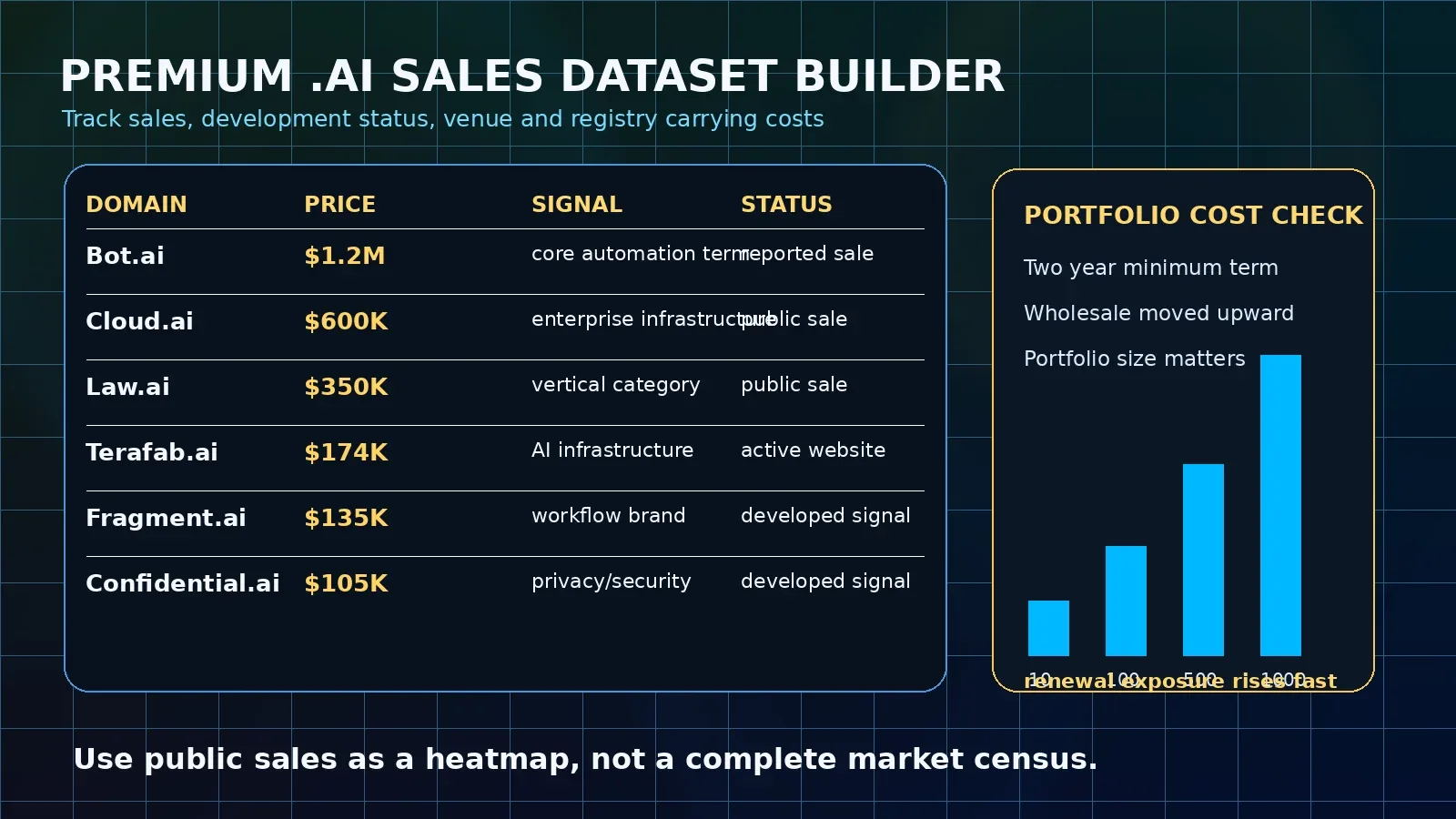
Why Bot.ai Reached $1.2 Million (Plus Some Lessons)
Bot has obvious tech meanings.
A bot can be a generative app. It can also be an automated process, a virtual assistant, a chat agent, etc.
Bots already live inside our common technology vocabulary.
That meant Bot.ai did not need to spend thousands on a slogan or branding campaign before the visitor realized what sector it belonged to.
Domain names are(images). Bot.ai passes the eye test. It passes the typing test. You can pronounce it out loud easily.
Best of all: Bot.ai can support a consumer facing app, B2B software, developer tool, or bot network.
Sales data from Bot.ai also tells us this: when pricing a premium domain at seven figures or higher — make sure the buyer path is clear.
Someone paid full price for Bot.ai. They didn’t haggle. Buying a domain isn’t always a swift process. Brands can negotiate with brokers for weeks on price. Bot.ai shows us that for ultra-elite names, some buyers are willing to pay instantly if the domain feels required.
Another lesson from Bot.ai: bot is a generic technology term but that didn’t stop this sale from reaching seven figures.
Scarcity is real. So is category fit, easy recall, and extension alignment. Bot.ai may trigger countless AI searches each month, but thousands of searches don’t equate to thousands of buyers.
Finding the company that would pay $1.2 million to own Bot.ai will be difficult. There is no formula to guarantee investor success. However, sales like Bot.ai do give us clues on which AI words have reached a certain market threshold.
Pricing Variance In The Aftermarket: Human vs. Technical Keywords
Other names in the seven figure group offer additional signals. Domain sales teach us about pricing logic.
Surface.ai sold for $110,000. Law.ai sold for $350,000.
Domain length and commercial applicability impact sale price. Both were.tech terms before the sale. Both broke into the six figure range based on varying strengths.
Marketing can influence these prices. Buyer pools can expand or contract. Investor interest can move quickly so trends we identify today may not hold true next month.
As always: buy domains you can hold if the sale does not materialize.
However, if we were to divide premium sales data into two groups based on category vs. brandable strength — it might look something like this:
|
Domain Type |
Example |
Commercial Strength |
Primary Risk |
|
Generic category word |
Bot. ai or Law. ai |
Instant sector authority |
Highest acquisition cost |
|
Technical infrastructure |
Cloud. ai or Enclave. ai |
Enterprise relevance |
Specialized buyer pool |
|
Action word |
Certify. ai or Climb.ai |
Strong product bias |
Potential for broad interpretation |
|
Brandable word |
Amber. ai or Mila. ai |
Memorable & expansion opportunities |
Marketing required |
|
Technical compound |
Terafab. ai |
Fits specific company purpose |
Limited buyer pool /resale value |
|
Long phrase |
[insert multi-word-brand-here] .ai |
Easy to enter, hard to remember |
Marketing / holding cost |
Compound phrases can reach buyers across many industries. Human names feel ultra-brandable. Words like certify and climb are onomatopoeias that fit many verticals.
Sales data does tell a story. However, it cannot sell domains for you.
Choose your pricing strategy wisely.
AI Domain Names Under Development
Analytics firm NameBio profiled several dozen .ai sales in a recent story.
We found approximately two thirds of these names are live websites already.
Seeing is believing.
Who is buying premium.ai names? What kind of companies are deploying versus flipping?
Our best signal comes from developed names. Example names that sold for seven figures or more:
|
Domain |
Price |
Development / Use Signal |
|
Fragment.ai |
$135,000 |
Procurement automation platform |
|
Surface.ai |
$110,000 |
Human resources/cloud devop tool |
|
Confidential.ai |
$105,000 |
Encrypted compute stack |
|
Enclave.ai |
$100,000 |
Bug discovery marketplace |
|
Evo.ai |
$100,000 |
Governance system for AI agents |
|
Synthetic.ai |
$100,000 |
Accounting automation suite |
|
Celeste.ai |
$95,000 |
Regulatory technology for agents |
|
Primitive.ai |
$90,000 |
Responsible AI finance tool |
|
Janet.ai |
$88,000 |
Product devops platform |
|
Una.ai |
$75,000 |
Financial operations tool |
|
Liberate.ai |
$75,000 |
Insurance automation |
|
Cinder.ai |
$62,000 |
Consumer digital safety |
|
Lio.ai |
$60,000 |
Procurement software |
|
Porta.ai |
$47,500 |
Online receptionist app |
Instead of agents or AI we see industries like security, finance, HR, procurement, insurance, accounting, physical goods operations, and computing infrastructure.
…the intersection of buyers is AI.
The average price of ai domains is impossible to know
Many visitors ask us what the average price of an ai domain is.
We see similar questions every month about every extension. Prices change too often for a single average to tell the full story.
If you want to calculate average ai prices. First ask yourself:
1. What date range are we looking at?
2. Are we including all sales venues?
3. Should we exclude private sales from average calculations?
4. Should we only calculate average prices on disclosed sales?
5. Should we limit our sample to .ai domains sold for more than $10,000?
6. Are investor to investor transfers being separated from end user sales?
7. Are we separating generic keywords from human names / brandables?
8. Should we remove sales that did not ultimately close?
9. Should auctions be averaged with fixed price purchases?
10. Should Bot.ai skew our average?
There is no right answer.
Right now, if we calculated an average sale price with every sale listed above — Bot.ai would impact that average more than every other sale.
This isn’t useful data.
Calculating the median sale price helps. Reporting mean and median together can also tell a story.
Industry professionals rarely discuss average sale prices because the metric is too vague to offer real insights.
Better metrics to analyze include:
|
Metric |
Usefulness |
|
Transaction count |
Measures activity visible to the public |
|
Median sale price |
High value sales do not skew median sales prices |
|
Mean sale price |
Understands overall sample value. Can be easily skewed. |
|
Lower quartile |
Visible entry point pricing |
|
Upper quartile |
Top range of middle market premium sales |
|
Largest transaction |
Public sales ceiling |
|
Sale venue |
Identification of where most sales are occuring |
|
Development rate |
Percentage of purchased domains that are live websites |
|
Domain age |
At what point do buyers develop |
|
…more. |
|
…more.
Getting Answers With Better Questions
What is the average price of an AI domain ?
We don’t know.
The average price of an ai domain sold last month is impossible to calculate. Even if we defined the parameters above every investor would arrive at a different number.
…but we do know this.
“How much did XX cost?” is a worse question than “what sales have closed for XX?”
By tracking AI aftermarket sales over time — along with category, word length, time to develop, and sale price — we can begin to answer more valuable questions:
Which words have sold for the highest prices?
What AI extensions are being used by active businesses?
Which domains hold value longer than others?
What sale prices move immediately to development versus being flipped?
…
Is there value in tracking sales data? Absolutely.
Just remember that most sales do not become public. And if they do, the seller decides the story that accompanies it.
When reporting past sale prices always consider-point-of-sale.
Using sales prices as an aftermarket heatmap.
In case readers missed it…
Bot.ai sold for $1.2 million Dollars.
NameBio recently analyzed 49 sales made through Spaceship. Of the domains they reviewed — 67% were live businesses.
Some chose to develop immediately. Others likely converted an active technology brand.
While we wait for the next 1-million-dollar sale to reach the public… let’s look at sales trends and terminology.
Dissecting Sales Claims: Understanding Mean Vs. Median Sale Prices
Median Sales Price = (Highest Price + Lowest Price) ÷ 2
We want to encourage investors to understand marketplace numbers instead of accepting them at face value.
Certain reporters love publishing AI sales data. But rarely do they analyze their numbers. Every bucket can be sliced infinitely. Samples can be tested by sale price, domain length, venue, developer status, keywords vs. brands, generic terms vs. brandables.
Before sharing public sale prices ask yourself:
Where are these sales occurring?
Why are these names being sold?
Is the renewal date public?
…and how does one sale compare to others in that bucket?
Stop trusting averages.
Bot.ai = $1.2 million
Know the median price of your favorite bucket. Understand where the outliers land. Compare your data to public sources and watch how quickly your opinion on sales prices will change.
Check listing prices. Then watch what happens post sale.
Assemble a Clean Sales Dataset
The public sale price of a domain is often irrelevant.
Every seller on the planet can list a domain for any price they want. However listing a domain and selling a domain are two different transactions.
Public sales data starts when the domain closes and doesn’t appear on a listing.
Take these prices with a grain of salt.
I prefer NameBio over other sales tracking services because they allow you to filter sales. Search by date, domain extension, sale price, and venue. Filter data from NameBio and then cross reference sales with news publications like DNJournal or Domain Name Wire.
Build a spreadsheet with these 15 columns:
Domain Sales Price Sale Date Sales Venue Source URL BRANDORKEYGENIC Character Length Word Count Website Status Verified Buyer Verified Seller Original Acquisition Price Annual Renewal Cost Estimated Holding Period Category Notes
Keep things organized. Only input what you know.
Your sales dataset shouldn’t have a ton of holes. If the column is unknown leave it blank. Do not guess at metrics because entries with unknown wholesale prices are just as valuable as known sales.
Holding a .ai Portfolio Requires Increased Due Diligence
Investors new to .ai should know about these cost increases before buying their first domain.
Minimum term costs…
Registering a .ai requires buyers to pay for at least two years of domain ownership up front. That increases the initial cost to register a speculative name.
Wholesale prices are rising.
Registrants must pay fees directly to the registry. According to Domain Name Wire, Identity Digital increased .ai wholesale prices on March 5th, 2026.
Registrars add their own markup.
The public renewal price you see will vary from registrar to registrar.
These are mid-to-long term changes that will impact portfolio strategy.
Portfolio strategies will need adjustment.
A small speculative portfolio can become pricey when factoring in renewal costs.
|
Portfolio |
Minimum Cost To Renew For Two Years |
Approximate Annual Cost |
|
10 domains |
$1,600 |
$800 |
|
100 domains |
$16,000 |
$8,000 |
|
500 domains |
$80,000 |
$40,000 |
|
1000 domains |
$160,000 |
$80,000 |
…and higher.
Does your strategy account for renewal costs?
These prices do not include coupon discounts or registrars who offer added value through partners.
AI Registry Is Now Also Selling Expired Names via Auction
Another industry update…
Expired names are reaching customers before general availability.
Identity Digital shared several important updates regarding auctions and DroproZone via a blog post earlier this year.
Domains that do not sell via auction are transferred to a platform Identity refers to as DropZone. Inside DroproZone registrars bid on expired names via Dutch auction format. Domain names have up to 14 days to sell inside DropZone.
Channels through which expired names can sell to the public:
1. Ordinary registration (if still available)
2. Registry auction
3. DropZone
4. Registrar who owned the name passes it off to clients.
5. Public sales venue
6. Private sales venue
7. Broker sales
Building an acquisition strategy means accounting for all sales channels.
Sales Venue Distribution Will Matter To Investors
Depending on your buy path certain domains may never surface on your radar.
Fixed price purchases should ideally utilize a clean checkout experience. Broker sales would benefit from establishing relationships and sales tiers.
It’s hard to see a broker price being listed on Sedo. For broker sales an optimal sales route requires trusting your broker.
Atom Sales and Brokerages have worked with several investors buying premium ai names.
They have strong sales data but wouldn’t appear on DNJournal because they don’t publish listing prices.
Here’s where reported sales have been occurring this year.
7 AI Sales Venues
|
Venue |
Article Detail |
|
Sedo |
Bot.ai sold for $1.2 million through Sedo. |
|
Atom |
Formerly known as SquadHelp, operates an exclusive marketplace with dedicated collections for ai domains. |
|
Afternic |
Listing a domain on Afternic means it can appear in millions of monthly search queries that flow through leading registrars. |
|
Spaceship |
Domain Name Wire credited Spaceship with over $3 million in Ai sales across 2026. |
Seller identity matters.
Just because you can sell a domain via multiple venues doesn’t mean you should.
Picking A Broker Or Sales Venue Comes Down To Portfolio
There isn’t a single destination for every premium domain sold in the aftermarket.
Focus on product market fit.
Building A .ai Acquisition Strategy
Step 1: Know What Bucket You’re Pricing
Identify domains as brandable or keyword generics.
Step 2: Evaluate Usability
Ask yourself what the company could build using the domain.
Can both large and small companies use it? Does it work broadly in agents, automation, security, infrastructure, or data?
Step 3: Research Reported Sales Prices
Search NameBio.io by extension. Compare data to public sales articles by DNJournal and Domain Name Wire.
Note asking prices versus reported sale prices.
Step 4: Develop Websites Signal Strength
Open the domain.
Is it developed? Redirected? Parked? Leaving for launch? Is the product on it?
Checking development status helps. Domains can sell without websites. However if a buyer develops quickly we can infer the product category and assignment of the domain.
Step 5: Cost To Hold
It’s easy to get caught up in price discovery.
Don’t forget carrying costs. Especially on premium ai domains. List price isn’t everything.
Use live renewal pricing to model at least two full renewal cycles.
Step 6: Test the Name
Read it aloud. Have a friend type it. Look at how it looks in all lowercase.
Step 7: Legal Checks
Clear trademarks and company names. You don’t want to own a great domain only for someone to file a dispute or lawsuit against you after the fact.
Step 8: Price the Domain
Domain pricing isn’t easy.
Add a sales venue. Set a realistic BIN. Decide between Make offer, BIN, lease-to-own, or I’ll take it all approaches.
Conclusion: What High Value .ai Sales Tell Us About Market Demand
The .ai extension is evolving.
What was once only a registration game has flipped to a segmentation phase.
Generic names like Bot, AI, Cloud, Data, Infrastructure, Agent, Factory will keep scaling toward seven figures because there are fewer of them and companies need them to fit inside short brand opportunities.
This isn’t a signal every premium .ai name is worth millions. LongTail.ai is alive and well.
…but 2026 will be remembered as the year Premium .ai sales started to scale.
Don’t get caught trying to catch a trend. Start building your portfolio.