
Not every splashy domain sale needs to come from the highest tiers of the aftermarket. Today’s spotlight sale is reported to have closed at $27,995, which may not seem earth shattering, but Tendrils. com was a single word .com coming from one of the more stable categories of domain names: common English dictionary nouns.
Sales like this one are easy to overlook if you only pay attention to seven figure sky scrapers. However, strong five figure sales of domain names that don’t evoke trends, acronyms, or specific categories are good indicators of where the aftermarket finds continued value.
Value of .com Nouns
Words are useful. Owning a domain name that is a common dictionary word provides branding advantages. It is easy to spell. It often looks natural on a page. It has linguistic authority. It fits into speech easily.
These are precisely the reasons why corporations buy dictionary words. They want clean assets they can build upon. When looking at database of previously sold names, investors should take note of single words selling at the retail level because it tells them these names continue to hold value for brand buyers.
Why Tendrils Makes Sense As A Brand Asset
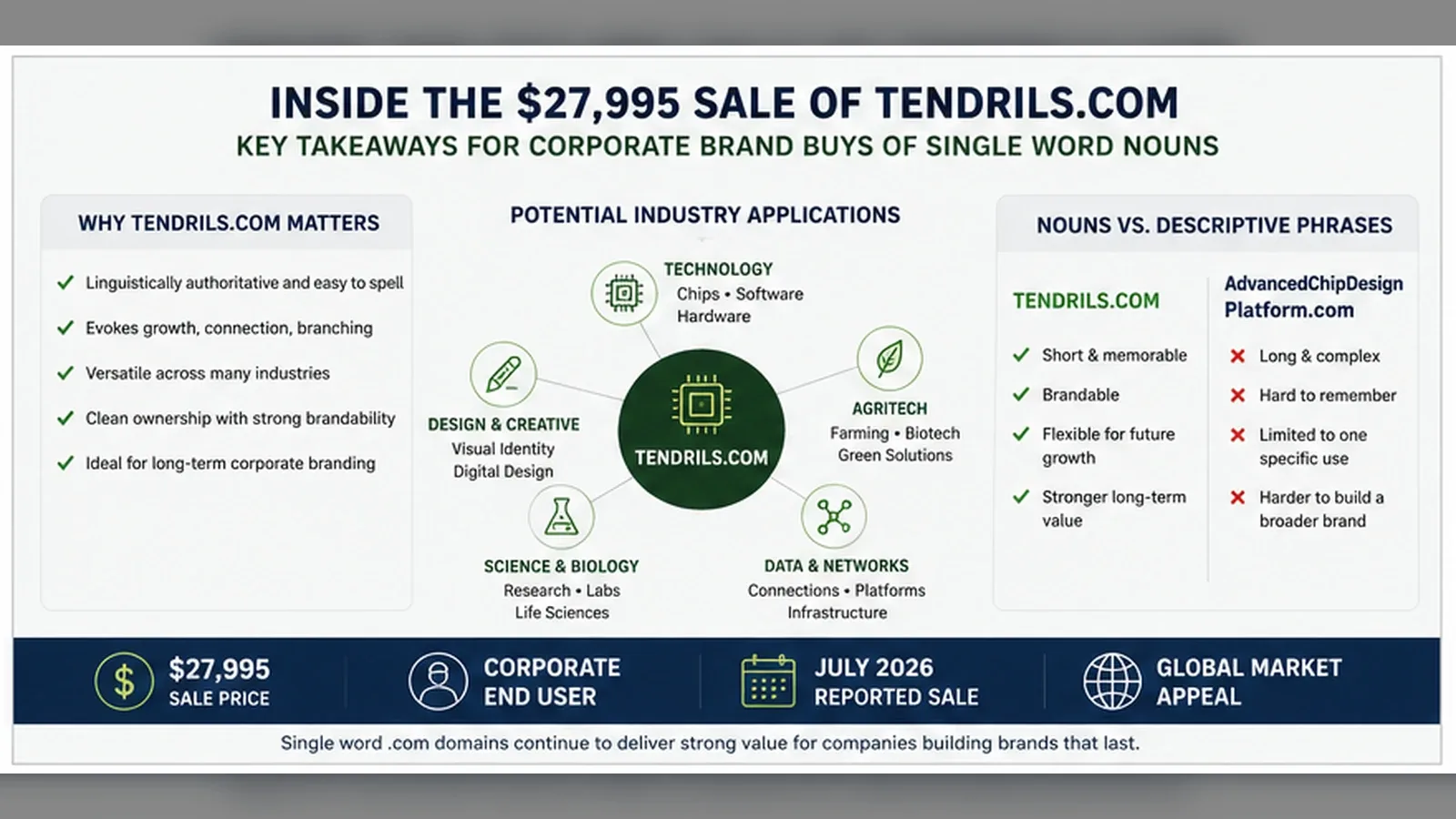
Technically speaking, tendrils is a visual word. When one hears the word they may think about growth, reaching outwards, connections, roots, vines, organic growth, branching, and other concepts.
While those concepts can apply to many industries or sectors, certain types of technology, design, agriculture, and scientific markets could all see an asset like Tendrils as useful. That helps the name feel versatile and flexible. With flexibility comes brandability. More specifically, the ability to own the word as a stand alone brand.
Because it is a .com and not attached to an existing brand or trademark, the word also has clean ownership value. Ownership matters for portfolios considering resale value down the road.
Industry applications are somewhat speculative, but that is perfectly reasonable. Purchasing agents, brand agencies, or corporate product teams do not need to publicly announce specific product plans when shopping for domain names. In many cases, the domain name is acquired well before any public reveals.
Rather than guessing at specific industry uses, look at the value Tendrils provides as a noun. It is:
-Linguistically authoritative because it is an actual word.
-Simple and easy to spell/type.
-Inspiring of visual connections and images that could apply to technology products, agriculture technology, data connections, software interfaces, hardware, design markets, or even biology.
Is the word perfect? Of course not. Companies do not need perfect domain names. Businesses just need domain names that fit what they want to do.
Looking At Seasonality
As the summer season lulls buyers and sellers alike into quieter reporting periods, sales like Tendrils.com demonstrate that the aftermarket does not stop moving just because large sales are less frequent.
Last week’s Domain Name Wire article covering sales from the same week on Sedo pointed out how summer seasons can often mean less activity in terms of reported domain name sales. Even so, we were able to identify clear end user demand from the names on that sales list.
The lack of branding announcements around Tendrils.com made me curious if readers would guess at what industry the name would apply. We may never know for sure, but would readers have guessed computer chips?
When analyzing sales, it’s good to consider potential uses. Some industries may see immediate value while others may not.
Word like Tendrils feel at home in the technology and hardware world. Chips are literally branches of tech that reach out and connect to circuitry. Branches become tendrils when applied to technology. Without knowing the buyer’s identity, analyzing use cases like chips lets us explore the range of possibilities while avoiding guessing games.
Branding is more than dictating every feature. Branding allows companies the flexibility to own words, pictures, and concepts in a way that creates memorable differentiation.
Noun Versus Descriptive Phrases
Look at how much difference exists between Tendrils. com and something descriptive and exact match like AdvancedChipDesignPlatform. com.
Both would apply to the same industry. Both communicate a clear idea. Only one is light enough to become a true brand.
Flexibility For Future Growth
There are many great domain names that do not come in a single word format. That’s fine. Exact match domains can be highly valuable when they meet user intent in a conversion focused marketplace. Artificial intelligence made a lot of people wealthy because of keyword searching and lead generation demand.
However, corporations looking for brand flexibility cannot use Exact Match Domains in nearly the same way. When deciding between buying an abstract noun or a descriptive phrase, brand teams often choose the former.
While descriptive domains have value, corporate brand buyers need more adaptability.
Single Words Dominate Corporate Watchlists
Why do corporations gravitate towards single words so frequently?
Dictionary terms have commercial flexibility because they are not tied to a narrow product or industry. That provides brands the opportunity to grow beyond one offering. Descriptive phrases often struggle to transcend one market or product vertical unless the company purchases an expensive array of keywords that try to spell out every feature.
Technology brands struggle to choose nouns sometimes because they view tech dictionaries as depleted. That is understandable. Computer, tech, mobile, software, and website are gone. IPad and ITunes were taken quickly. But quality nouns remain.
Tendrils keeps the image in your head simple but suggestive. Good nouns do not dictate every detail. They allow the brand to define the picture.
Snap Judgement: Do I Want To Own This Word?
A common question asked when browsing sales data is “would I own this?” Would you pay list price for Tendrils.com if you had the cash available right now?
It depends on your industry vertical and how you would apply it. Some buyers would jump at the opportunity while others wouldn’t. However, since we know corporates values nouns… and they just spent nearly $30,000 on one, it behooves investors to pay attention.
Absurdly High $$$$$ For Nouns? No Way.
Anyone who has studied sales data for an extended period of time knows that certain assets reach ridiculous prices. Single words do not typically fall into this category because corporations understand their value, but when an overpay does happen it throws cynics into a state of disbelief that shakes their foundational domain pricing theory.
Reality eventually comes back to settle the news. Until then,
Don’t buy words you are unsure about. Businesses deserve quality domains that have real brand potential. If you have doubts about a name, hold off on paying top dollar.
Retail prices for dictionary nouns are not going to hit seven figures. There simply are not enough corporations out there with that kind of domain buying budget. $30k is probably as high as we will ever see them.
Summary
Many buyers missed out on a perfect noun years ago, but others were smart enough to buy early when prices were lower. This name is no longer available. Thankfully, there are others like it.