
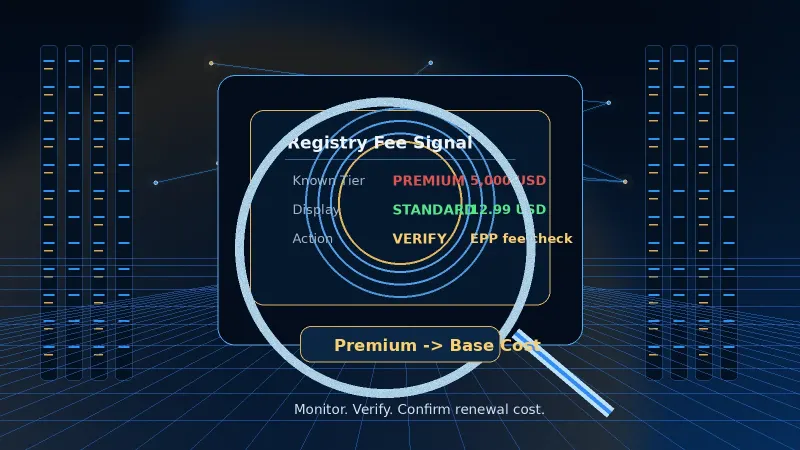
Registry tiered pricing is one of the least understood components of the modern domain aftermarket. Domain investors might recognize when a name has a standard registration price and when one has a premium price assigned but fewer know how those classifications move through registry systems, registrar feeds, pending delete cycles, and price confirmation checks.
This article will cover the technical side of that subject. It is not a guide to breaking registry controls or abusing registrar platforms. It is a guide to recognizing how premium domain drops can appear at baseline pricing when published registry data, registrar pricing engines, and drop timing are not aligned perfectly.
Why It Matters To InvestorsFor investors that spend serious time and money every year on premium domains, mispriced drops matter. Names previously valued at $1,000, $5,000, $10,000, or more may surface at list price through a public registrar path.
Sometimes it is because of a legitimate reclassification by the registry. Sometimes it is because of an intentional temporary display mismatch by the registrar. Sometimes it is due to a bona fide data propagation issue somewhere inside the ecosystem.
Domain buyers that understand how these components work can assess these situations far more safely than those that simply see low price and hit buy.
Understanding Registry Tiered PricingThe baseline pricing for an ordinary domain registration is simple from a pricing perspective. The registry charges a wholesale price, registrars add margin, and consumers see a retail price to checkout.
Premium pricing adds additional complexity because the registry can apply classifications and price tags to individual names inside their system.
Premium pricing can be attached not just to specific extensions, but to specific domain strings themselves.
That’s why two domains inside the same extension can sometimes have drastically different prices. A generic name might be under $20 to register. An exact match keyword or popular commercial term in the same extension could cost hundreds or thousands of dollars more due to registry classification.
Reasons To Use Tiered PricingDomain registries use tiered pricing because domains are not always created equal in terms of market value. It is reasonably well understood that some short commercial words, high demand nouns, and category terms carry more market value than obscure phrases or low-demand combinations.
Registry owners want to capture that additional value on first registration and sometimes at renewal. They set price tiers so their top tier names cost significantly more than baseline registrations. This applies to many newer extensions and some ccTLD systems.
This is also why investors must always triple-check premium renewals before paying. Because if the domain was once worth $1,000 but suddenly comes up as a $15 standard registration… something may have changed.
The important takeaway for now is price tags are not magical. They are informational attributes handled by software inside registry and registrar systems. Price data must be stored correctly, published to interfaces, queried by registrars, mapped to retail pricing tiers, confirmed by EPP command checks, and charged properly.
Data moves a lot in domain backordering. Keeping accurate pricing between all those steps takes correct timing and configuration.
Fee Attributes For Premium DropsHow does the registry handle pricing attributes? One common method is through the EPP protocol.
Domains are registered through Extensible Provisioning Protocol commonly called EPP. To create, renew, transfer, or manage a domain, registrars send these commands to registries through EPP.
Premium prices are often delivered through EPP fee attributes. RFC 8748 defines the registry fee extension for use with EPP.
RFC 8748 describes how registrars can ask about and confirm these fees:
Summary: This document defines a registry fee extension for use with EPP.
Essentially, it provides standardized XML data that registrars can use to inquire about and confirm fees related to domain commands. That data can tell a registrar if a domain name is normal, premium, discounted, or something else entirely.
Wrong Fee = Failure.The critical piece about premium pricing is registrars should never attempt a command for a premium domain without knowing what the fee is. Some registries do not allow a registrar to simply create a domain with an incorrect submitted fee value. The system checks what you think you are paying versus what the registry prices are. If they do not match, the command fails.
Standard vs. Premium Domain ClassificationSome registry systems classify domains as standard or premium:
Standard: Follows baseline TLD pricing.
Premium: Followed domain specific pricing rules set by registry.
Premium rules can apply to creating, renewing, transferring, restoring or other billable actions taken on domains.
With that in mind let's look at how this applies to the scanning process. Imagine a domain you thought previously was premium starts returning standard fee information at multiple registrar interfaces.
What happened? Did the registry declassify the name? Is it an intended temporary promotion? Is it simply a front end display error on those registrars?
A smart investor is not going to rely on scanning one registrar website or interface. Instead, they scan multiple sources for signals:
· Search multiple registrars for same name.
· Search premium feeds if available.
· Query RDAP status.
· Watch pending delete feeds.
· Compare known registry tier list price attributes.
Tracking Registrations Through Lifecycle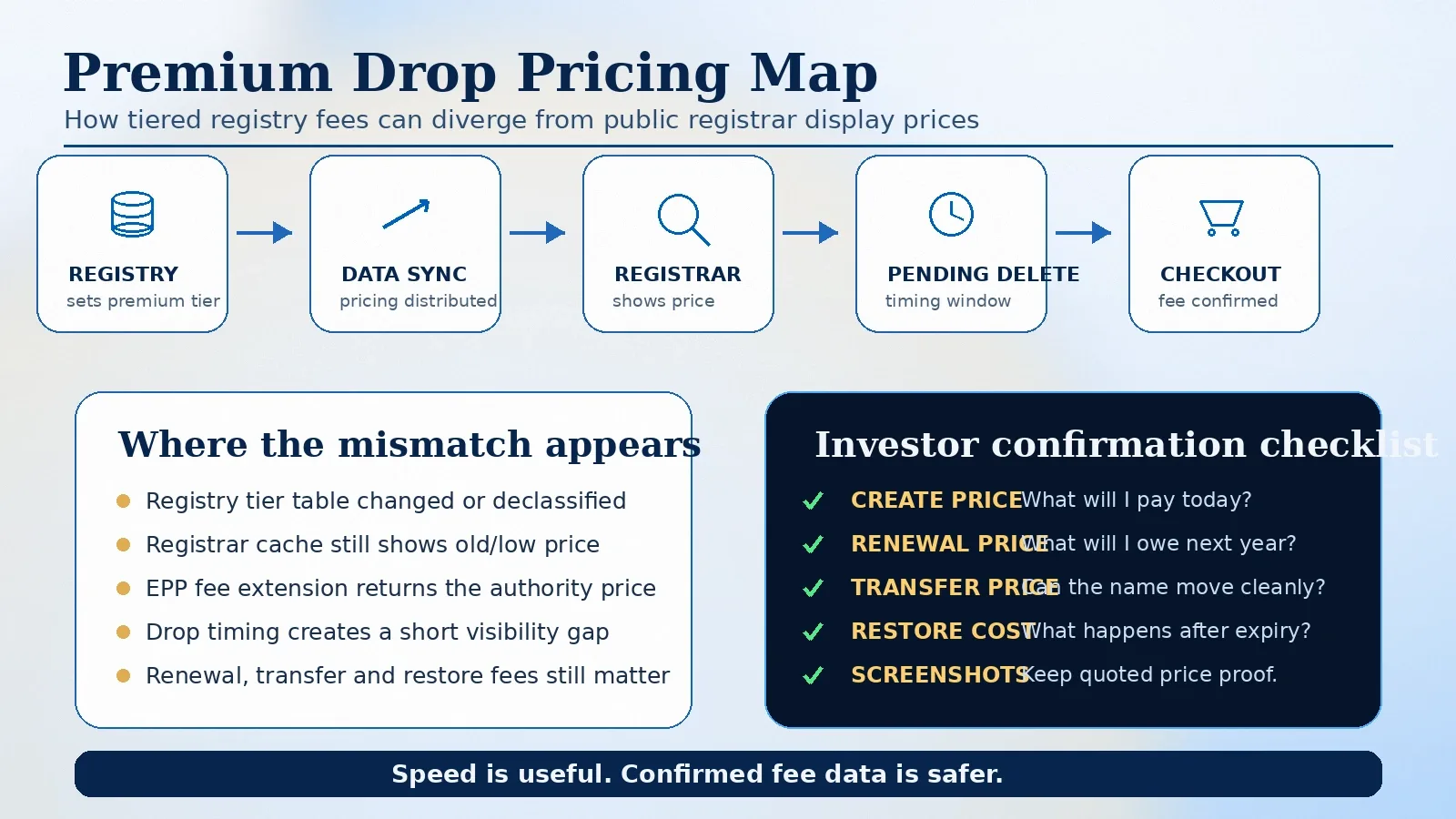
Domains go through a registration lifecycle. Understanding that timeline is critical for premium drops because price attributes may be checked at different stages of domain availability.
When a domain name is deleted it can enter redemptionPeriod.
ICANN defines redemptionPeriod as a grace period following normal expiration during which the domain may be recovered by the original registrant. A domain in redemptionPeriod is held for 30 days before it moves up to pendingDelete. After pending delete window it is purged by registry and becomes available for registration following registry policy.
Premium tags may be queried differently depending on if a name is registered, expired, in redemptionPeriod, pending delete, or has never been registered at all. Drops only occur in that small window between when registry ownership is purged and when the name can be registered anew.
Why Timing Creates Pricing ErrorsErrors occur when one part of the system displays standard pricing while another part still shows premium. This could occur anywhere in that process:
One registrar may have finished publishing the price change. Another has not.
The registry may have updated their feed, but registrar search tools have not.
There may be a cache serving yesterday’s data somewhere.
The drop catcher may list it as available before fees are double checked.
Registry configuration error.
Ok, but how does that happen?
Many investors say stuff like registry glitch or misconfigured. Dramatic language but technically those price errors are due to pricing state mismatch.
State mismatch occurs because pricing lists, registrar price mapping tables, EPP fee attributes, display caches, and reseller private APIs do not update at exactly the same time. Domain is transitioning state and data does not align perfectly across the entire industry at that moment.
Registry Errors Are Actually RarePremium domains do not typically accidentally unload into registrar interfaces at list price. If anything, registries double check and patch these errors quickly. Premium prices are revenue. Registry intends to charge high value words, names, or phrases plenty of money.
As mentioned before, buyers should approach these drops with caution. It could be legitimate change. Easy purchase. Instant win.
Or…it could be temporary issue that fails at checkout. Something that corrects right as you try to register. Something that does register but renew at the correct premium price.
Please do your due diligence and learn the difference. Premium names legitimately placed at standard pricing by registries do happen. They are just rare enough that investors should not gamble blindly on every domain that seems like one.
Even More Issues: The High Renewal CatchAll too often investors looking for premium domain catches focus solely on first year cost to register. Premium models can have high register costs and high renewals.
Always know renewal price. Understand the domain could reset to that price immediately upon registering.
.CO Registry documentation nicely displays public tiering system. They list multiple premium categories where registration price = renewal price = transfer price.
What they fail to mention in that document is if you drop and then later restore that premium domain. You pay standard restore fee surcharge PLUS premium renewal cost to restore.
Added costs like this is why some investors look past purchase price and focus on long-term costs to own a domain.
Better Questions To Ask Before BuyingInstead of jumping straight to can I buy it?
Try asking what would this domain cost me to own next year?
Investor should know create price, expected renew price, transfer price, estimated restore costs, and understand the registrar supports all those functions before getting excited about a cheap price.
Keep confirmation of price quoted. Keep screenshot of price when you checkout. Keep order confirmation email and don’t assume renewal will match what you see today.
It’s not paranoid. It’s called asset management.
Premium names can have weird billing properties. Failure to evaluate renewal cost could turn a great find into a very expensive mistake.
Timing Patrol: Pending Delete MonitoringOk, technical how does one monitor for this stuff?
First step is pending delete queue. Build filters around high probability premium terms: One word names, short verbs, common finance terms, technology words, cryptocurrency keywords, exact match commercial terms, short domain hacks, strong surnames, and commercially pristine two-word phrases.
Now start comparing pricing on those names. If a name matches structural patterns you expect to see as premium but is coming back standard on fee queries, you might want to look closer.
Bonus: Abuse Vs. Monitoring Public DataLet's review: Automated tooling scans public drop lists published by registrars. That data is displayed on registrar websites that are publicly available.
Monitoring those name vs attempting to attack a registry are two very different things. Tool that scan pending delete queues should respect registrar query rate limits, terms of service, and publicly published access guidelines.
How To Build Filters That Get ResultsCollecting every domain on a drop list is not ideal. To spot good candidates consider scoring name quality before even checking price.
Length, dictionary vs. surname, commercial category, TLD reputation, historic registration data, backlinks, trademark risk, and recent sales history all should matter.
Now that you have a quality score on the name check price.
Weak names are still bad investments even if you buy them at list price. Small component phrases do not suddenly become investable just because you see them for cheap.
Good candidates would be names that meet your normal investment criteria even if they were not listed at baseline prices.
Coincidentally two word seo phrase.com would not fit that example criteria. Bad name. Never a good investment.
Weak names aside… if you find a name you would consider buying at list price… do not trust one registrar display.
Use multiple sources to verify signal strength across independent registrar interfaces or APIs.
See standard pricing on 4 out of 5 sources. Looks promising. However if you see $12 on one and $2,500 on four others… that weak signal.
Where possible test transfer price visibility as well. Renewal prices.
Many registrars hide renewal pricing on available domains and only display create prices. Others front load renewal price higher than registration cost. Know what you’re looking at and use the most direct fee attributes your registrar partner exposes via compliant API paths.
Speed is good. Being right is better.
Fee Attributes Plus Cheap Prices Can Still FailPart of reason you want to check API price data is due to how premium systems behave on mismatched prices. Because the price you think you are paying does not always equal the price that gets charged.
For example, the .CO Registry article How to Register a Premium .CO Domain via EPP explains that if the command sends an incorrect fee then the command will be rejected.
If the Command sends a incorrect fee then the command will be rejected.
The fee submitted with a command must match the fee stored by the registry. If there is a mismatch command fails.
Translated to English if fees don't match your buy attempt will fail. You will see a cheap price but registry rejects your order.
You might see a low price, try to buy it, and get your money back because the registration never completed.
Not every cheap domain will fail but until that domain shows as registered in your account the deal is not real.
Four Steps To Catch Without Abuse1. 1. Build quality wanted pending delete names.
2. 2. Compare expected premium pricing vs actual price signals you see publicly.
3. 3. Use registrar or backorder services that legitimately support the TLD you are targeting.
4. 4. Double check actual billed cost matches what you think you were going to pay before assuming the deal is done.
Scanning multiple backorders helps because each registrar has unique connections to various registries. But do not try to catch domains with registrars that lack proper support for the extension you are targeting.
Pick Services You Can TrustDo not blindly trust all low prices come from registry glitches. Look for legitimate services that show clear pricing and support the TLD pricing model.
Some backorders advertise unsupported TLDs as compatible and try to catch them anyway. This often leads to failed registrations and unhappy customers.
Same goes for registries. Just because one registry behaves a certain way does not mean others will follow suit.
Identity Digital exposes price category data through their registrar reports. Radix openly publishes that domains names themselves can be placed into pricing tiers.
Both make it clear that ultimate fee authority is held by the registry systems.
Domain Front Ends Are Just That, Front EndsSee cheap price? Hit register and pray?
Wrong. Once again keep careful records. Domain you catch at list price may not renew at list price.
If you catch a premium domain at standard pricing make sure to keep records of what you were told before validating the deal and paying full price.
Price was confirmed at registration time but if you do not keep records of that fact it happened.
Also try not to breathlessly push every domain you catch straight into your park.
Operational Risks After CatchingIf you register a premium name for cheap, lock it, check transfer restrictions, confirm renewal prices are what you expect them to be, and make sure your registrar account is showing correct pricing for future renewals.
Configure basic DNS settings, enable security features you trust, and double check you will be notified ahead of expiration.
Don’t view the domain name as some kind of prize to be wasted. It was valuable enough to catch at baseline price. Handle it accordingly.
Don’t forget to quickly decide if this is something you plan to hold long-term. Something you are going to develop on or resell. Or if you plan on holding for 6 months then trying to flip immediately.
Premium price clocks change risk/reward calculations.
Cheap Name ≠ Old ValueIf you catch a premium name at baseline pricing does not automatically mean it is worth the previous highest renewal price you knew for that name.
Smart buyers care about factors like how that domain can be used, how much trust they have in that TLD, recent sales of similar names, future cost to own that domain, and likelihood you can resell it for profit.
Premium priced domain drops caught cheap are only worth previous value if the market sees it that way too.
Domain Resell value: Name renews at standard pricing = Good
Name renews at $1000 per year = buyer pool gets smaller and smaller.
Nobody cares what Verisign once charged for a domain. But everybody who makes an offer cares what that domain will cost them next year.
TLDR;Registry tier pricing is complex but understood by few domain investors. Prices assigned to names move through multiple ecosystems before reaching public registrar prices. Those systems can have temporary misalignments which create pricing opportunities for domain investors that understand risk, proper filtering, and technical domain lifecycle.
This stuff is great for the domain industry because investors are digging deeper into the technical workings of how our market operates. Not every investor will learn these details or want to. That’s ok. Many just want to buy names and hope for big wins.
Advancing our knowledge about how these systems work forces everyone to improve. Registries need to make pricing more visible. Registrars need to make public prices align perfectly with private pricing. Buyers need to review and understand cost before paying premium prices.
Registrars gain nothing by correcting “glitches” that no one knows about. Investors profit little from racing to buy names they do not understand.
Domain Pricing Inefficiencies Exist Domain price inconsistencies exist. As long as computer systems talk to each other sometimes things are going to fall out of sync. That does not mean you should try to force them back in alignment. You should monitor, verify, and learn how to recognize when they do diverge on their own.