Every industry has seasonal myths. Domain investing is no exception. Repeat something often enough and it starts to sound believable, even if the facts disagree.
One legend that persists centers on summer months. Buyers are on vacation. Companies delay naming decisions. Brokers wait for fall. Investors become scarce. These ideas can sound logical until you look at the domain market itself.
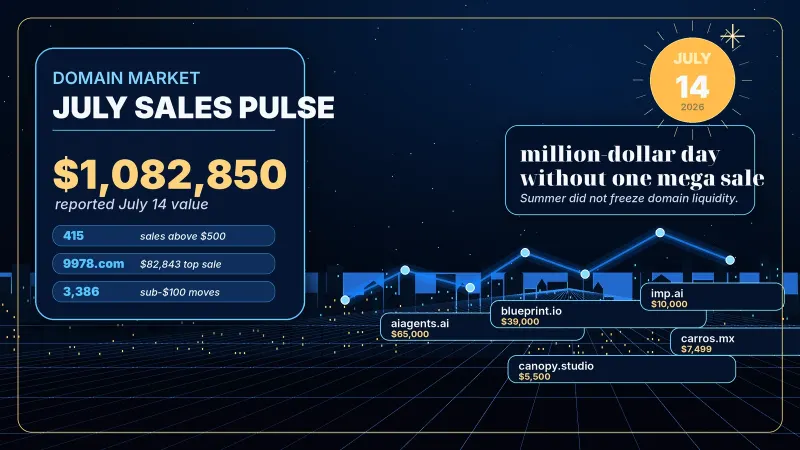
July did not produce frozen transaction counts across premium names, wholesale auctions, alternative extensions, and retail landers. In fact, there were thousands of individual transactions that helped push the reported sales value to $1,082,850 on July 14, 2026. On that date, Crunch.id showed 415 declared domain sales above $500, while DN.com also recorded thousands of additional lower-price transactions.
9978.com for $82,843 was the highest declared sale in that July 14 dataset. A seven-figure daily sales number matters because it happened during peak summer season, the time of year when some investors expect the market to come close to a standstill.
That does not mean portfolios are getting offers every day. It does not mean every seller will find a buyer. However, high transaction counts on strong volume days prove that liquidity is possible across thousands of aftermarket names when the right buyer connects with the right asset.
The Million Dollar Baseline
July 14 crossed the million-dollar threshold on DN.com, and that figure matters because it did not come from one blockbuster transaction. Daily sales data can be misleading if the conversation focuses only on a single giant deal. July 14 featured strong sales volume through many categories.
DN.com reported July 14 sales volume at $1,082,850, with the average transaction price landing at $1,021.56. The same report noted that July 14 transactions decreased only 0.5 percent from July 13, while transaction value increased 30 percent.
Crunch.id added further context. Its July 14 breakdown covered .com, .ai, .io, .mx, .de, .org, .studio and other extensions. Seven-figure days do not occur in silent markets.
Seasonal Summer Sales
For many reasons, domain investors may experience summer quiet periods. An investor may not receive as many offers. A broker may not see an interested reply from one target company. A founder may table a naming project until a cofounder returns from vacation.
Those are valid scenarios, but they become mythology when expanded into industry-level assumptions. An inbox can be quiet while auctions are full. Premium lists can be slow while bargain venues move hundreds of names each day. Large public buyers can pause operations while smaller companies quietly take advantage of summer pricing.
Seasonality is worth discussing because domain buyers have budgets, brokerage platforms have sales, aftermarkets have volume, and assets continue commanding attention online.
Data Matters
Examining monthly and daily trends helps separate perception from market reality. It is easy to assume July is slow when a specific portfolio receives few offers between July 1 and July 31. However, domains still sold every day in July.
Sellers should not base pricing strategy on mood. Pay attention to counts, pricing trends, retail versus wholesale balance, and extension mix. The wider picture often looks different from one seller inbox.
Numbers Are Fluid
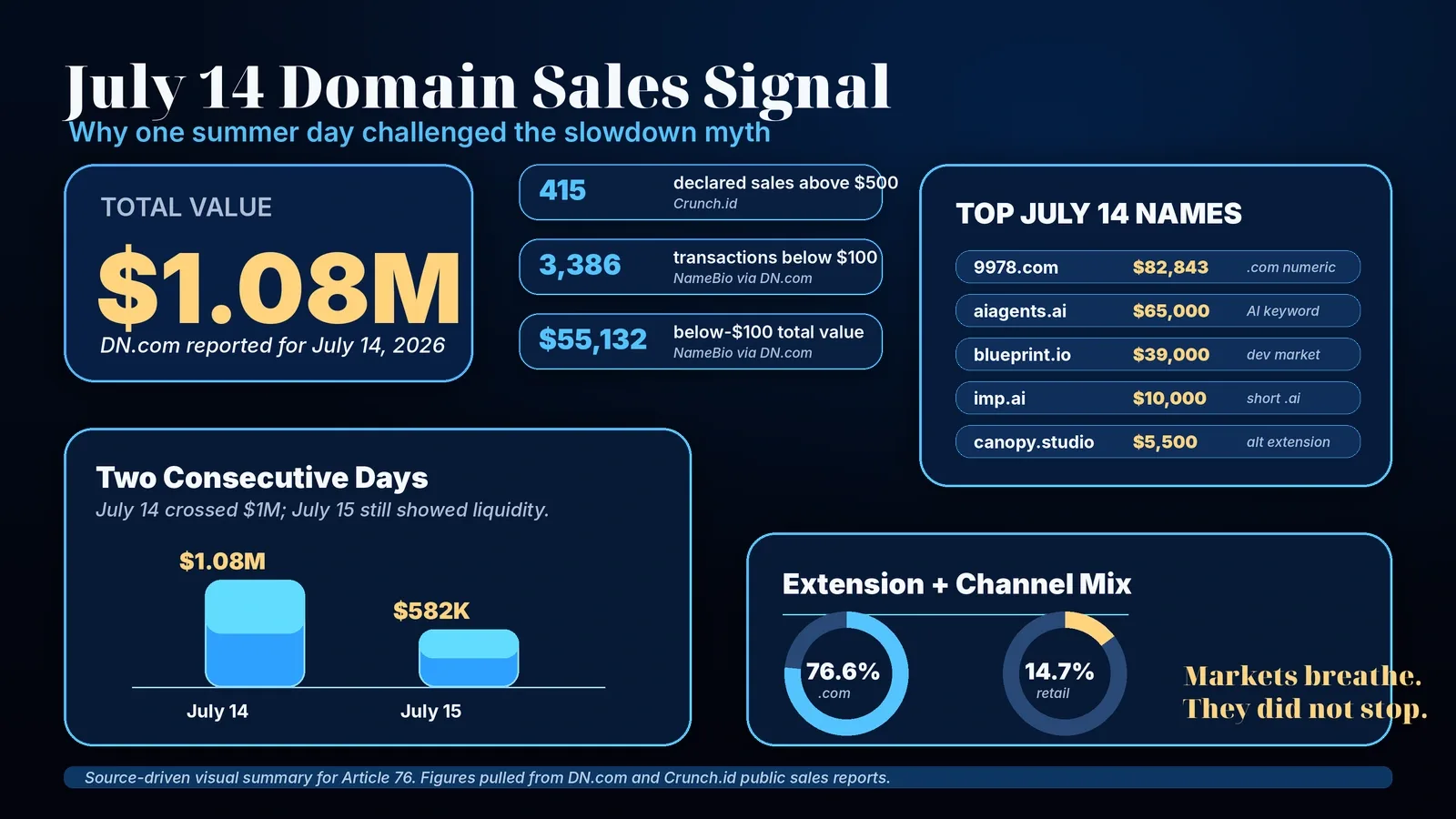
Daily data fluctuates, which is why multiple reports help identify the bigger pattern. For July 14, the top declared sale was 9978.com for $82,843. Artificial intelligence interest stayed serious with aiagents.ai selling for $65,000. Developer appeal also showed up with blueprint.io closing at $39,000.
More signals were visible when sales were broken down by venue, extension, and asset type. Buyers were not just scooping up old-school .com domain names. Retail mixed with wholesale. Multiple extensions sold above $10,000. Different styles of names changed hands.
Add it up and July 14 showed signs of a market staying active during summer.
Wholesale And Retail Together
Retail helped drive July 14 sales momentum. Domain names purchased as projects launch, brands upgrade, or agencies secure retail listings still sell in the aftermarket.
Crunch.id explains its wholesale and retail classification by treating sales from GoDaddy, Dynadot, NameJet, DropCatch, Namecheap and several other venues as wholesale, while classifying other venues as retail for data purposes. No classification system is perfect, but it still gives investors a useful snapshot of where inventory moved.
Wholesale represented a large share of declared sales above $500 on July 14, yet retail sales still appeared in the dataset. Value came from both retail and wholesale channels.
Do Not Ignore Microlayers
Million-dollar days often get headlines. However, DN.com also lists domain sales below $100 for each day. Buyers purchase cheap domains for projects. Drop-catching activity clears inventory. Small investors and builders move names that never become headline sales.
For July 14, DN.com said NameBio recorded 3,386 transactions priced below $100, adding $55,132 in transaction value. Cheap sales do not create million-dollar totals by themselves, but they help show the depth of daily activity.
Low-cost names changing hands still mean transaction flow. It may not be glamorous, but thousands of microtransactions help feed investor liquidity and keep the aftermarket moving.
Corporate Timing Does Not Obey Folklore
Consider corporate timing factors. Just because some companies take summer vacations does not mean every company pauses digital asset purchases.
Advertising teams have seasons based on annual budgets. Product launches do not care about summer. Startups may close funding rounds and then buy names when the money is available. Attorneys may see value in a defensive domain acquisition without regard for the month.
Domains are often bought on project timelines. Do not expect every company to assess availability in July simply because the industry repeats a summer-slowing story. Buyers purchasing domains care about launch timing more than folklore.
Launches Over Seasons
Seasons are societal constructs. If a company needs to purchase a domain to complete work, the calendar is less important than the launch deadline. Terms like summer slowdown fail to account for active buying timelines.
A startup raising funds in June may wait until July to secure web address inventory. The press release may not go public until September, but the domain decision can happen before that. July 15 was lighter than July 14, yet Crunch.id still listed 392 declared domain sales above $500 for the day.
When entrepreneurs need to acquire a domain before product announcements go public, they will act. This drives momentum in periods typically associated with slow sales.
Whether a company buys from retail networks or competes in auctions on GoDaddy, Sedo, NameJet, Dynadot, Namecheap, DropCatch or other marketplaces, the main driver is need. Projects need names. Summer does not stop entrepreneurs from founding companies.
Domains Follow Demand
Brokers facilitate. Buyers cause market movement. If strong brands and premium domains sell every day, investors have reason to keep studying auctions and retail listings.
At this stage in the industry, domain names still unlock value in many ways. Entrepreneurs launch companies. Companies defend brands. Marketers set up email and advertising campaigns. Developers use certain extensions to build apps. Small businesses register websites. Investors speculate on resale value.
The dulling of one category does not mean all sectors stop buying.
Where Buyers Bought In July
Buy-now domain parking networks take friction out of transactions. Buyers see a name. Buyers see pricing. Buyers click and pay through a familiar vendor. Sellers do not need to negotiate if the price is already acceptable.
This matters in slower summer months. People travel. People take vacations. Someone may not reply to an offer immediately. But if pricing is clear, infrastructure is trusted, and the buyer senses opportunity, many transactions can still close.
Afternic, Sedo, GoDaddy, NameJet, Dynadot, Namecheap, DropCatch and other venues serve different parts of a diverse investor market. Retail conversions happen on some sites more than others. Wholesale auctions appear across multiple platforms, but only select venues dominate specific inventory types.
The domain aftermarket does not rely on a single outlet. The ecosystem is stronger for it.
Price Can Reduce Negotiation Delays
Every business experiences summer slowdown at some point. Deals take longer to close when humans are not interacting at full capacity. Email responses slow. Calls go unanswered. Travelers avoid screens.
Buy-now pricing removes back and forth and allows the buyer to make a clear decision. It works especially well when mid-market names test the market. Someone seeing a $6,000 domain may hesitate to negotiate if the price already feels acceptable.
Premium names usually require negotiation. But fast lander access, prompt replies, clear payment paths, and safe escrow routes can reduce hold times wherever possible. Make it easy to buy and you improve the chance of a summer sale.
July 14 Does Not Equal July 15
Domain sales on July 15 did not match July 14 levels. DN.com posted July 15 total transaction value of $582,557, and WW55.com led the day at $20,504. The average transaction price dipped to $590.83.
July 15 also recorded 3,104 domain sales below $100 worth $51,338. Every million-dollar day does not mean the rest of the month will post the same totals. The market breathes.
However, July 15 still featured hundreds of sales above $500 recorded on Crunch.id, and DN.com still showed thousands of lower-price transactions. July 15 was simply not as robust as July 14.
Look past one day. Evaluate weekly trends. Review monthly sales velocity. July showed variety.
.com Still Led, But It Was Not Alone
.com remained the dominant extension in the July 14 and July 15 Crunch.id datasets. Crunch.id reported that .com accounted for 76.6 percent of July 14 sales and .com accounted for 78.8 percent of July 15 sales.
That leadership matters, but sales were not limited to .com. Alternative extensions showed strength as well.
Sector Variety Fuels Stronger Domain Sales Days
Extension variety also played a role on July 14. Multiple tech-focused extensions sold above $10,000. Names such as aiagents.ai, blueprint.io, imp.ai, carros.mx and canopy.studio came from different sectors and naming categories.
Variation helps fuel stronger domain sales days. A healthy aftermarket is not a single-lane market. It includes wholesale liquidity, retail upgrades, alternative extensions, numeric names, AI keywords, developer names, and lower-price trades that rarely make headlines.
Broad Sales Mix
Monthly data can be skewed by a mega sale. Daily data can also be distorted by one seven-figure transaction. July 14 was different because the $1 million-plus total did not depend on one sky-cracking deal.
There were micro sales across lower price tiers. Mid-market purchases showed demand through a variety of categories. Multiple extensions cleared meaningful sales. Seasonality matters less when large parts of the aftermarket continue to transact.
Think Beyond Monthly Slogans
Months come and go. Industries experience ebbs and flows. Some months feel slow. Others feel strong. Investors should look beyond monthly expectations and study the actual numbers.
Do not get trapped by slogans. Study counts. Watch sales totals. Separate $1,000 names from $100 names. Follow both. Public sources such as the NameBio historical domain sales database, Crunch.id domain sales statistics, and the DN.com investment news index can help investors build a broader view.
July Data Is Good For The Domain Industry
Sentiment does not always match reality. Stories spread because they sound believable, but the data often adds nuance.
Yes, budgets can influence summer buying power. Yes, vacations happen. Yes, categories may slow down. But based on reported activity from July 14 and July 15, domain buyers still purchased domain names in July.
Ignore people who downplay aftermarket value without data. Focus on daily sales volume, strong names clearing auctions, ongoing project work, and the retention of retail conversions.
July stayed active for multiple reasons. That is better for industry health than a market dependent on one platform, one buyer type, or one extension.