Every domain seller has lists. You buy lists, you compile lists, or you have clients share outreach contact data with you. When it comes time to reach these people, many fly by the seat of their pants. They send hurried sales messages without real grammar, correct headers, or proper compliance. Outbound should not be done that way.
Domain selling to end users requires an outbound infrastructure. Marketplace selling is passive. Having a lander page is semi-passive. Buying and selling domains outbound is active, structured, and extremely reputation sensitive. When done properly it can generate retail buyers and create liquidity. Done incorrectly it can poison your sender reputation and cause legal issues.
Herein lies a detailed manual on the professional outbound methods crucial for direct domain sales to end users. The upcoming guide provides a thorough examination of domain sales scripts, negotiation frameworks, cold domain sales emails, and the psychology influencing five-figure domain transactions.
|
Disclaimer: The first rule of effective outbound is that you do not try to game spam filters, hide your identity, or pressure busy legal teams into something they do not want. The best outbound connects with buyers because the message is crystal clear, compliant, accurate, and respectful. Approach every sale like that and your metrics will improve. |
Premium domains are not random digital products. Premium domains are business assets that can benefit another brand. They can drive traffic, create trust, shorten URL routes, serve as a defensive holding, or act as a primary upgrade path. Translating that value into a buyer's language takes tact.
Why Outbound Fails
Most domain outbound fails because it is written from the seller's perspective and not the buyer's problem. The seller writes something like, “I own this domain and want to sell it.” The buyer reads that and thinks, “Some random person is trying to sell me something I did not ask for.”
Notice the disconnect. Outbound email and message resistance is high. Corporate buyers get messages like yours all day long. Their legal teams are trained to avoid risk. Their marketing teams do not respond to vague pitches from strangers. Top-tier executives literally do not have time for weak asset claims.
A domain seller looking to convert has seconds to prove they are worth reading. Frame the domain as a logical option that can help solve a current challenge or future-proof the business. Explain that you know why the domain matches the company brand, category, or product. Explain that you understand it may reduce customer friction online, then offer a short reply path as proof of value.
The Compliance Foundation
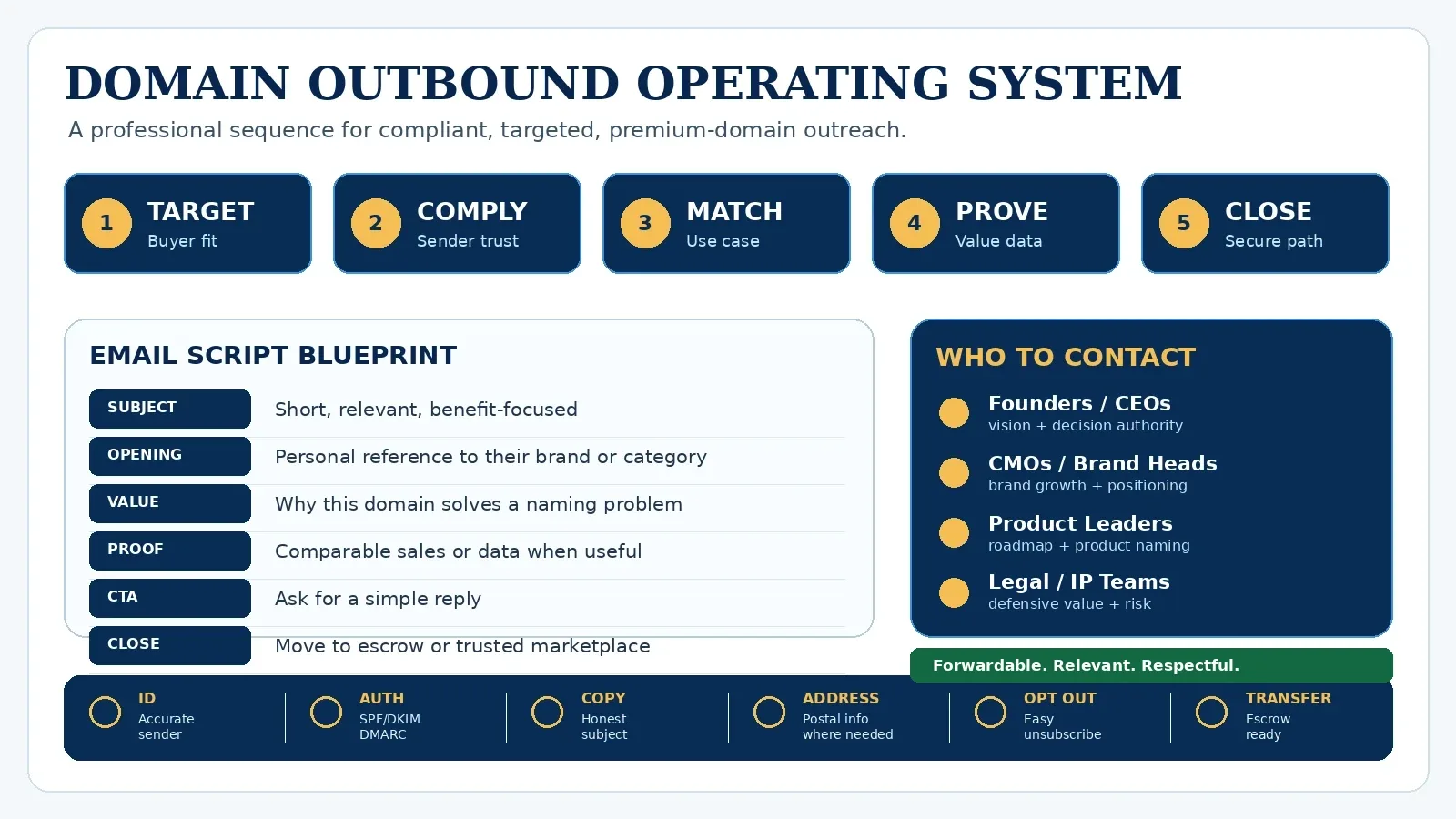
Email scripts and negotiation angles can come later, but every sender needs to learn basic compliance. Commercial sender compliance includes honest sender id, proper header information, accurate subject lines, including a physical address where required by law, and including an easy way to stop future messages.
If the recipient tells you to stop emailing them, stop. Full stop. That is not devilment; that is conversion best practice. Any buyer who feels tricked into communicating with you will not trust you with a real asset transaction.
Another reason compliance comes first is that authentication matters. While not perfect, it is strong evidence that a domain sender is who they say they are. A serious outreach campaign should come from an owned domain, include proper SPF alignment, include DKIM alignment where possible, and include DMARC alignment where possible.
Pick easy-to-read names, authentic authentication, and professional sending domains. A free mailbox, weird sender name, and poor grammar should send warning signs to your prospect before they read your offer.
The Right Targeting Model
The ideal outbound list is not the largest one. It is the most correct one.
Buyers who have logical reasons to care about specific domain names are the only ones who should appear on your safest send lists. Purchasing random business contact lists online is outbound poison.
Good targets can include existing businesses who use a longer version of that name, private companies in the exact same category, funded startups using a weak extension, brands buying ads on the keyword, related businesses who may need it as a redirect, or companies who already own similar names but not the exact name you are selling.
Salespeople often make the mistake of buying generic target lists that include obscure businesses, random executives, omnibus “Marketing Help Desk” contacts, or companies who likely have a trademark on their name that your domain is clearly trying to target.
Outbound needs to be built on buyers who logically match your inventory, not brands you are hoping will feel pressured to reply.
Finding The Right Contact
Do not send everything to public@company.com. That inbox already has too many tasks. Emails go to that inbox for a reason. They get delegated to outside support teams, routed through automatic rules, or handed off to staff who cannot authorize brand purchases.
What you want to do is target easier converts first. Founders. CMOs. Heads of Brand. Business Development Leads. Heads of Product. Corporate Development departments. Even Legal if your message is specifically crafted around brand protection.
RDAP will not always pull up contact details due to privacy laws, but domain registration can confirm who owns a business related domain. When registration data is not publicly available, an ICANN Registration Data Request Service path may exist for legitimate access requests. Just remember, you are not scraping personal information. You are confirming registration context and then using public channels to identify the right business contacts.
About Corporate Gatekeepers
The support gatekeepers at big brands are your friends, not enemies. They manage budgets, executive time, legal risk, and unnecessary emailing. Your job is to write an outbound message that gets it in front of the right person.
The email needs to be short enough to forward internally. Do not tell them it is the CEO personally reaching out. That is fraud.
Simple. To the point. Not overly salesy. You are offering the asset as an option, not as a requirement.
Breakdown Of Domain Angles
A domain pitch should be matched to the buyer's reality. Different buyers respond to different value angles, so do not force every domain into the same script. Use the angle that fits the buyer and the name.
|
Angle |
Best-fit buyer |
Message angle |
|
Brand upgrade |
Buyer uses a longer, weaker, or less memorable version of the same name. |
This domain can simplify your brand path and reduce customer confusion. |
|
Defensive hold |
Buyer owns a strong brand but not the matching domain or close variant. |
This is a clean defensive asset that keeps a relevant name out of competitor hands. |
|
Product route |
Buyer has a product, app, or internal initiative matching the domain. |
The name could work as a direct product URL, campaign route, or upgrade asset. |
|
Traffic / redirect |
Buyer already advertises around the term or category. |
A shorter domain can make campaigns cleaner and help capture direct navigation. |
|
Category authority |
Buyer wants to look bigger in a competitive vertical. |
The domain creates instant category relevance and helps the brand look established. |
Sample First Email Script
|
Subject: Domain
option for [Brand / Product] |
Follow-Up Script
|
Hi [Name], |
Data To Support The Price
Pricing should not be explained with emotion. Use comparable sales, category fit, traffic history where available, extension quality, buyer use case, and replacement difficulty. A buyer is more likely to respect a price when the seller can explain why the asset matters in business terms. NameBio can help provide historical domain sales context, but do not overload a cold email with ten comparable sales. Save deeper evidence for buyers who show interest.
Negotiation Framework For Five-Figure Deals
Five-figure domain sales require calm structure. Open with the domain's business fit. Let the buyer ask price questions. Present a clear number or range when appropriate. Avoid false urgency unless another live negotiation actually exists. When the buyer is serious, move the conversation toward process: buyer identity, payment method, transfer route, timeline, and escrow preference.
Transaction Confidence
A buyer who trusts the transaction process is easier to close. Escrow.com can be used for dedicated domain escrow, Sedo offers transfer support for domain transactions, and Afternic provides marketplace context with distribution through registrar partners. The right route depends on the buyer, the price, and the seller's account setup. The important point is to make the buyer feel protected.
Conclusion
Professional domain outbound is not about spraying emails and hoping for a lucky response. It is a buyer-fit exercise. The seller identifies who could logically benefit from the asset, sends a concise compliant message, presents value in business language, and moves serious buyers toward a trusted close. Do that consistently and outbound stops feeling like spam. It starts functioning like a disciplined sales channel for premium digital assets.