
Introduction
The old domain playbook used to be simple to sell. Buy a domain that matches a valuable search phrase. Publish enough content around that phrase. Collect organic visitors. Turn those visitors into leads, ads, affiliate clicks, or product sales. Do that for many years and you had a real business.
AI search is forcing a reevaluation of that plan. The question is no longer only “do keyword domain names still help SEO in 2026?” The better question is whether a domain can survive if search engines answer more questions before the user ever leaves the results page. That is a different kind of market pressure.
The uploaded brief frames this as an impact assessment on AI search domain value impact, exact match domain SEO 2026, and generative answer engines. That is the correct focus. Keyword domains are not dead, but the weak version of the model is dying. A domain that only repeats a query is losing power. A domain that becomes a recognized brand, data source, tool, or trusted entity still has a strong future.
The Zero Click Reality
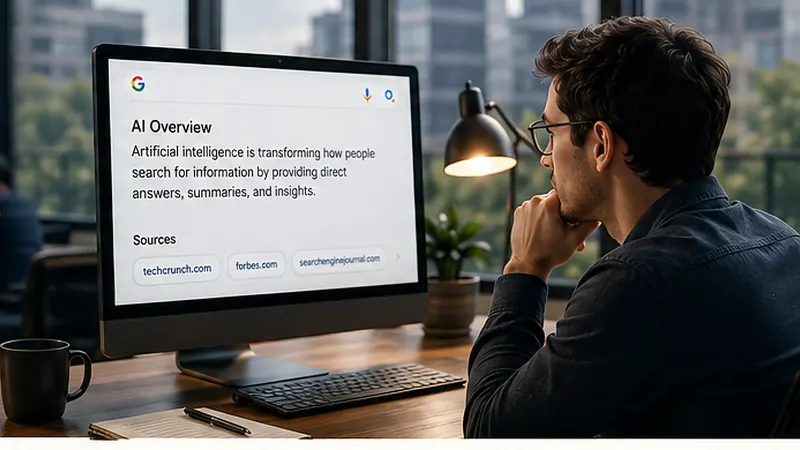
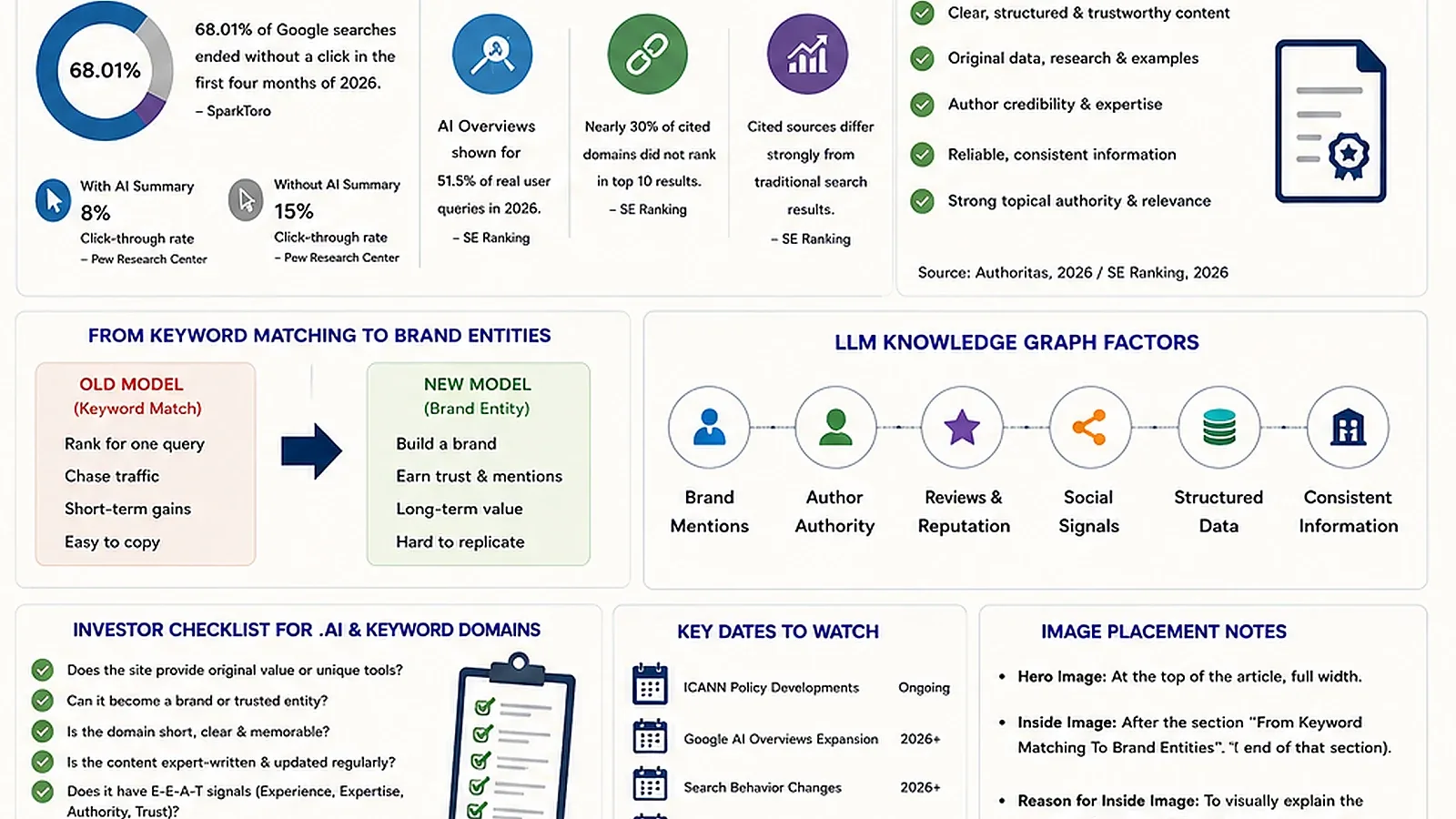
Zero click search is not a theory anymore. SparkToro reported that in the first four months of 2026, 68.01 percent of Google searches ended without a click. Pew Research Center also found that users who saw an AI summary clicked a traditional search result in 8 percent of visits, compared with 15 percent when no AI summary appeared.
For exact match informational sites, that changes the economics. A domain like a simple buying guide or definition site may still appear in search. It may even help train or inform an answer. But if the user gets the answer directly inside the search interface, the page owner may receive visibility without the visit.
This is the painful part for legacy affiliate operators. Rankings and traffic are no longer the same thing. A site can appear near the answer, influence the answer, or sit under the answer, yet still receive fewer clicks than it would have received in the older list of links environment.
Why Exact Match Alone Is Not Enough
Google’s own Search Central documentation is useful here because it says domain words are considered as one of many relevance factors, while its exact match domain system works to prevent too much credit for domains built only to match a query. That means the keyword inside the domain can still communicate relevance, but it cannot carry a weak website by itself.
AI search pushes that logic further. Generative answer engines do not simply match a typed phrase to a domain phrase. They work through entities, sources, context, topical authority, citations, public references, user intent, and confidence. A long descriptive domain may explain its topic, but it may not become a memorable entity.
This is where the old pattern breaks. The domain name may still describe the page, but the system is trying to understand who is behind the answer, why the source should be trusted, and whether the content adds anything original. A keyword string without brand identity has less room to defend itself.
From Keyword Matching To Brand Entities
The domain market should not read this as bad news only. It is a shift in what becomes valuable. Short, memorable, phonetic, brandable names are gaining strategic importance because they can become entities. A clear brand can be searched, cited, mentioned, linked, reviewed, used in videos, discussed in forums, and remembered by buyers.
A generic phrase domain may win attention for one query. A brand can win across many queries. That is the difference between renting demand from search and building demand around the name itself. In an AI search environment, brand recognition becomes a kind of insulation.
This does not mean every exact match domain loses value. A clean category name can still be powerful when it supports a real product, marketplace, data tool, calculator, directory, or community. The danger is with thin content domains that exist mainly to catch old organic search volume.
How Generative Engines Choose Sources
A 2026 study comparing Google Search, Gemini, and AI Overviews found that AI Overviews were generated for 51.5 percent of representative real user queries in its benchmark, and the cited sources differed strongly from traditional search results. Another study of Google AI Overviews found that nearly 30 percent of cited domains did not appear in the co displayed first page results.
That is a major warning for domain investors who still judge assets only by traditional ranking position. The future of exact match domains for affiliate traffic depends less on whether a domain can rank for one keyword and more on whether the site can become a source that answer systems choose to reference.
The citation game is different from the ranking game. AI systems want sources that are clear, structured, credible, and useful enough to support an answer. A site with original tables, proprietary research, expert review, comparison data, calculators, product testing, and real world examples has a better chance than a page that rewrites existing information in a slightly different order.
The LLM Knowledge Graph Problem
Large language systems are hungry for context. They do not only need pages. They need relationships. They need to know that a brand has a founder, a location, a product, a topic area, contact details, social references, reviews, consistent naming, and repeated mentions across the web.
That is why a domain should be treated as the home of an entity, not only as a keyword target. The name, logo, author profiles, about page, organization details, product pages, research pages, schema data, citations, and outside mentions should all support the same identity.
Schema.org and Google’s organization structured data guidance are not magic buttons, but they help machines parse who you are. For a domain owner, this is basic hygiene now. If an AI crawler cannot understand the site, the brand, the page type, the product, and the author, the site may be easier to ignore.
The Fall Of Weak Informational Domains
The highest risk category is the low quality informational exact match domain. These are sites built around phrases like best product, cheap service, or how to do something, with little original knowledge behind them. They once survived because keyword demand was large and search results needed many blue links.
Generative answer engines weaken that model because many informational queries can be answered instantly. A user asking for a basic definition, a short checklist, or a general comparison may never need to visit ten pages. If the answer box satisfies the first layer of intent, the old traffic funnel shrinks.
A 2026 study of AI summaries and Wikipedia found that exposure to AI Overviews reduced daily traffic to English Wikipedia articles by about 15 percent in the studied setup. Wikipedia is stronger than almost any thin affiliate domain. If even a major reference source can lose visits on answer friendly queries, weak content sites should not pretend they are protected.
Where Keyword Domains Still Work
The positive side is that keyword domains still have use when they sit on top of real utility. A domain built around a product category can perform well if it hosts inventory, original pricing data, a comparison engine, booking tools, calculators, expert reviews, or a service workflow that cannot be fully replaced by a short answer.
For example, a person may accept an AI answer for what is a business loan. But when they need to compare providers, calculate repayment, check eligibility, read current terms, and submit an application, they still need a working site. The domain that owns useful action has more value than the domain that only owns text.
This is why domain investors should separate informational value from transactional value. Informational value is easier for AI to compress. Transactional value, tool value, and community value are harder to replace.
Affiliate To Product Is The Real Pivot
The affiliate model is not gone, but the lazy version is under stress. A site that only reviews other companies products using borrowed descriptions is weak. A site that gathers original data, builds useful filters, tests products, publishes fresh findings, and helps users make a decision still has a reason to exist.
The stronger path is to turn a domain into a product surface. That can mean a software tool, a lead capture system, a marketplace, a pricing index, a niche directory, a downloadable dataset, or a member community. In this model, the domain is not waiting for traffic as charity. It is offering something the answer engine cannot fully deliver.
For domain owners, this changes valuation. A domain with no product and shrinking organic traffic may deserve a lower price. A domain with a memorable brand, direct users, email subscribers, tools, original data, and partner relationships can remain valuable even when search traffic becomes more unpredictable.
AI Agents And The Next Traffic Channel
The next stage may be agent driven discovery. Users may ask an assistant to find a vendor, book a service, compare products, check availability, or shortlist options. In that world, the domain still matters, but it may be accessed through structured data, feeds, APIs, reviews, and trusted business profiles rather than a classic search result click.
This is where domain names can capture new value. A short brandable domain that powers an application, marketplace, tool, or verified database can become a destination for agents as well as humans. The best domains will not only rank. They will integrate.
Axios reported on 25 June 2026 that brands are already trying to influence AI search visibility through generative engine optimization, with companies publishing content designed to be cited by AI systems. That trend will attract both useful work and spam. Serious domain owners should choose the useful side by building better sources, not just louder pages.
Portfolio Strategy In 2026
Portfolio owners need to become stricter. Low quality exact match domains that depend entirely on old search volume should be reviewed. If a name needs outdated SEO conditions to survive, it is not a strong asset. It is a bet on yesterday’s interface.
Capital should move toward names that can hold a brand, a tool, a data product, or a real business. Short words, strong invented names, clear category brands, and clean two word commercial names can still perform well. The key is whether the domain can be remembered, spoken, protected, and built upon.
This does not require abandoning every keyword domain. Some are excellent. But investors should ask harder questions. Can this name become a trusted source? Can it host original data? Can it support a product? Can it attract branded searches? Can it earn mentions beyond search results? If the answer is no, the domain may be less future ready than it looks.
Checklist For Digital Real Estate Investors
First, identify domains in your portfolio that rely only on informational organic traffic. These are the names most exposed to AI answer compression. If they have no brand, no tool, no community, and no direct demand, consider selling, developing, or dropping them before renewal cost builds up.
Second, reinvest in names that sound like brands. A good name should be easy to say, easy to remember, and broad enough to grow. In the AI search age, memorability matters because the user may not click ten results. They may ask for a company by name.
Third, clean up entity signals on developed domains. Use consistent brand naming, strong about pages, author information, organization schema, product schema where relevant, contact details, social profiles, and clear editorial standards. Machine readability and human trust should support each other.
Fourth, publish content that AI systems have a reason to cite. That means original surveys, pricing benchmarks, field tests, expert interviews, local data, transaction data, technical diagrams, and genuinely useful tools. Rewriting public knowledge is becoming a weaker business every month.
What This Means For Domain Values
Domain values will not collapse across the board. They will separate. Weak keyword strings may lose demand because the traffic story behind them is weaker. Strong brandable names, category defining names, short commercial names, and domains attached to useful products may become more valuable because they solve a harder problem.
That harder problem is identity. In a web where answers are summarized, brands need names people can remember outside the search page. They need domains that can appear in a citation, a podcast mention, a product demo, a social post, a conference slide, an app marketplace, and a customer conversation.
This is good for the domain industry in the long run. It moves the market away from lazy keyword speculation and toward real digital property. A better domain market is one where names are not just bought for search tricks, but for businesses that users recognize and trust.
Final Analysis
AI search is not killing domain names. It is killing weak assumptions about why domain names are valuable. The old exact match shortcut has been losing power for years, and generative answer engines are speeding up that change.
For domain investors, the message is clear. A keyword inside the domain can still help explain relevance, but it is no longer enough. The domain must carry brand strength, entity clarity, utility, trust, and a reason for users or AI systems to choose it.
For website owners, the same lesson applies. Do not build a site that can be replaced by one answer paragraph. Build something that gives users tools, proof, data, experience, and confidence. That is the kind of domain asset that survives when search becomes more conversational.
The positive view is that serious domain owners now have a chance to separate from low quality competition. Better names, better development, better data, and better brand signals can still win. The market is not closing. It is becoming more selective, and that is exactly where good digital real estate should become more important.