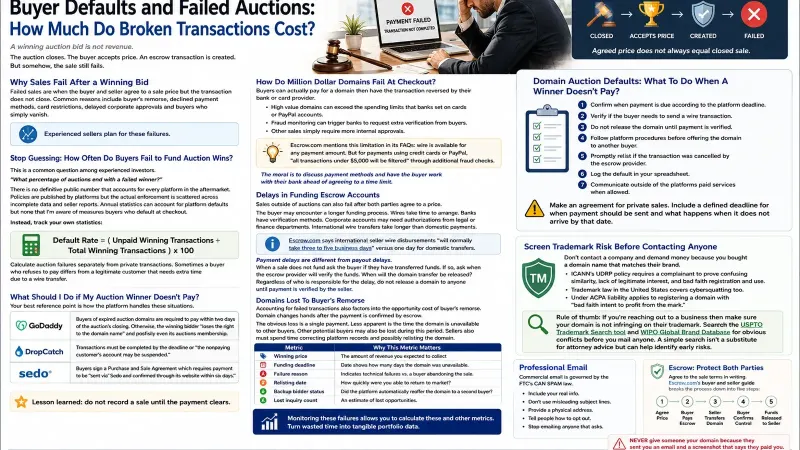
A winning auction bid is not revenue.
The auction closes. The buyer accepts price. An escrow transaction is created. But somehow, the sale still fails.
Failed sales are when the buyer and seller agree to a sale price but the transaction does not close. Common reasons include buyer’s remorse, declined payment methods, card restrictions, delayed corporate approvals and buyers who simply vanish.
Experienced sellers plan for these failures.
Stop guessing: How Often Do Buyers Fail to Fund Auction Wins?
This is a common question among experienced investors.
“What percentage of auctions end with a failed winner?”
There is no definitive public number that accounts for every platform in the aftermarket. Policies are published by platforms but the actual enforcement is scattered across incomplete data and seller reports. Annual statistics can account for platform defaults but none that I’m aware of measures buyers who default at checkout.
Instead, track your own statistics:
Default Rate = ( Unpaid Winning Transactions ÷ Total Winning Transactions ) x 100
Calculate auction failures separately from private transactions. Sometimes a buyer who refuses to pay differs from a legitimate customer that needs extra time due to a wire transfer.
“What should I do if my auction winner doesn’t pay?”
Your best reference point is how the platform handles these situations.
GoDaddy has published an FAQ explaining that buyers of expired auction domains are required to pay within two days of the auction’s closing. Otherwise, the winning bidder “loses the right to the domain name” and possibly even its auctions membership.
DropCatch has a similar rule in its Terms of Service. Transactions must be completed by the deadline or “the nonpaying customer’s account may be suspended.”
Sedo does things differently with its own contract. Buyers sign a Purchase and Sale Agreement which requires payment to be “sent via” Sedo and confirmed through its website within six days.
Lesson learned: do not record a sale until the payment clears.
How Do Million Dollar Domains Fail At Checkout?
Buyers can actually pay for a domain then have the transaction reversed by their bank or card provider.
Why does a deal sometimes fall through? High value domains exceed the spending limits that banks set on cards or PayPal accounts. Fraud monitoring can also trigger banks to request extra verification from buyers.
Other sales simply require more internal approvals. Escrow.com mentions this limitation in its FAQs: wire is available for any payment amount. But for payments using credit cards or PayPal, “all transactions under $5,000 will be filtered” through additional fraud checks.
The moral is to discuss payment methods and have the buyer work with their bank ahead of agreeing to a time limit.
Delays in Funding Escrow Accounts
Sales outside of auctions can also fail after both parties agree to a price.
The buyer may encounter a longer funding process. Wires take time to arrange. Banks have verification methods. Corporate accounts may need authorizations from legal or finance departments. International wire transfers take longer than domestic payments. Escrow.com says international seller wire disbursements “will normally take three to five business days” versus one day for domestic transfers.
Payment delays are different from payout delays.
When a sale does not fund ask the buyer if they have transferred funds. If so, ask when the escrow provider will verify the funds. When will the domain transfer be released? Regardless of who is responsible for the delay, do not release a domain to anyone until payment is verified by the seller.
Domains Lost To Buyer’s Remorse
Accounting for failed transactions also factors into the opportunity cost of buyer’s remorse.
Domain changes hands after the payment is confirmed by escrow.
The obvious loss is a single payment. Less apparent is the time the domain is unavailable to other buyers. Other potential buyers may also be lost during this period. Sellers also must spend time correcting platform records and possibly relisting the domain.
|
Metric |
Why This Metric Matters |
|
Winning price |
The amount of revenue you expected to collect |
|
Funding deadline |
Date shows how many days the domain was unavailable. |
|
Failure reason |
Indicates technical failures vs. a buyer abandoning the sale. |
|
Relisting date |
How quickly were you able to return to market? |
|
Backup bidder status |
Did the platform automatically reoffer the domain to a second buyer? |
|
Lost inquiry count |
An estimate of lost opportunities. |
Monitoring
these failures allows you to calculate these and other metrics. Turn wasted
time into tangible portfolio data.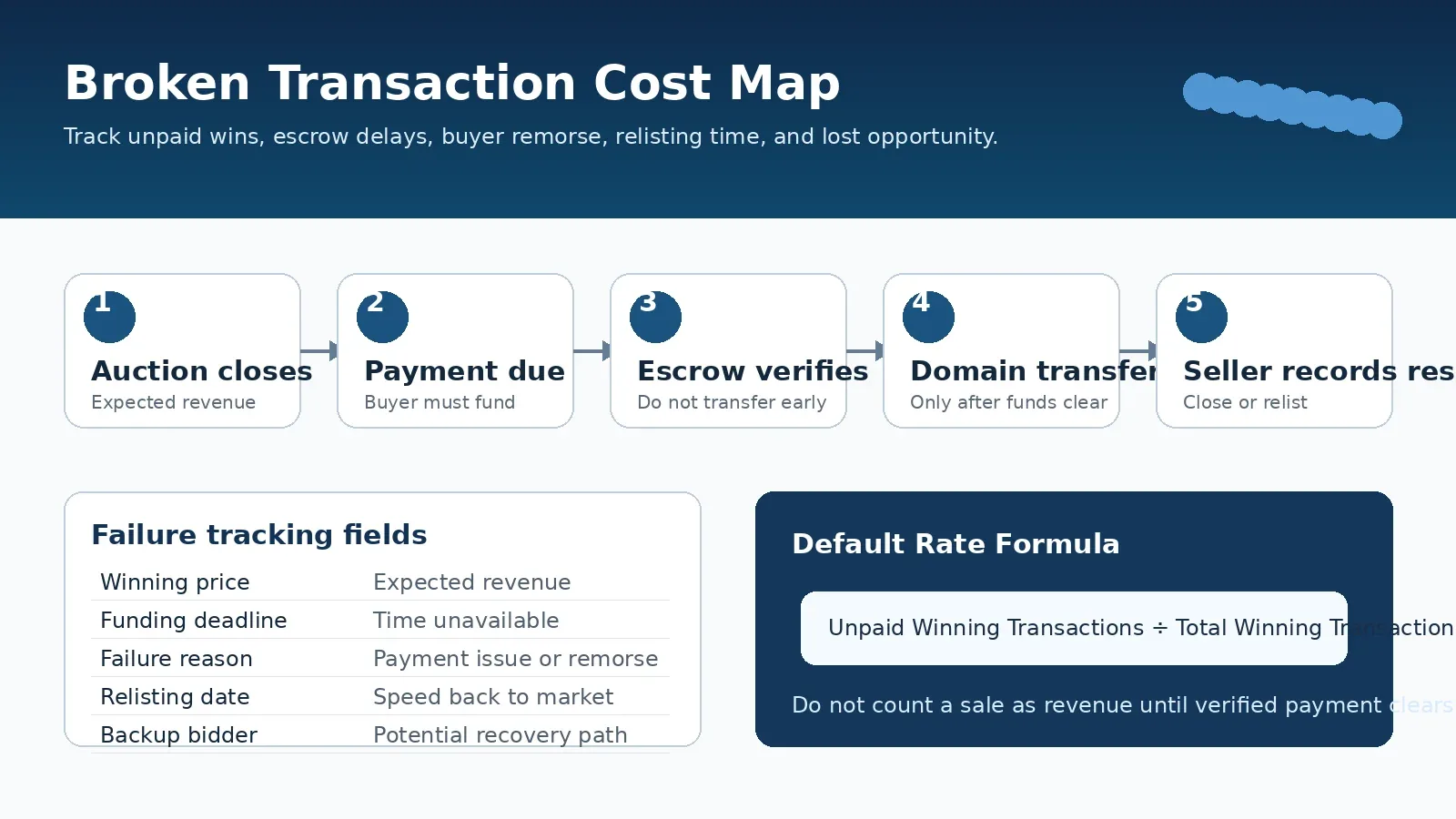
Domain Auction Defaults: What To Do When A Winner Doesn’t Pay?
1. Confirm when payment is due according to the platform deadline.
2. Verify if the buyer needs to send a wire transaction.
3. Do not release the domain until payment is verified.
4. Follow platform procedures before offering the domain to another buyer.
5. Promptly relist if the transaction was cancelled by the escrow provider.
6. Log the default in your spreadsheet.
7. Communicate outside of the platforms paid services when allowed.
Make an agreement for private sales. Include a defined deadline for when payment should be sent and what happens when it does not arrive by that date.
PREVENT FAILED TRANSACTIONS BEFORE THEY HAPPEN
The easiest way to avoid defaults is to prevent them from happening.
Choose platforms that verify user identities, publish clear rules for settling transactions and securely store buyer payments. GoDaddy explains its system for verifying bidder identities and prohibiting certain forms of auction fraud through account suspensions.
Escrow.com offers a structured process for direct sales. Buyers and sellers agree to terms. Buyers send payment. Sellers initiate transfer of the domain after funds are verified. Buyers verify they received control of the domain. Funds are released.
Three Stages of a Successful Sale:
1. Agree on price.
2. Receive verified payment.
3. Transfer domain.
Only the third stage results in revenue.
Failed transactions are unfortunately part of buying and selling domains. Reduce their effect by using platforms with defined deadlines, secure payment paths and meticulously recording every failed transaction.