
Section 1: The .ai Extension for Identity and Capital Allocation
The .ai extension is now one of the most recognizable visual brand signals in the technology marketplace. Originating as a country code top level domain assigned to Anguilla, the Government of Anguilla remains listed as the namespace manager in the official IANA delegation record for .ai. However, the commercial meaning of this domain extension has undergone a significant transformation. Owning a short .ai address has come to signal that the company’s core product is intrinsically linked to artificial intelligence, and this signal can be communicated even before a prospective customer reads the homepage, reviews a product demonstration, or engages in a conversation with the sales team.
For founders, this development has raised a critical capital allocation question: is a .ai domain worth the premium price associated with it, or is the startup paying for a fashionable suffix without any measurable business return? The answer is not universal. It depends on a variety of factors, including the asset itself, the nature of the product, the target customer, and the cost of alternatives. Investing in a premium corporate identity can help to reduce naming friction and it may improve recall, create a cleaner product story and make the company easier to discuss in investor meetings. On the other hand, it can also become an expensive distraction if the domain is purchased without a clear measurement plan.
The best approach is neither unbridled enthusiasm nor blanket skepticism. Instead, the correct path is to conduct a return on investment (ROI) audit. To understand the context of this shift, we need to look at the transition of .ai from the Anguilla ccTLD to a technology infrastructure platform. The growth of .ai is not just a hypothesis; it’s a quantifiable reality. According to a report by the International Monetary Fund (IMF) on Anguilla’s domain revenue, registrations in 2023 increased significantly from 144,000 in the previous year to 354,000 in 2023. The same IMF report stated that the total revenue from .ai registrations during 2023 reached EC$87 million (approximately US$32 million), accounting for just over 20 percent of the total government revenue of Anguilla during that year.
The infrastructure that supports the .ai domain has expanded rapidly. In January 2025, Identity Digital, a leading global domain registrar, announced that the namespace had successfully completed its migration to the company’s platform. Its .ai migration announcement also noted that the namespace had over 600,000 registered domains and was available for registration through 164 retailers around the world. By the end of 2025, another milestone had been achieved. A March 2026 analysis published by Hogan Lovells, a prominent law firm, reported that the .ai registry had surpassed one million registrations. This figure was cited from an announcement by the Government of Anguilla. The economic impact of the domain continued to grow in 2025. In an IMF Eastern Caribbean Currency Union report published in April 2026, the revenue generated from domain sales in Anguilla was estimated to have more than doubled to EC$227 million during 2025.
This is no longer a small scale naming experiment. The extension has developed a large registration base, a global distribution channel and an aftermarket with visible corporate demand. The visibility of the .ai domain is notable. For example, a significant portion of Alexa’s top ranked sites now utilize the .ai extension. This visibility is accompanied by the fact that a growing namespace can still contain weak domains. The fact that founders, investors, developers and speculators are paying attention is indicated by registration statistics. However, these statistics do not prove that every company using .ai is raising money faster or converting customers more efficiently.
Section 2: Evaluating Startup Return on Investment (ROI)
It is a distinction that matters. In the evaluation of startup domains, it’s important to view a startup domain as a component of a larger brand system. The domain interacts with the product name, the website, the email address, the investor presentation, advertising campaigns, social identity and the sales process. The extension alone cannot rescue a confusing company name. In fact, a strong name on .ai can still be valuable, because it compresses the company’s positioning. To illustrate this, let’s compare two hypothetical domains:
Domain
Structure Immediate Impression
WeDoSoftwareAI.com Descriptive but visually heavy
WeDo.ai Shorter and more focused
|
Domain Structure |
Immediate Impression |
|
WeDoSoftwareAI.com |
Descriptive but visually heavy |
|
WeDo.ai |
Shorter and more focused |
One of the questions that founders often ask is how tech extensions impact startup funding rounds. The public evidence does not support a simple answer. Investors do not fund a company because it owns a .ai domain. They do not primarily consider the extension when they examine a portfolio opportunity. Instead, investors examine the team, product, market size, distribution, revenue, technical capability, customer demand, defensibility and execution risk. A strong domain can still improve the presentation. A clean .ai address signals to the investor that the founder understands the category and has secured a credible public identity. It can reduce the impression that the company is operating on a temporary placeholder. It can also help investors remember the company after a crowded pitch day.
The reason that matters is because venture conversations are compressed. A founder may have only a few minutes to explain the product. A domain that reinforces the product category removes one small piece of friction. The value is cumulative rather than magical. The domain should be treated as a supporting asset inside the funding narrative, not as evidence that funding will occur.
Section 3: Premium Corporate Identity and the Replacement Cost Question
A startup should not evaluate the .ai domain in isolation. The more useful question is: what is the cost of operating without the stronger name? A founder may begin with a longer .com, a prefixed identity or a product name containing several words. That compromise may be acceptable during early validation. However, the cost can increase later in the company’s life cycle. A longer address may be harder to say aloud. Customers may forget one word. Email recipients may assume that the company owns a cleaner version. A future rebrand can require changes across website infrastructure, email accounts, contracts, product documentation, analytics systems, customer support and marketing materials. A premium corporate identity can reduce that future migration risk. The asset does not need to be perfect. It needs to be sufficiently strong that the company can build around it for several years without feeling trapped. A .ai address is not automatically better than .com. The choice between the two depends on the specific circumstances of the company. A .ai domain may be more capital efficient when the matching .com is unavailable or priced beyond the startup’s realistic budget. When .ai moves into an expensive aftermarket or when speculative .com alternatives start to sell for unusually high amounts, some companies find that the math favors the shorter AI domain.
The .com extension remains the broadest general purpose commercial identity. A strong one word .com can work across sectors, regions and customer groups. It does not require the buyer to understand a technology trend. It is familiar inside email addresses, printed materials and spoken recommendations. A .ai domain offers a different advantage. It communicates specialization. A buyer seeing a concise .ai address can reasonably infer that the company operates in artificial intelligence, automation, agents, data infrastructure or related software. This creates an efficient positioning shortcut when the company is genuinely AI focused. The comparison is not binary:
Situation
Likely Domain Preference
Broad consumer company serving several categories Strong .com
AI native developer platform Short .ai may be highly effective
Enterprise software company using AI as one feature .com may offer more
flexibility
Early stage AI product with a weak multi word .com alternative Clean .ai may
provide better naming efficiency
Company with sufficient budget and long term ambitions Consider acquiring both
|
Situation |
Likely Domain Preference |
|
Broad consumer company serving several categories |
Strong .com |
|
AI native developer platform |
Short .ai may be highly effective |
|
Enterprise software company using AI as one feature |
.com may offer more flexibility |
|
Early stage AI product with a weak multi word .com alternative |
Clean .ai may provide better naming efficiency |
|
Company with sufficient budget and long term ambitions |
Consider acquiring both |
The secondary market provides useful evidence of buyer conviction. Hogan Lovells reported recent sales including law.ai for $350,000, cloud.ai for $600,000 and you.ai for $700,000. These transactions are not typical registration costs. They represent premium retail outcomes for names with unusual scarcity, clarity or commercial flexibility. The aftermarket also contains lower priced assets and many speculative registrations that may never find a buyer. That is why .ai domain valuation shifts should be analyzed carefully. A short category word is not equivalent to a long phrase. A clean technical term is not equivalent to an awkward combination of buzzwords. A startup buying one operating domain has a different financial model from an investor renewing hundreds of speculative names.
Use NameBio to research reported comparable sales by extension, keyword, date and venue. Use marketplaces carefully as well. Atom, formerly known as Squadhelp, describes itself as a premium marketplace, registrar and brand platform. Its marketplace includes dedicated collections for .ai domains, short AI domains, one word AI domains and other modern extensions. Marketplace inventory can help founders understand the current asking price landscape. Completed sales matter more than asking prices.
The Premium Renewal Multiplier
The .ai extension carries a higher operating cost than many ordinary domains. The Name.com page for .ai domains states that .ai names require a minimum two year registration. The wholesale cost also increased in 2026. Domain Name Wire reported that the .ai wholesale price increased on March 5, 2026. The standard two year wholesale amount rose from $140 to $160 before registrar markup. Retail prices vary by registrar. A founder should check the live renewal price before buying. The acquisition cost matters, but the carrying cost matters too. Consider a basic scenario:
Item Standard
.ai Domain
Minimum registration term 2 years
Reported wholesale amount for standard 2 year term $160
Registrar markup Varies
Premium aftermarket acquisition price Varies widely
Renewal requirement Ongoing
|
Item |
Standard .ai Domain |
|
Minimum registration term |
2 years |
|
Reported wholesale amount for standard 2 year term |
$160 |
|
Registrar markup |
Varies |
|
Premium aftermarket acquisition price |
Varies widely |
|
Renewal requirement |
Ongoing |
Calculating the CAC Delta
Customer acquisition cost should be measured, not assumed. A shorter .ai domain may reduce visual clutter in advertisements. It may improve recall after a podcast mention. It may be easier to type on mobile. It may also clarify the product category for technical buyers. These are sensible hypotheses. They are not universal facts. The correct method is to test them. Run a controlled paid campaign with two versions of the creative. Keep the offer, audience, landing page content, budget and timing as similar as possible. Change only the visible domain or brand treatment where the campaign structure allows it.
Metric Why It
Matters
Click through rate Shows whether the domain treatment attracts more visits
Cost per click Measures advertising efficiency
Landing page conversion rate Shows whether visitors complete the target action
Cost per qualified lead Measures lead quality, not only traffic
Direct traffic Shows whether people return by typing the domain
Branded search volume Shows whether recall is increasing
Email reply rate Helps measure trust during sales outreach
Demo completion rate Measures deeper product interest
Customer acquisition cost Shows the final commercial effect
|
Metric |
Why It Matters |
|
Click through rate |
Shows whether the domain treatment attracts more visits |
|
Cost per click |
Measures advertising efficiency |
|
Landing page conversion rate |
Shows whether visitors complete the target action |
|
Cost per qualified lead |
Measures lead quality, not only traffic |
|
Direct traffic |
Shows whether people return by typing the domain |
|
Branded search volume |
Shows whether recall is increasing |
|
Email reply rate |
Helps measure trust during sales outreach |
|
Demo completion rate |
Measures deeper product interest |
|
Customer acquisition cost |
Shows the final commercial effect |
Real World Conversion Rates for .ai Websites
There is no reliable public benchmark showing one average conversion rate for .ai websites. A cybersecurity platform, a consumer chatbot, a developer API and an enterprise analytics product operate in different markets. Their conversion funnels cannot be compared through the domain extension alone. A company should build its own baseline. Record conversion performance before and after a domain upgrade where possible. Separate branded traffic from non branded traffic. Compare direct visits, paid traffic, organic traffic, partner referrals and outbound campaigns. Track the migration date carefully. A domain change can affect analytics, attribution, email, redirects and search visibility. A rushed migration can damage the data needed to prove the investment case. The correct question is not: “What is the conversion rate for .ai websites?” The correct question is: “Did this specific domain improve the acquisition economics of this specific company?”
Search Performance Requires Caution
A domain should
not be purchased on the assumption that the extension will create an automatic
search ranking advantage. Google documents an exact match domain system
designed to prevent content from receiving excessive credit merely because the
domain matches a search query. The same principle applies to the suffix. A .ai
ending can strengthen branding for human visitors. It does not replace useful
content, technical performance, relevant pages, backlinks and product
credibility. A founder should separate brand ROI from SEO mythology.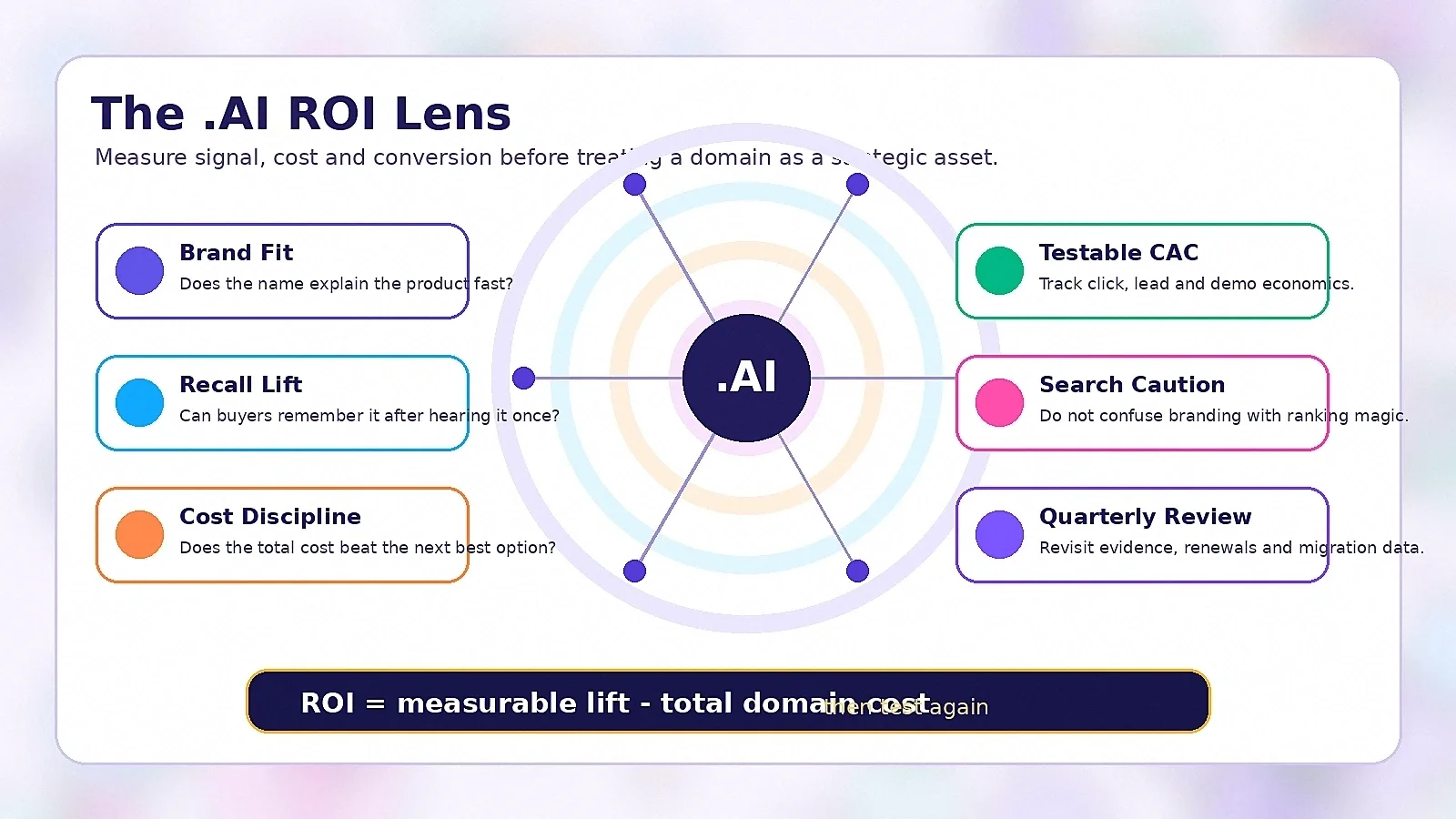
A Practical Tech Startup Domain ROI Formula
Start with total domain cost:
Total Domain Cost = Acquisition Price + Renewal Costs + Transfer Costs + Legal Review + Migration Cost
Then calculate the measurable return:
Measured Domain Return = Incremental Gross Profit + Avoided Migration Cost + Avoided Brand Confusion Cost
Finally:
Domain ROI = Measured Domain Return minus Total Domain Cost divided by Total Domain Cost multiplied by 100
The hardest variable is incremental gross profit. The founder must isolate what changed after the domain purchase. A domain upgrade may happen at the same time as a funding round, redesign, product launch, pricing change or sales expansion. Use scenario planning when causality is unclear. Scenario Measured Benefit Confidence Level Lower estimate Only verified direct revenue improvement High Base estimate Verified revenue plus reasonable migration savings Moderate Strategic estimate Includes longer term brand value Lower
Do not present the strategic estimate as audited financial performance.
|
Scenario |
Measured Benefit |
Confidence Level |
|
Lower estimate |
Only verified direct revenue improvement |
High |
|
Base estimate |
Verified revenue plus reasonable migration savings |
Moderate |
|
Strategic estimate |
Includes longer term brand value |
Lower |
Step by Step .ai Corporate ROI Audit Protocol
Step 1: Define the Naming Problem
Write down the current domain and the proposed .ai upgrade. Identify the specific friction: length, spelling ambiguity, weak extension, confusing prefix, product mismatch or customer leakage.
Step 2: Calculate the Full Cost
Include purchase price, two year registration structure, renewal price, migration work, email changes, legal review, redirect setup and internal staff time. Do not budget only for the purchase.
Step 3: Research Comparable Sales
Use NameBio and reputable sales reporting to compare similar words, lengths, extensions and buyer types. Separate asking prices from completed sales.
Step 4: Test Customer Response
Run controlled paid campaigns, direct recall tests and sales outreach comparisons where appropriate. Measure click through rate, qualified leads, direct visits, branded search and customer acquisition cost.
Step 5: Review Search and Migration Data
Use Search Console, analytics, server logs and conversion tracking. Monitor redirects, indexing, traffic sources and branded queries before and after the change.
Step 6: Check Trademark Alignment
Search the WIPO Global Brand Database and relevant national trademark systems before committing to a premium name. A database search is an initial screen, not a replacement for professional legal advice.
Step 7: Revisit the Decision Quarterly
Compare the domain’s carrying cost with the measured benefit. A domain can be strategically useful even when the precise revenue lift is difficult to isolate. The company should still record the evidence honestly.
The Real Economic Value of .ai
The .ai ecosystem has real momentum. It crossed one million registrations by the end of 2025. It has generated substantial public revenue for Anguilla. It has produced visible premium aftermarket sales. It has become a recognizable technology identity for AI focused companies. That does not make every .ai domain a profitable asset. The highest tech startup domain ROI appears when a concise domain solves a real naming problem, matches the product category, remains affordable to hold and supports measurable improvements across acquisition, recall and brand clarity. A premium domain is not a shortcut. It is infrastructure. The investment works when the company measures it with the same discipline applied to any other strategic asset.