Owning one domain feels a lot different than owning ten.
And owning ten feels nothing like fifty.
But the jump from fifty to a hundred domains? That’ where things feel different.
Kinda like you’ re doing something right.
Kinda like you’ re building something.
You stop thinking of it like a hobby. You start thinking of it more like a portfolio.
So if you’ve ever wondered how some investors quietly sit on portfolios with hundreds of domains under their belt while others struggle to keep up with ten. The secret lies in one simple word:
They built it.
At first, every investor starts out the same way.
You buy that one domain you think could be big. It’ may be keyword based. Maybe it’s brandable. Maybe you just kinda woke up and thought about it and it stuck.
You buy it. You hold it. You glance at it every once in a while hoping that’ll convince someone to buy it from you.
Then you buy another one.
And another.
And after a few, it feels fun. But kind of all over the place.
Because at this point, you’ re still exploring. You aren’t really building quite yet.
Phase 1: 1 – 10 Domains - Exploration Phase
Once you start getting into the groove of actually looking for domains instead of randomly buying them, you slowly transition into building your portfolio.
Transitioning from exploration to building doesn’ take buying more domains. It happens when you know why you’ re buying domains.
Because the truth is, once you get past the 20 or 30 domain mark:
Patterns will show.
And you’ ll realize that some names feel harder than others.
So how do you buy smarter?
How do you fine-tune your approach so you start buying domains you like, instead of domains you kind of just like?
Well first, let’ simplify this:
You don’t need 100 great domains to have a great portfolio.
You need a variety of great domains spread throughout different niches.
Let’ break this down.
______________________________________
Phase 2: 10 – 30 Domains
The First 10 Domains: Exploration Phase
Your first 10 domains shouldn’ all feel like home runs.
They should teach you what does.
So you’ ll:
Buy names you’ll regret
Buy names you’ll miss
Wonder why you bought some
It’s part of the process.
You’ re building domain awareness, not your bank account.
Remember how I said to “fine-tune your approach?”
At this stage, that tuning looks something like this:
What feels like a good domain to you?
Then slowly refine that answer.
______________________________________
Phase 3: 30 – 100 Domains
10 To 30 Domains: Pattern Phase
Buy your 10th domain. Analyze your 20th domain.
At some point, you will start to see patterns.
You will understand:
• What names feel strong.
• What niches interest you.
• What kind of domains gravitate to you.
More importantly, you will realize that not every domain needs to feel amazing. But it does need to make sense.
Which is why this is a great stage to pause.
Buy a few more. Sure. But start really looking at your buys.
Because this is the phase where you start shaping your style.
______________________________________
30 To 100 Domains: Portfolio Phase
Once you hit this phase, you’ re no longer feeling around in the dark. You know what you’ re doing. Kinda.
Right about now is where strategy starts creeping in.
You still may not have a defined strategy. But you start to understand that you want one.
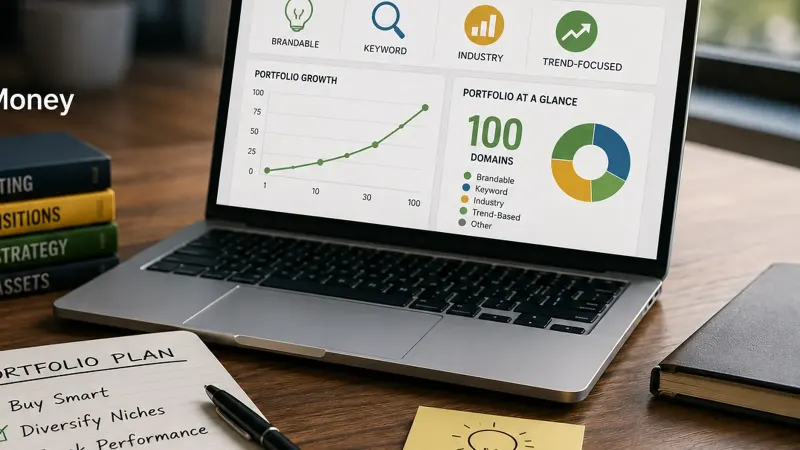
Building a portfolio usually means creating a balance.
Not a random balance. An intentional one.
You may want some:
Brandable domains
Keyword domains
Industry based domains
Domains that align with current trends
And that’ okay.
Create a
balance because every domain moves differently.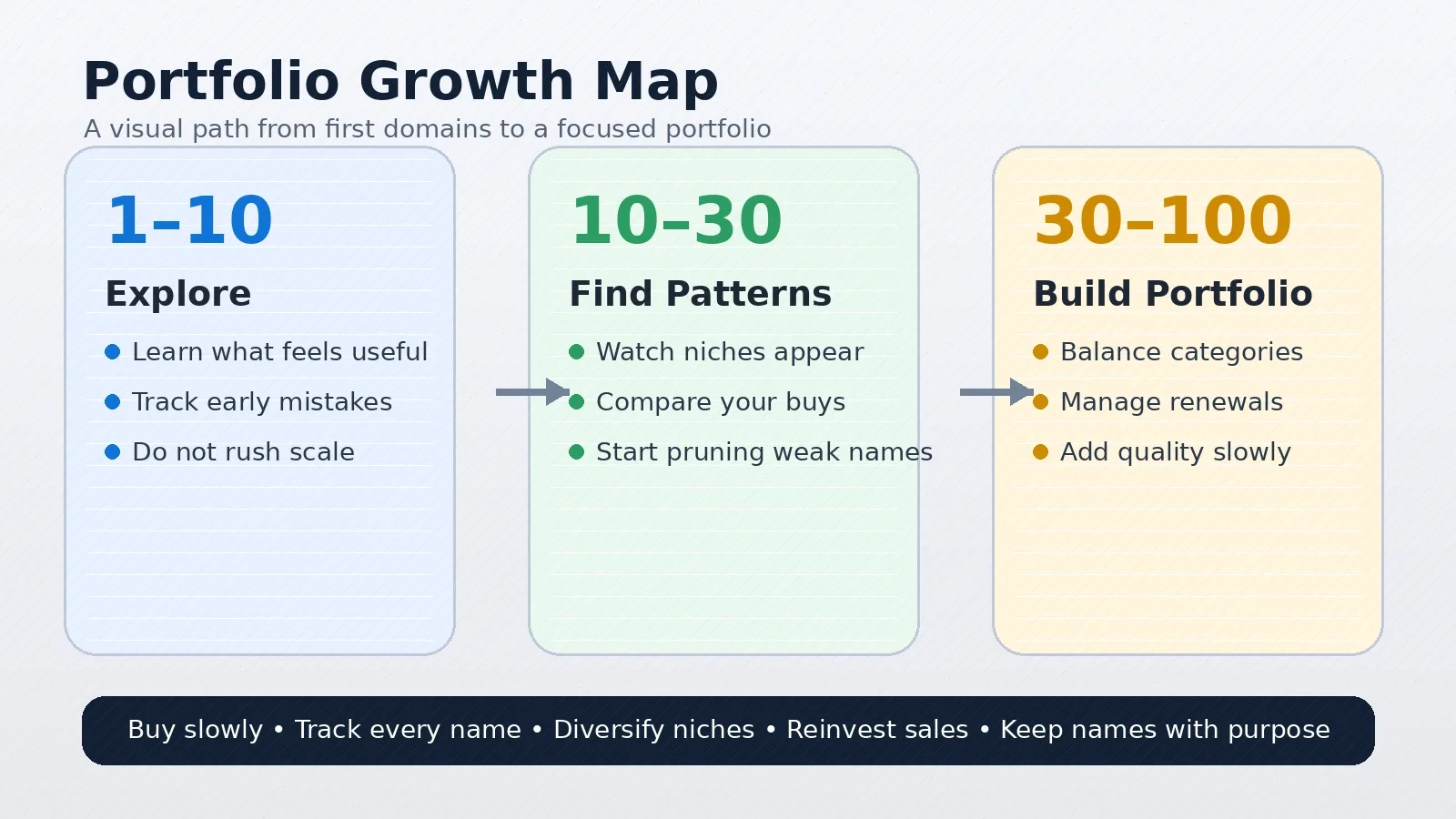
Some domains sell right away. Some take years. And some gain value as the trend around them grows.
Diversify Your Portfolio
Here’ another way to look at building your portfolio.
If all of your domains fit into one niche. One area of interest. Your success is dependent on that one area remaining popular and relevant.
But what if you owned domains that could spread across:
Artificial Intelligence
Finance
Health
SaaS
Service-based businesses
You create more chance for your domains to sell because you’ ve diversify where they live.
You don’ necessarily have to buy all of these domains. But when building your portfolio, don’t limit yourself to one type of name.
What’ s The Thought Process Behind Buying For Your Portfolio?
Before you buy a domain name as part of your portfolio, ask yourself these questions:
• Does this domain feel usable?
• Who would want to buy this?
• How does this fit with what I already own?
Notice I said how it fits with WHAT YOU ALREADY OWN versus how it “competes.”
Why?
Because as your portfolio grows, you’ ll notice your portfolio start to make sense as a whole. Rather than as individual names.
Scale Your Portfolio the Right Way
When people first start buying multiple domains again, they tend to rush.
Suddenly you’ ve gone from owning 10 domains to wanting to own 100.
And what happens?
You feel overwhelmed by renewals.
You start buying low quality names just to hit that number.
It becomes difficult to track.
Buy slowly.
Buy in layers.
Allow your portfolio to grow instead of forcing it.
Tracking your portfolio can be as simple or as complex as you make it.
All I’ m going to show you is enough to get you started AND help you stay organized.
When you buy a domain, track:
• The domain name
• What you paid for it
• Date of purchase
• Category (ideally)
• Notes (why you bought it)
This takes seconds for each domain. But when you start buying in bulk. It’ helps you identify the type of domains you gravitate toward.
Don’t Buy Your First 100 Domains All At Once
Let’ pretend you currently own 50 domains.
50 isn’ that small. But you’ ve also not started building your portfolio quite yet.
Looking at your dashboard you realize half of your portfolio is just eh. They’ re okay names. But they’ re not hitting anything.
You have 50. Why not buy 100?
Sure. You can buy 100.
But you’ d be much better off buying 60-70.
Why?
Because you would’ reanalyzing your current portfolio and identifying where you can improve.
Maybe you realize you should own more blog name domains. You nonexistent. You decide to focus on buying blog names that feel strong.
Buy themes that strengthen what you already own. That’ how you scale your portfolio.
Selling a Domain? Reinvest Back into Your Portfolio
The funny thing about selling a domain is that once you’ ve sold one.
Everything you buy after that just seems to make more sense.
You’ ve mentally priced out a domain.
You’ ve seen what buyers are interested in.
You gain confidence.
So many new investors get excited when they sell their first domain. They immediately take that profit and run.
Take that money and put it back into your portfolio. Focus on buying better. More refined domains.
Let’ Build Something
As you start building your portfolio, you won’t always keep every domain you buy.
And that’ perfectly fine.
If you buy 10 domains. You might keep 8.
You might sell 1 tomorrow for whatever reason.
You might realize 1 was a poor decision and let it go.
That doesn’t mean you failed.
That means you just optimized your portfolio.
Focus On Adding One Good Domain At A Time
Portfolio building isn’t about adding 100 domains to your portfolio.
It’ about adding 1 good domain at a time.
Buy one domain a week that you really like.
Buy domains that fit into your portfolio that you know you’ ll hold long term.
Buy domains that excite you!
You slowly add to your portfolio instead of trying to build it all at once.
Here’ a recent example of someone who built a portfolio.
This investor began with 5 domains.
Yep. Just five.
They slowly built their portfolio over time. And didn’ rush anything. Because of that. They were able to grow to 80 awesome domains.
They succeeded because of their 5-10 BEST domains.
Not all 80.
I could give you examples of investors that began with 20 domains and sky rocketed to over 200. But they all have one thing in common.
They were curated by grabbing a handful of awesome domains at a time.
Once You Know You “Got It”
You’ won’t look at a domain and wonder if you should buy it.
You’ ll immediately ask yourself:
“Does this domain fit the theme of my portfolio?
Should I keep this domain or let it go?”
And that, right there is the difference between someone who collects domains and someone who builds a portfolio.
Portfolio Growth Summary Table
|
Stage |
Approx. Portfolio Size |
Main Goal |
Risk to Avoid |
|
Exploration |
1–10 domains |
Learn what feels useful |
Buying only by emotion |
|
Pattern |
10–30 domains |
Notice niches and naming style |
Ignoring renewals |
|
Portfolio |
30–100 domains |
Diversify and track quality |
Scaling too fast |