There’s a moment every domain investor comes across. You stare at your computer screen, firing off domain ideas left and right. Then, somewhere between “awesomeidea.io” and “bestidea.web,” you stop and realize you have no clue what you’re doing.
Am I picking names with strategy, or am I just feeling them out?
This is a common crossroad for beginners and even experienced investors. Many people start exclusively with feelings. After all, a name either sounds cool or it doesn’’t. That’’s why startups are named SpaceX and not IWillTryToLaunchStuffIntoSpace LLC. But then you start registering domains left and right based solely on these feelings and nothing happens. Dead end after dead end.
Sure, sometimes you’ ll get lucky and stumble onto a winner. But if you can break into that VIP club every time by guessing, more power to you. For the rest of us mortals, it’’s time for a strategy that actually works.
Now hear me out, I know that sounds fancy and technical. But it’’s really not. Keyword research, at its core, is data you’ re probably already observing. It’ s simply applied in a more focused manner.
Keyword research is looking at what people care about, what businesses are built on, and where interest is being generated. You aren’’t guessing what could work. You start to recognize what does.
Let’ s dive into a quick example.
Let’ s say someone buys BrightFutureZone.com or NextGenIdeasHub.com. Neat names, sure. But they don’’t actually mean anything to you or anybody else. Now let’ s look at someone who types “online loans” into a keyword tool and sees tens of thousands of searches each month.
Online loans is suddenly less of a phrase and more of a demand. Businesses are fighting over it, advertising on Google for it, and building entire companies around it.
Searching for keyword ideas isn’’t guesswork, it’ s data.
As you start recognizing terms with actual search volume you will begin to understand market demand. Once you start looking for keywords you’ ll see them everywhere.
But now comes the tricky part. Turning them into domains.
Understanding Intent vs Information
The first thing you should know is that not all keywords are created equal. Some are strictly informational, while others have commercial intent behind them. Saying someone searched “what is digital marketing” holds very little value over someone searching “digital marketing services pricing.”
Searches with clear intent to buy or hire tend to create better value in domain names because you can tie them to existing businesses.
Informational queries are still important, they just won’ t typically translate to $10k+ domain sales right away.
Once you start exploring keyword tools, it’ s easy to feel consumed by data. Don’ t sweat it, you don’ t need to understand every little thing. There’ s just 3 pieces of information you should get familiar with.
• The relevance of the keyword to your niche
Quick Reader Table: Keyword Research Filter
|
Signal |
What it shows |
How it helps domain selection |
|
Search volume |
People are already looking for the topic |
Shows whether the idea has visible demand |
|
Relevance |
The keyword fits a business, niche, or buyer type |
Helps avoid random names with no clear buyer |
|
Commercial intent |
Searchers may buy, hire, compare, or subscribe |
Points toward domains businesses may pay for |
If you can find keywords with these 3 qualifiers, you’ re ahead of 90% of beginners. For arguments sake, let’ s look at a keyword tool and type in “AI tools.”
Obviously we see decent search volume, but we also see related keywords like “AI writing tools,” “AI video generator,” and “AI marketing software.” Instead of randomly thinking of names, you now have a place to start.
Pretty neat when you think about it.
Keyword tools don’ t magically give you domain names, but they guide your
thinking toward what already works.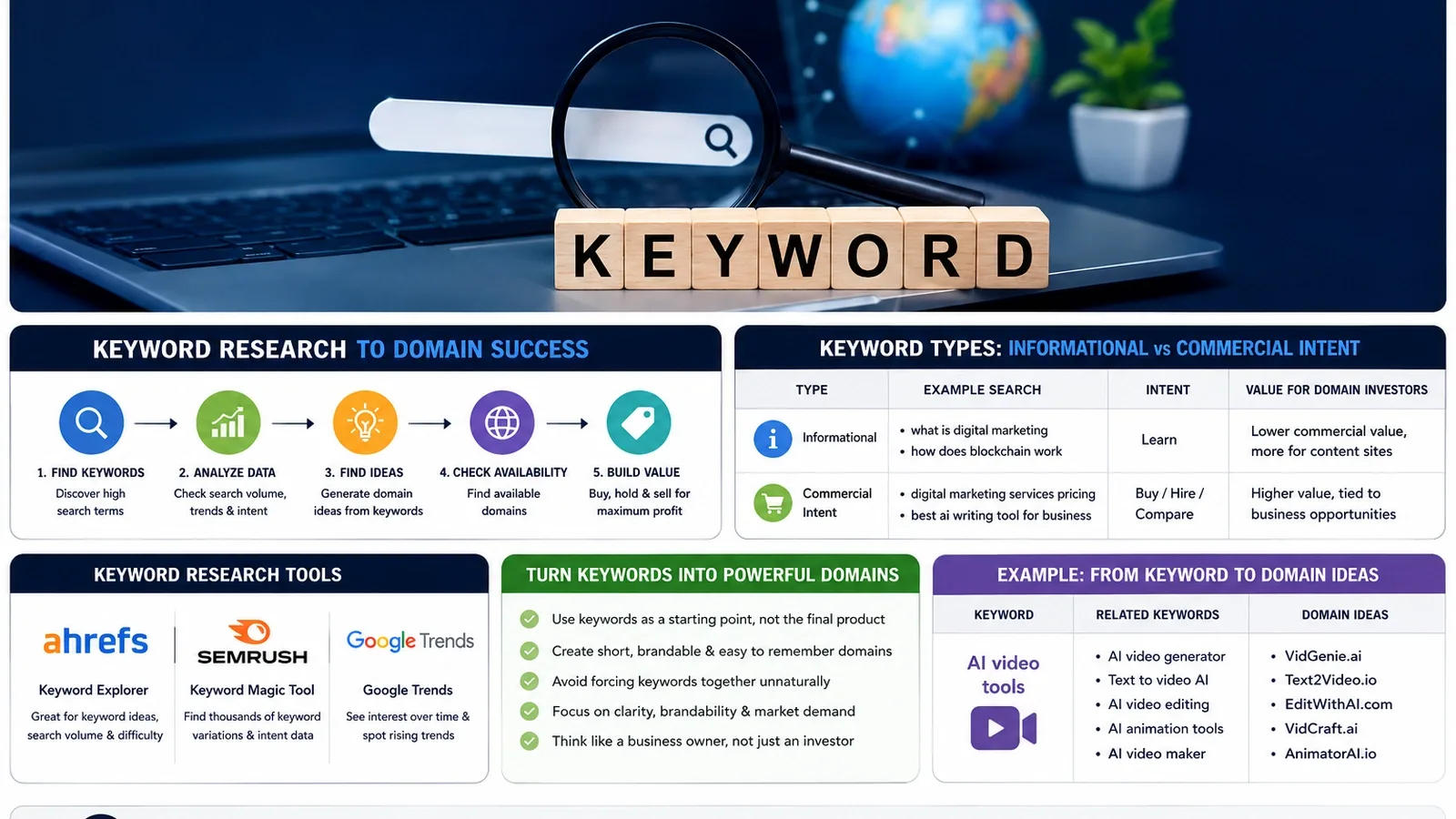
But don’ t try to force keywords into domains
Here’ s where many beginners slip up. Seeing a keyword like “AI writing tools” they think they need to turn it into a domain name.. immediately.
That logic tends to create something like BestAITools.com.
Keyword domains can be successful (Link), but these exact match-names are difficult to brand. It’ s very hard to picture a company advertising with that URL.
Instead, use keywords as a starting point. Look for small variations that still feel natural. Instead of AI writing tools, maybe Brainstorms.io, Write clusion.io, or even Craft(&)Write.com.
Keyword suggest a direction, but your domain still needs to sound like a domain.
While not exactly a keyword tool, Google Trends is something you should use in tandem. It doesn’ t give you exact numbers but can reveal interest levels over time.
Searching for popular terms like AI tools, remote jobs, or crypto wallet can open your eyes to businesses trends.
Look how interest in “AI tools” has stayed fairly consistent over the past few years. If trends show steady interest or growth, you know you’ re not jumping in too late. There will always be trends that are too late. But you can avoid MANY by using Trends.
Nobody likes to be late to the party.
Instead of researching domains after everyone else, use tools to identify potential early.
There you have it. One simple methodology you can use to start finding actionable domain ideas.
• Find a broad term with strong search volume
• Explore related keywords
• Look for variations that feel natural
• Rinse & repeat
If you study keyword tools enough you will start to recognize patterns. You’ ll notice certain industries are stronger than others. You will begin to see terms with higher intent than normal. Before long, you won’ t even need tools to recognize keyword strength.
Let’ s do one more quick example.
You notice a lot of people have been searching for “AI video tools.” Digging deeper, you find related searches like “video generator ai” and “automated video editing software.” Trends show an upward trajectory and you know this space is only going to grow.
But instead of waiting for the gold rush, you begin ideating domains now.
Some cool ideas will be AI Video Forge , Video Brainstorm.ai , and Film (&)More.io. These wouldn’ t have randomly popped into my head if I wasn’ t searching for related terms first.
Searching for terms vs recognizing terms.
This doesn’ t mean you won’ t ever register a bad domain again. Heck, you might even register MORE bad domains at first.
Keyword research isn’ t a means to prevent failure. It’ s a tool to tilt the odds in your favor.
It trains you to recognize potential instead of asking “does this name sound cool?” You ask yourself “why would someone search for this?” and “what kind of business would offer this?”
Keyword research won’ t solve all your problems, but it will spark a new way of thinking.
A way of thinking that doesn’ t randomly search for domains, it recognizes them.