

WIPO’s Uniform Domain Name Dispute Resolution Policy hits version 25 today. To celebrate, WIPO has published its latest set of annual statistics showing how many cases they handled in the calendar year 20twenty-five.
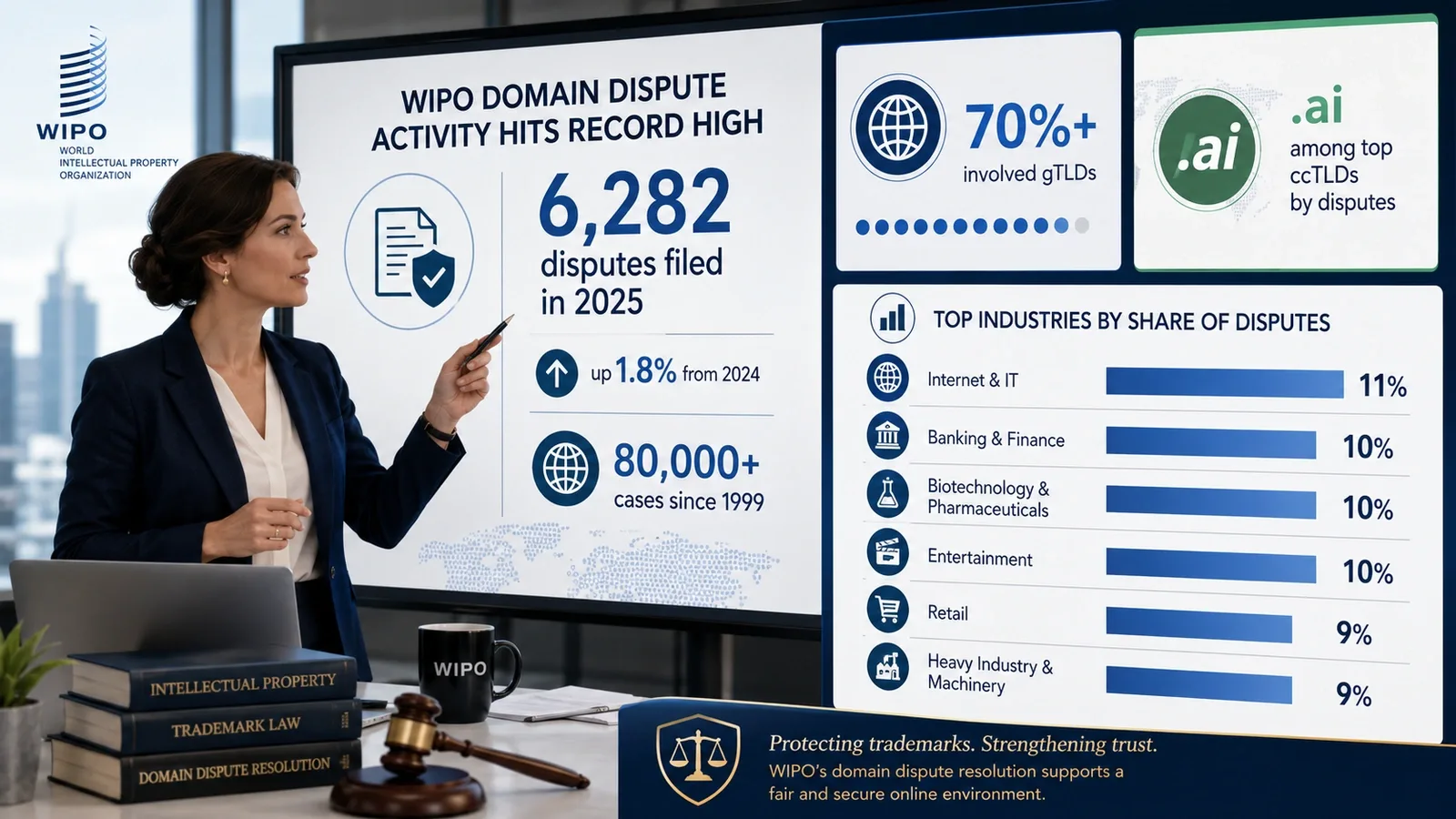
The numbers continue upward. WIPO reports that it handled 6,282 domain name disputes filed by trademark owners in calendar year 20twenty-five. That makes 20twenty-five the busiest year since WIPO began offering the service in 1999. Compared to the prior year, filings went up by 1.8 percent.
Taken by themselves, those numbers do not suggest a breaking wave. Instead, what trademark owners are seeing is a consistent upward creep in pressure as more businesses, products, artists, and scammers look to establish a presence online.
WIPO Trademark Disputes: The UDRP As A Solution
When planes crash, investigators try to find the first small problem that was ignored. In the trademark world, cybersquatters are the first problem. Someone files a domain name that is identical or confusingly similar to a trademark, then plans to sell the domain back to the brand owner or use it in some way that hurts the brand.
Established in 1999, the Uniform Domain Name Dispute Resolution Policy (the UDRP) was created as a practical solution short of court. It allows a trademark owner to initiate a proceeding seeking transfer or cancellation of an infringing domain. Although this still requires a trademark owner to prove three elements of the policy, it is far quicker than starting a lawsuit.
WIPO receives dispute filings involving every gTLD and ccTLD.
WIPO provides its domain name dispute resolution service to all gTLDs and ccTLDs. Since launching the service in 1999, WIPO has now administered more than 80,000 domain name cases. Just over 70 percent of these involved generic top level domains. Nearly 10 percent involved country code extensions.
WIPO is usually only one option for dispute resolution. This volume explains why the UDRP remains the starting point for most considerations of domain name disputes involving trademarks.
The problem starts with a website address. For brands, the losses can extend into money paid for unused services, damage to reputation, and targeted attacks on customer safety.
WIPO Marks 25 Years With Anniversary Conference
WIPO marked the quarter century anniversary of the UDRP with a virtual conference. As WIPO tells it, participants from around the world attended four panel sessions and discussed the history of the UDRP, successes and challenges, why dispute filings have been increasing over time, what impact new gTLD introductions have had on UDRP filings, and more.
Brand owners will want to pay close attention to the last point because ICANN is planning several new gTLD extensions for 2026. Every one of those provides new real estate for legitimate businesses. Unfortunately, each extension also provides a new place for cybersquatters to register trademarks that someone else already owns.
Objections are a type of preemptive UDRP. WIPO has been selected to serve as exclusive provider of two objection procedures during ICANN’s 20twenty-six new gTLD round.
WIPO will exclusively administer two objection procedures, Legal Rights Objections and String Confusion Objections, as part of ICANN’s upcoming 20twenty-sixth New gTLD Program. Both mechanisms allow parties to challenge a proposed new gTLD before it is delegated. Trademark holders, brand owners, and cybersquatters will need to pay attention because these two procedures are technically separate from a regular UDRP case. Taken together, the growth in disputes shows that companies are protecting more than their core website address.
Who Is Filing Disputes?
Curious readers will note that there is no singular industry targeted by cybersquatters in calendar year 20twenty-five. WIPO includes a handy breakdown showing which industries filed the most disputes across their service. Internet and information technology took the top spot by accounting for 11 percent of all cases filed. Banking and finance, biotechnology and pharmaceuticals, and entertainment were next at 10 percent each.
Retail and heavy industry and machinery each checked in at nine percent, with food, beverages and restaurant and fashion closing out the top ten at eight percent each. These industries sell goods and services online, but they also send invoices and corporate communications by email.
WIPO used a Swiss crime film to highlight one decision where parties argued over an “Austria spelled backwards” slogan. The takeaway for many brands may be found in an unrelated case where WIPO notes that a disputed domain was used in a fraud attempt valued at USD 798,682.81.
AI Begins To Play Role In Domain Name Disputes
Domain names featuring artificial intelligence are now part of the UDRP picture. WIPO counts .ai among the top 10 country-code extensions with the most dispute filings in 20twenty-five. That does not mean .ai had the largest growth rate compared to all other extensions. However, it does confirm that AI domain names are becoming important enough to join .co, .au, .cn, and .io in WIPO’s annual enforcement report.
Trademark owners will also want to read decisions involving the .ai extension for a novel legal argument. In one case highlighted by WIPO, the complainant relied on the .ai extension as part of its trademark claim. When evaluating abusive registration, the panel examined whether AIUS Healthcare was selected for the dictionary meaning of the words aiushealthcare or as a reference to and targeting of A.I. Healthcare LLC.
AI (artificial intelligence) domain names are coming. They will appear in disputes as every company experiments with how this technology can enhance their marketing. One recent decision suggests registrants should be prepared to explain why they selected a specific dictionary word and extension. Claimants should be prepared to show how a trademark is likely to be found within that dictionary word plus the applied-for extension.
WIPO also recently highlighted a decision where the panel applied “greater scrutiny” to a pleading likely prepared using AI. Everyone should read that sentence twice. The inclusion of AI tools does not automatically make a complaint or response more persuasive. Factual evidence will still need to be verified. Arguments will still need to be legally sound.
Don’t Reverse Hijack A Domain Name
Brand owners have rights, but those rights are not unlimited. Filing a UDRP complaint against someone else’s domain just because you would like that domain is known as reverse domain name hijacking. When assessing complaints WIPO panels look for evidence that the complaint was filed in bad faith to deprive a registrant of their domain.
Reverse Domain Name Hijacking occurs when a complainant lodges a UDRP complaint in bad faith. Simplified too much, brand owners should always conduct due diligence before filing a UDRP case. This means reviewing when the domain was registered, any apparent use by the registrant, and checking whether elements of the policy can be proven.
Company names, stock symbols, product names, common misspellings, new campaigns, and high profile executives may all be targeted. Monitor registrations of those domains before they can be used as online traps. Keep evidence of suspicious registrations in a file as soon as they are discovered. Those screenshots often speak louder than email arguments made after the damage is done.
Preparing For 2026: Consider A Trademark Clearinghouse
Key brand elements. Premium products. Company misspellings. Product launch names. These are a few examples of the keywords that should be on every brand owner’s monitoring list.
Trademark Clearinghouse (TMCH) services are not required by every business. In some cases registering with the TMCH may actually increase the risk of targeted cybercrime. For brand owners who do register their most valuable trademarks with the Trademark Clearinghouse, there are potential benefits. These can include access to Trademark Sunrise services and Trademark Claims notifications when a matching domain name is registered during the “Claims” period.
The new gTLD rush is coming. While every company does not need to register every possible variation of their brand, everyone should know which domains pose the biggest risk. Quickly addressing a targeted attack can limit harm. Taking immediate counteraction against a common misspelling can prevent outsized damage to reputation and loss of money or data.
Fighting a Domain Name Dispute: Who Wins at WIPO? 2026 Edition
WIPO recommends checking the registrar. WIPO suggests reviewing registration details. WIPO warns brand owners to confirm their rights in a trademark before filing. If your company is facing a potential domain name dispute in 2026 or beyond, start with evidence. What does the data say about when the domain was registered?
Domain investors are not cyber squatters. Registrations that predates trademarks can still be legitimate. Sometimes cybersquatters choose words that sound similar to a trademark. Often they do not. Many of the strongest domain name disputes I have handled focus on clear intent to target the trademark owner and create confusion or uncertainty for the trademark owner’s customers.