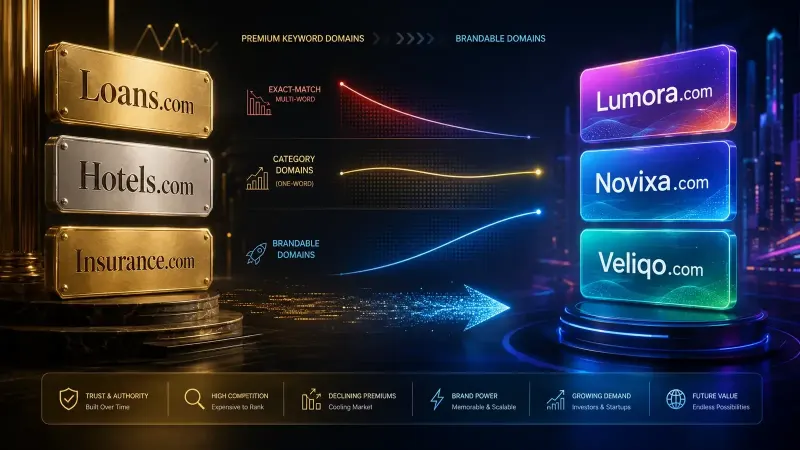
Early domain investing boiled down to a pyramid.
If you could control a single word generic .com keyword you sat at the top. Two word commercial phrases were next. Pre-generated words got written off as speculative throw-away domains that sounded too complicated to spell.
The pyramid hasn’t gone away but sections of it have shifted.
Single-word category domains will always be valuable. Short names that summarize and claim entire commercial categories will always hold strategic value. The heat has left the middle: bloated exact-match domains that blend several words into awkward , search-engine-focused landings pages.
Startup naming has evolved in kind. Companies want brandable names that can withstand a pivot, pass the radio test, fit into an email signature, clear trademark clearance, and hold up when advertising in unrelated markets or geoexpanding.
Keywords vs Brandables isn’t the debate. It’s which domain name will help today’s startups build lasting value?
Premium Keyword Domains Still Work
The biggest advantage of a premium keyword domain is instant clarity.
Loans. com. Hotels.com. Insurance.com. When a user sees a address that succinctly matches an intended destination, they need less explanation. The name sells itself.
Keyword categories are not going away. NameBio’s historical domain-sales database has tracked over $3 billion in reported sales over the years. Perusing their all time reported-sales table is a good way to see the high price-points that rare quality assets can still command.
What has changed is the definition of quality.
A one-word directory doesn’t compete with a four-word phrase cobbled together around a search term. Loans.com is rare digital real estate. BestOnlineBusinessLoansToday.com is spammy ASCII collection of letters that will kill your brand if you use it as your main website address. Both URLs contain keywords but they shouldn’t be part of the same discussion.
Domain Cooling is Happening in the Middle
The fastest cooling I’ve noticed is in legitimate multi-word generic domains bought almost exclusively for SEO.
Sure, BusinessLoanQuotes.com might still describe what your company does. Maybe you can cram enough keywords onto the page to support a focused landing page. The URLs are long though. Memory-holing customers to type it correctly is difficult. Long words are ugly. Reading those urls in places where customers won’t click a hyperlink feels expensive.
Google also made some changes to how it treats exact match domains.
Here’s what Google says about its exact match domain system.
Giving content undue credit simply because it lives on a domain specifically crafted to target that query was never our intention. Words in the domain name will still matter. However, the domain itself will no longer act as a type of cheat code for ranking.
That SEO advantage is gone. For domains bought solely for their traffic potential, this change isn’t huge. For keywords inflated beyond reason in aftermarkets sales, it pushes the value proposition back down to SEO landlords and speculators.
Keyword domains built around a narrow category that have trouble branding themselves outside their domain name are going to experience narrower buyer pools.
Not all Exact Match domains will cool by the same amounts. Just the ones whose valuations were largely propped up keyword volume and didn’t leave enough room for traditional branding.
Startup Names Need Flexibility Brandables Offer
Brandable domains don’t have that problem.
Unique names allow companies to establish a clear identity without shoehorning every product description into the domain name. Brandables can be invented words. Or they can be made up of common terms used together in a stylish way.
Memorable word combinations matter because companies evolve.
Taskrabbit starts as a scheduling tool. Now it’s a project management service. Square began as a mobile credit-card processor. Today they support lending, invoicing, fraud, reporting, and I’m sure many other features I don’t know about. A FitBit watches turns into “digital health”
An overly specific exact match domain becomes a constraint on that growth. Stick with a name that doesn’t represent how your business defines itself? Or go through a costly and risky domain migration after your business has already grown into your new brand?
Brandable domains give startups more room to maneuver.
Good brandable domains aren’t JUST random words. Look at DomainsByMail’s inventory. Clean, short, single-word offers. They’re pronounceable. When I look at them, I forget how to spell Xe.to after about 30 seconds. But I know how to type them when someone says them out loud. They feel intentional. Brandable with room to grow your company story through your product and marketing.
How Trademarks Impact Naming
One underappreciated part of naming is trademark strength.
The USPTO has a guide on strong trademarks. The short version: Marks that are coined or completely unrelated to your product are stronger. Arbitrary trademarks get rights because you came up with the word, not because you decided the word should mean what your product does.
Descriptive terms and phrases are on the other end of the spectrum.
As a startup, you can’t just buy a descriptive domain and immediately prevent all other users fromever using that word in a similar context. Your trademark, even if registered, only applies to your company in connection with the goods or services you specified when you registered it. That’s why VCs generally prefer inventable domains for startups. The domain name is a piece of brand identity, but with trademark considerations and business growth factored in, it’s also part of a larger identity system.
With a short invented name, there’s less risk of direct competition using the core keyword you bought to describe your business.
Brandable names aren’t guaranteed. You still need to check for similar spellings, phonetic matches, potential conflicts, and an abundance of clearance before jumping. But if you have the right resources they can be incredibly safe bets.
Premium Generic Keywords vs Short Invented Words
Premium Generic Keyword Domain vs Short Brandable Domain
Immediate Category ClarityUsualy High Requires Positioning
Trademark DefensibilityLimited if used genericallyPotentially stronger if unique enough
Flexibility After PivotCan be very narrowUsually allows for more growth
Target Buyer PoolTypically industry specificCan apply to multiple industries
Keyword IntentClear, but can lack brand signalBuilt through branding and content marketing
MemorabilityTypically strong for short keywordsTypically strong if looks good & sounds right when spoken
How Much Will It Cost?Insanely high for premium namesCould be cheap or expensive.
Sales CycleRequires either
personal buyer or company willing to make brand splash.Can work well with agile
startup decisions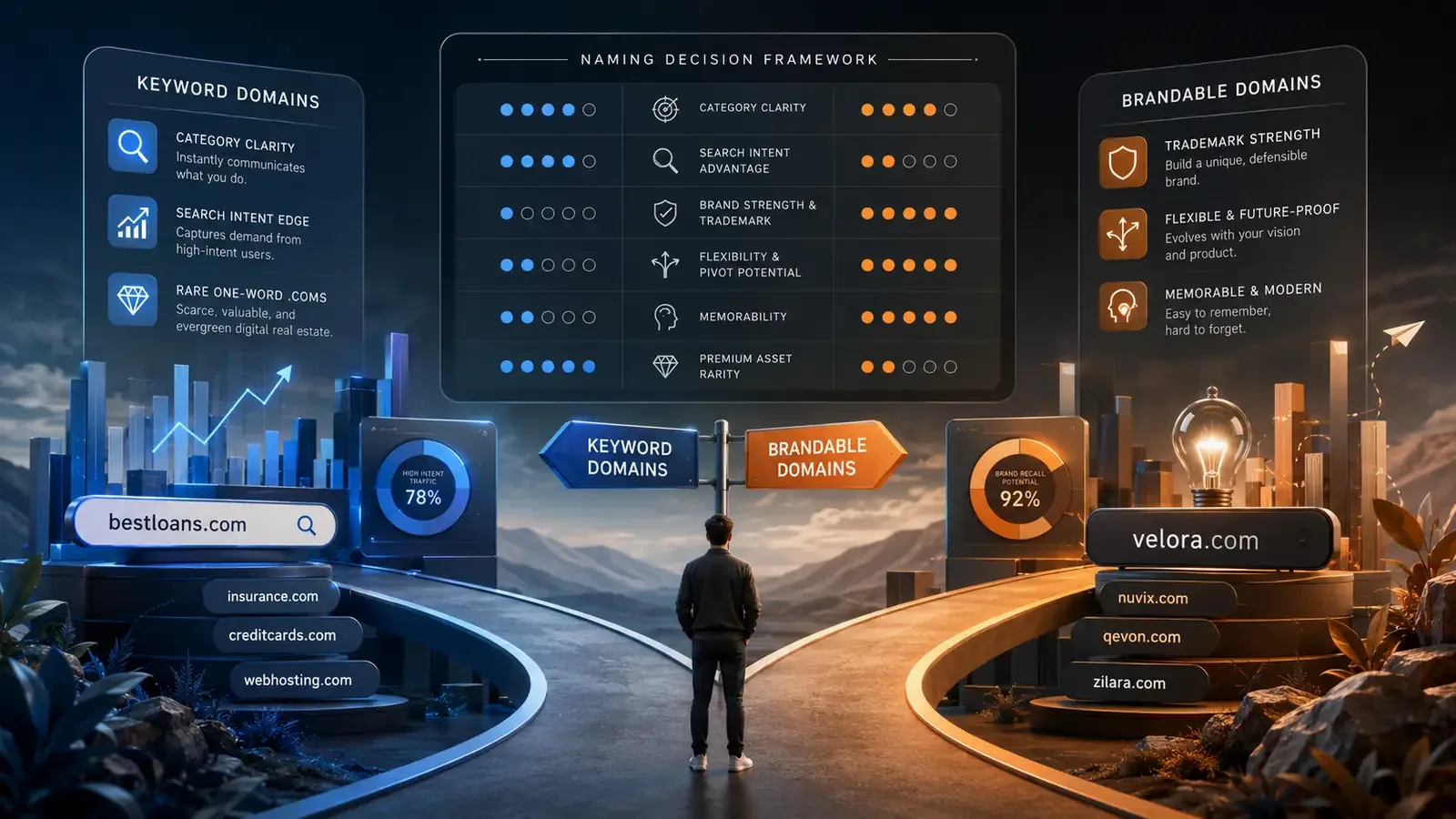
Premium Keywords Aren’t Going Away, Just Getting Practical
Long-tail keyword domains are not going anywhere. One word categories will remain rare as new gTLD opportunities open up. The difference is simply this: keyword due diligence will now include branding fundamentals. Does this keyword sound like other brands in its space? Will it limit its product vision post-launch?
Brandable domains aren’t flipping faster across the entire aftermarket. What is happening is branded domains under certain prices tiers fit a wider array of early-stage company naming needs. Whereas expensive “command the category” domain names become practical purchases for fewer startups.
That will affect liquidity.
What’s Selling Fast? Look at where the inventory goes.
Places like DomainsByMail cater to brandable-name shoppers. Their customers know what they want. They type into the search box, get immediate feedback on whether the domain fits their brand style, and move quickly when they find a winner.
This is not how brokerage investments work. Longer sales cycles happen when buyers request custom lists that fit imperfect criteria. Or requires the right set of market conditions to find a strategic buyer.
Atom Found A Market In Brandable Domains
Atom was previously known as Squadhelp. They have a marketplace curated around how startups think about names.
But there’s more to the story. Read how they explained their own rebrand during a 2024 name change.
If you dig into the history, you’ll learn Squadhelp didn’t start as a domain marketplace. It wasbuilt as a secondary branding option for startups. Then demand for its premium, expert-curated inventory grew to the point where it became their primary business.
If you bought every listing data feed for domain sales velocity, you wouldn’t necessarily see that trend reflected publically.
Some transactions are private. LTO agreements muddy the disclosed price-points. Marketplaces come and go. Today’s fast selling domain could have sat on a private shelf for years.
You won’t be able to prove brandables sell “x” times faster than generic keywords. But you can observe startups are naming themselves with shorter branded domains at higher frequency than in the past. That, in part, is fueling demand for curated marketplace inventory.
Users Appreciate Domain Names That Are Readable
Screens don’t tell the whole story.
Words are spoken aloud. They’re included in footers, podcasts, video titles, emails newsletters, and so on. A messy keyword-stuffed domain might work fine on page. But what happens when a sales rep tries to explain your brand without a browser in front of them?
Domain names are readable.
Domains are spoken. They’re typed into browsers by hand. A multi-word exact match domain may provide tonically relevant, but say it fast?
Keyword info definitely still matters. Businesses just don’t need to fit every element of their brands ideas into the domain name like they used too.
Building a Blueprint For Corporate Naming Decisions
Every company needs to evaluate names differently. But there are things every brand should consider when vetting names.
Define current product, then future product.
Bounds how wide a brandable name should be. Companies confident in their product definition can lean harder into generic keywords. Companies planning to diversify or expand into new markets should buy with their future products in mind.
Run a Trademark Search.
Use the WIPO Global Brand Database or similar systems to clear names before you start. Don’t limit searches to exact matches. Regional spellings. Phonetic similiarities. Alternative translations. Similar products or services. Tying a domain name to a potential trademark should always be part of your research process.
Run it through the radio test.
Sounds cool when you say it out loud? Great. Now ask someone else to write it down while you say it. How much did they miss? Did they drop the .com? Are you sure that slight spelling variation will never be used by someone else?
Once you think you have a winner. What problem does that domain solve for your company?
Helps your brand? Shortens your brand? Removes an annoying “get” or “try” prefix? Better international brandability? Startup budget probably doesn’t stretch to every keyword on your list. Identify goals before setting budgets.
Look at the .com
This applies more to startups than companies. But if you know you want to use a different extension, at least make sure the .com is safe.Owned by a competitor? Visit once everyone in your marketing team agrees to avoid acquiring it. Free for sale? Stack that price against the cost of living without it.
Use the Right Marketplace For the Domain You Want
Brandable domains fit a naming process built around browsing curated inventory. Singular keywords often require specific buyer intents to realize their full value.
Understand the strength of each segment. Invest accordingly.