A domain renewal receipt might not seem significant if it includes only one or two domains. That same invoice can stress annual budgets if a company registers hundreds of domains for brand protection, country-code websites, trademark terms, marketing campaigns, and defensive registrations.
Prices fluctuate across several layers. ICANN oversees the domain-name system and accredits registrars. Registries maintain the database for specific top-level domains. Verisign runs the registry for .com domains, for example. Registrars sell domain registrations and renewals directly to customers. From the customer perspective, several invisible fees underlie the visible retail price.
This matters because a modest wholesale price increase affects large portfolios. Let’s say a registry hikes prices by $0.71 per domain per year. That trivial amount on a single name isn’t meaningful. Update 10,000 domains and you’ve added $7,100 to the portfolio’s annual wholesale price before retail markup.
Where will that price increase come from? The .com domain registry has hiked prices steadily in recent years. Let’s review how that trend may continue in 2026 and beyond.
Understanding .com Price Increase History and Trends
COM price increases draw the most attention.
In its announcement about modifications to the .COM Registry Agreement , ICANN clarified that Verisign would have the option to:
increase the price of .com registry services by up to 7 percent during each of the final four years of the remaining six-year pricing period.
The first six-year pricing cycle began on October 26, 2018. The registry increased wholesale prices three times before September 1, 2024.
The current pricing cycle began on October 26, 2024. Verisign revealed in its Q1 2026 SEC filing that the annual wholesale registry fee for registering or renewing a .com domain will increase from $10.26 to $10.97 on November 1, 2026.
Domain prices under the previous pricing cycle
Effective date
.com wholesale price per year
Before September 1, 2024
$9.59
September 1, 2024
$10.26
November 1, 2026
$10.97
As shown in the
table, Verisign plans to hike prices by $0.71 per domain each year. For an
account with 10,000 active .com domains, the direct additional wholesale cost
equals $7,100 per year. Multiply that by ten yearly renewal cycles and the
price hike costs $71,000 before future hikes, retail markup, taxes, or service
fees.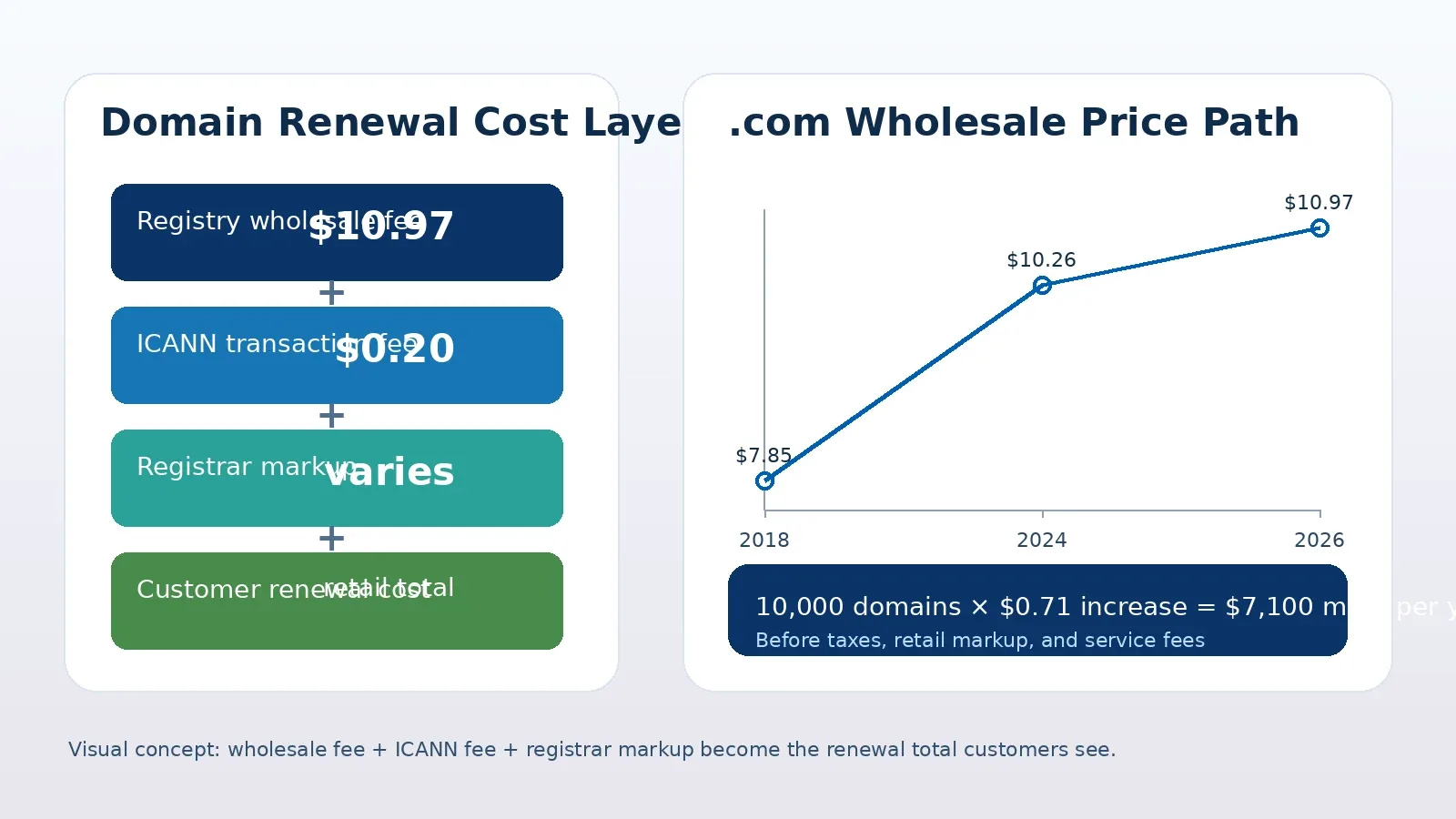
Timeline of Verisign’s Published .com Wholesale Price Hikes
An annual price hike sounds concerning, but there’s a key reason it doesn’t happen every year.
Instead, Verisign can increase prices by up to 7% during years five through eight of each six-year pricing cycle.
It means price hikes may occur every other year. In years when the price can change, Verisign isn’t required to raise prices by the full 7 percent. The opposite is true as well. Missing a scheduled price increase does not guarantee increases the following year.
Domain Portfolio Holders: Why Price Increase Timing Matters
While individual customers hope prices remain stable, domain portfolio managers should pay close attention to these announcements. Businesses can plan ahead to renew key domains before the price hike, drop rarely-used domains, or switch to a registrar with lower markup.
Keep in mind: there’s no guarantee other registrars will pass retail prices onto consumers. Verisign discusses this detail in an older 2024 blog article on .com price increases and retail markup percentages. Each registrar decides its own pricing. Retail prices can exceed wholesale fees by a wide margin. Customers often see price variations between competing registrars.
ICANN Fees Are A Minor Cost Per Domain, But Large With Many Names
Domain budgets should also track ICANN price changes.
On its registrar fees page, ICANN explains how accredited registrars pay:
An annual accreditation fee and transaction-based fees assessed by ICANN. For FY 2026, we have set a transaction-based fee of $0.20 for every annual increment of a qualifying add, renewal, or transfer transaction.
That fee started on January 1, 2026, but extends into the future. Registrars may charge this amount separately on the checkout page or hide it in the total price. Namecheap includes an ICANN fee disclosure on its own pricing page.
Each charge is trivial for one domain registration. However, ICANN transaction fees surpass $1,000 annually when charging 10,000 domain annual renewals.
Rising Costs and Margins: How Registrars Determine Retail Prices
Customers face wholesale prices on one side and stiff competition on the other side.
Consider how registrars make money. A domain registration might carry a low introductory price to attract new customers. The registrar banks on repeat revenue through renewals and add-on services. Upsells may include web hosting, email services, website-builder toolkits, security services, domain brokerage, premium DNS services, and paid account support.
Some registrars do remove free services to increase margins. Not every registrar follows that philosophy. One provider may offer free privacy protection or DNS services. Another may charge separately for add-on features. Intro prices may vary as well. Some registrars offer low introductory prices with higher standard renewals.
Instead of focusing on the initial registration cost, review the total price for three or five years.
Before registering or transferring with a new registrar, compare:
1. First-year registration price.
2. Standard renewal price.
3. Transfer price.
4. How they handle ICANN fees.
5. Costs for privacy protection.
6. DNS management interface.
7. Account security features.
8. Discounts for bulk accounts or resellers.
Look past low introductory prices when necessary. They shouldn’t overshadow the total cost of registration and renewal.
Premium Registrations Change The Math
Transparent pricing doesn’t apply to every TLD. Extensions launch with several category tiers. Popular new gTLDs often place baseline prices on “standard” registrations. Popular short words, commercial phrases, or short domain ideas may cost more as “premium” registrations.
Identity Digital publishes a list of premium domains. There’s also documentation showing how registrars access registry-level premium pricing tiers. The registry offers a technical interface that returns price data.
The crucial detail: review the registry’s renewal fees for premium domains.
A large-name registry may charge premium prices on renewal. Aftermarket purchases may not follow that framework: someone pays the premium price to acquire the domain, then renewments cost the same amount as any other registration on that TLD.
In other words: just because a domain costs more to register doesn’t mean it always costs more to renew.
How Often Do Domain Registry Costs Change?
Not every registry uses a single pricing schedule.
Some are upfront about wholesale pricing. Premium names might appear on a separate list. Other registrars pull that information through technical interfaces. Identity Digital mentions an EPP $ervice extension returns pricing data.
This is another reason screenshots and historical spreadsheets don’t always help. Review the pricing information on the registrar’s checkout page. Review any announcements from the registry. Renewal prices change frequently.
Prices may change across an entire TLD as well. A small set of domains affected by individual price hikes doesn’t impact existing portfolio budgets. Changing the baseline price changes the cost to renew every domain on that extension.
How To Future Proof Your Domain Portfolio Budget
Panic is never the right solution. There is a proper course of action instead.
1. Keep track of announced price hikes.
Follow news from registries, registrars, and ICANN when prices are scheduled to increase. Write down the date it takes effect, which extensions are affected, the current price, the new price, and how much your registrar intends to mark up prices.
2. Renew essential domains before price hikes.
If the registry allows it, consider preemptively renewing important domains before prices go up. You can already see this occurring with .com registrations. According to ICANN’s announcement on .com price amendments :
Registrants who wish to renew during the notice period may continue to register .com or .net domains for up to ten years at the then-current price.
Don’t automatically renew every expendable domain just to lock in a lower price. If the domain is useless, it doesn’t matter how much money you save.
3. Compare renewal prices between registrars.
Review advertised prices during your research. When managing larger accounts, ask about bulk pricing, reseller discounts, API access, consolidated billing, and advanced account protections.
4. Inventory domains with premium renewal fees.
Publish a separate spreadsheet that includes all domains with above-average renewal fees. Monitor this list separately. A domain costing $20 per year to renew requires a more compelling justification than a nominal $10.50 renewal fee.
5. Audit your portfolio annually.
Every year, audit each domain up for renewal. Hold onto domains that support an active business, protect a trademark, attract visitors, or have a strong resale value. Delete domains that don’t justify renewal.
Budget Accordingly: Prices Always Go Up
Mass price hikes are rare. Most increases occur gradually over time. They affect portfolios through wholesale price hikes, retail markups, registry-added premiums, and portfolio growth.
Domain registrations don’t visually resemble other technology expenses. That inconsistency becomes problematic when someone overlooks renewals in the annual budget. A domain portfolio should never grow large enough that leadership forgets to account for renewal costs.
Companies should manage renewals as they would any other annual expense. Forecast renewal costs, audit costs each year, and ask questions if prices seem too high.
Finding the cheapest registrar each year is a temporary solution. A longer-term strategy focuses on maintaining controlled ownership at a predictable price.