New generic top-level domains arrived with a promise to expand the naming space beyond .com, .net, and .org. The new gTLDs included many descriptive endings like .xyz, .online, .store, .shop, .tech, and .site.
The category is no longer small. The Domain Name Industry Brief for the first quarter of 2026 reported 49.6 million new-gTLD registrations as of March 31, 2026. That was a 31.3 percent increase over the same quarter in the previous year.
The difficult question is not whether new gTLDs are growing. It is whether that growth represents real businesses, long-term users, promotional registrations, or short-lived portfolio activity.
The Most Registered New gTLDsThe live ranking changes regularly, so buyers should use the nTLDStats top-level-domain dashboard rather than rely on an old screenshot.
As of this review, .xyz remains the largest new gTLD, with more than 10 million registrations and roughly 13 percent of the tracked new-gTLD market.
Extensions that commonly appear near the upper end of the live table include .top, .shop, .online, .site, .store, .vip, .icu, .club, and .bond. Their positions can move as registries run promotions, large portfolios renew, or speculative registrations drop.
That is why a most registered new gtld extensions list should be treated as a market snapshot, not a quality ranking.
.xyz vs .online Domain Adoption
Comparing the market position of .xyz vs .online domain adoption can show how positioning affects demand.
.xyz is broad and flexible. Developers, Web3 projects, startups, and personal sites have used it because it does not lock the owner into one business category.
.online is more literal. It can work for small businesses, ecommerce projects, creators, and service companies looking for a neutral alternative when the matching .com is unavailable.
Raw registration totals still need context. A deeply discounted first-year price can produce a fast surge without guaranteeing that buyers will renew at the standard rate.
Renewal Rates Are the Stronger Signal
The first-quarter 2026 DNIB report estimated a combined renewal percentage of 30.9 percent for all new gTLDs. For the “other legacy gTLDs” that it tracks, excluding .com and .net, the comparable estimate was 67.6 percent.
The gap matters.
A low initial registration price can attract experimentation, temporary campaigns, or speculative portfolios. When the renewal invoice arrives, weaker names are dropped. A business that is using its domain for email, marketing, and customer traffic is more likely to keep paying for it.
Anyone asking, “Do alternative domain extensions have high renewal rates?” should avoid one universal answer. Renewal performance differs by extension, registrar channel, pricing strategy, and user base.
Usage vs. Registration
Registration volume measures inventory. It does not measure deployment.
A healthy extension should show signs of real use: live websites, ecommerce stores, documentation portals, email activity, redirects, branded campaigns, and companies willing to renew.
Public active-site measurements are imperfect. Parked pages, defensive registrations, redirects, and inactive projects can distort the picture. Tools such as W3Techs’ top-level-domain usage report provide a useful web-usage view, but no single dataset captures every deployed domain.
For a buyer, the practical test is simpler.
Search the extension manually. Review whether credible companies use it. Check
whether the complete domain looks natural in a browser, email address, and
spoken recommendation.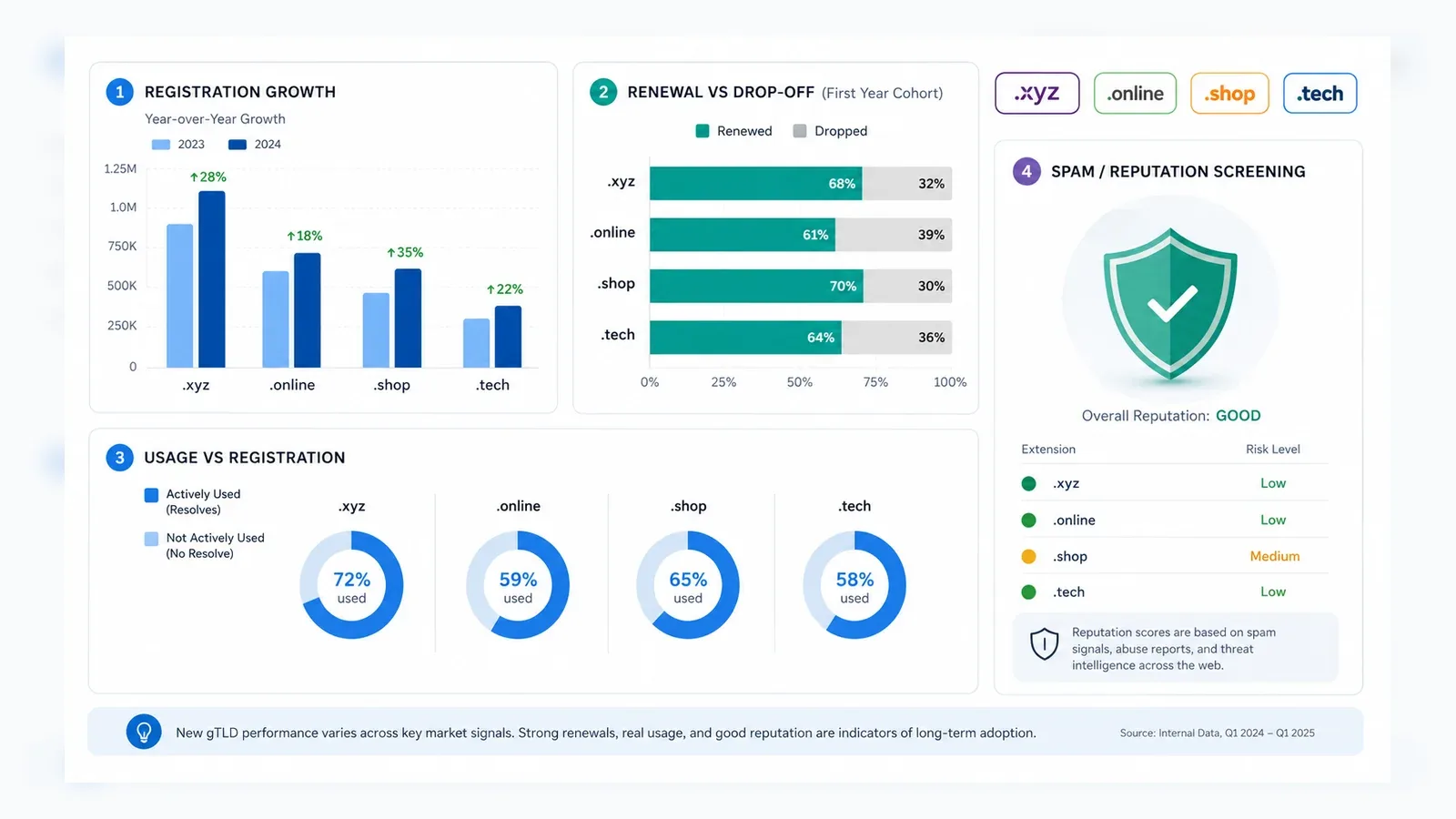
Tracking Spam Percentage in New Domain Extensions
Low-cost registrations can attract legitimate users and abusive operators at the same time.
Spamhaus publishes domain-reputation statistics that cover malicious activity across TLDs, registrars, networks, and countries. Its April 2026 report recorded 46.9 million newly observed domains between October 2025 and March 2026, alongside 2.15 million malicious domains.
The correct response is not to reject an extension automatically. Review the extension’s reputation, the registry operator’s abuse controls, and the domain’s own history.
Before registering an alternative extension, it’s recommended to:
1. Check current registration and renewal pricing.
2. Review the live new-gTLD ranking.
3. Search Spamhaus reputation data.
4. Confirm that the TLD resolves normally in mainstream browsers.
5. Review the registry operator.
6. Check trademark conflicts and matching social handles.
7. Secure the matching .com defensively when it is practical.
Which Alternative Extensions Are Actually Gaining Traction?
The strongest alternative domain extensions combine three qualities: clear meaning, sustainable renewal behavior, and visible end-user adoption.
.store and .shop are easy to understand for ecommerce. .tech and .app can fit technology products. .online is broad enough for many small businesses. .xyz remains one of the largest and most recognizable new-gTLD experiments.
The market will continue changing. ICANN’s New gTLD Program: 2026 Round opened its application window on April 30, 2026, with submissions scheduled through August 12, 2026.
More extensions will create more choice. They will not remove the need for judgment.
A good extension should support the brand after the discount ends.