Few businesses choose a premium domain for a reason completely detached from their main operations. The customer is usually responding to a wider commercial goal: a new startup or company launch, a seed funding round, a new product category, a rebrand or an effort to bolster consumer trust in a competitive space.
This is also why the domain aftermarket usually trails commercial momentum from the broader business world. When a sector heats up, when investment becomes available, and new companies enter the market, demand for trustworthy shorter names emerges. The most valuable assets are often not the ones packed with keywords. They are the premium names that help a company communicate authority in a glance and lower barriers across advertising, email, search, and word-of-mouth referrals.
Specialization is a possibility within a large market. The Domain Name Industry Brief reported that the total number of registrations across all TLDs increased to 392.5 million at the end of Q1 2026. Inside that broader namespace, corporate buyers are limited to a much smaller pool of memorable commercial names.
Category Value Does Not Equal Search Volume
The category-killer domain name is a short authoritative name that seems to define a market, not just compete within it. Domains built around finance, healthcare, software, cloud infrastructure, legal services, and energy can receive attention because the underlying industries and sectors often already have valuable customers.
Keyword demand is a factor, but a buyer’s use case is a more important consideration. The acquisition of a premium domain name by a business or startup often stems from its ability to build trust, polish a brand image, create a shorter URL, lessen confusion, and more effectively underpin a product launch or rebrand.
Public reports are not the full picture. Disclosure of private transactions is uncommon. NameBio’s historical database provides searchable public sales data with more than $3 billion in domain name sales reported. Even a comprehensive database like NameBio reveals only a portion of the aftermarket.
The practical question is not, “Which niche has the highest price per sale?” Rather, the question is, “Which categories repeatedly give buyers a commercial reason to consider an upgrade?”
FinTech Bubble: Banking, Payments, Credit, and Digital Assets
Finance-related domains remain in demand because trust is at the center of the transaction.
A banking platform, payment service, lending marketplace, insurance product, or investment app all handle personal information. Customers are expected to share personal details, connect financial accounts, transfer money, or make high-risk financial decisions. A low-trust domain name can cause a delay before the customer even reaches the product or application.
The most commercially useful fintech domains tend to be concise and easy to spell-soundmatch out loud. Keywords related to payment, credit, loans, banking, capital, wallets, investing, and financial security are easier to value when the potential buyer pool is more visible.
A startup founder may launch with a temporary address such as GetBrandApp.com or UseBrandPay.com because the preferred .com is unavailable. After the company raises funding or enters a broader market, a shorter Brand.com version may become strategically attractive. It is shorter to type, easier to include in email addresses, and less likely to sound temporary.
Fintech startup domain name acquisition trends extend outside of the .com space as well. Artificial-intelligence-powered tools for legal workflows and financial services have created additional demand for category-specific .ai domains. A March 2026 Domain Name Wire article from Hogan Lovells noted several reported sales including law.ai at $350,000 and cloud.ai at $600,000. These examples demonstrate how a clear commercial term may gain additional value when placed on an extension with growing technology connotations.
The lesson for investors is simple: financial keywords can be valuable, but meaningless concatenations are not automatically premium. A domain name must still have logical spelling, credible positioning, and multiple realistic buyers.
HealthTech and BioTech: Trust With Higher Stakes
Trust plays a role in healthcare as well but with different connotations.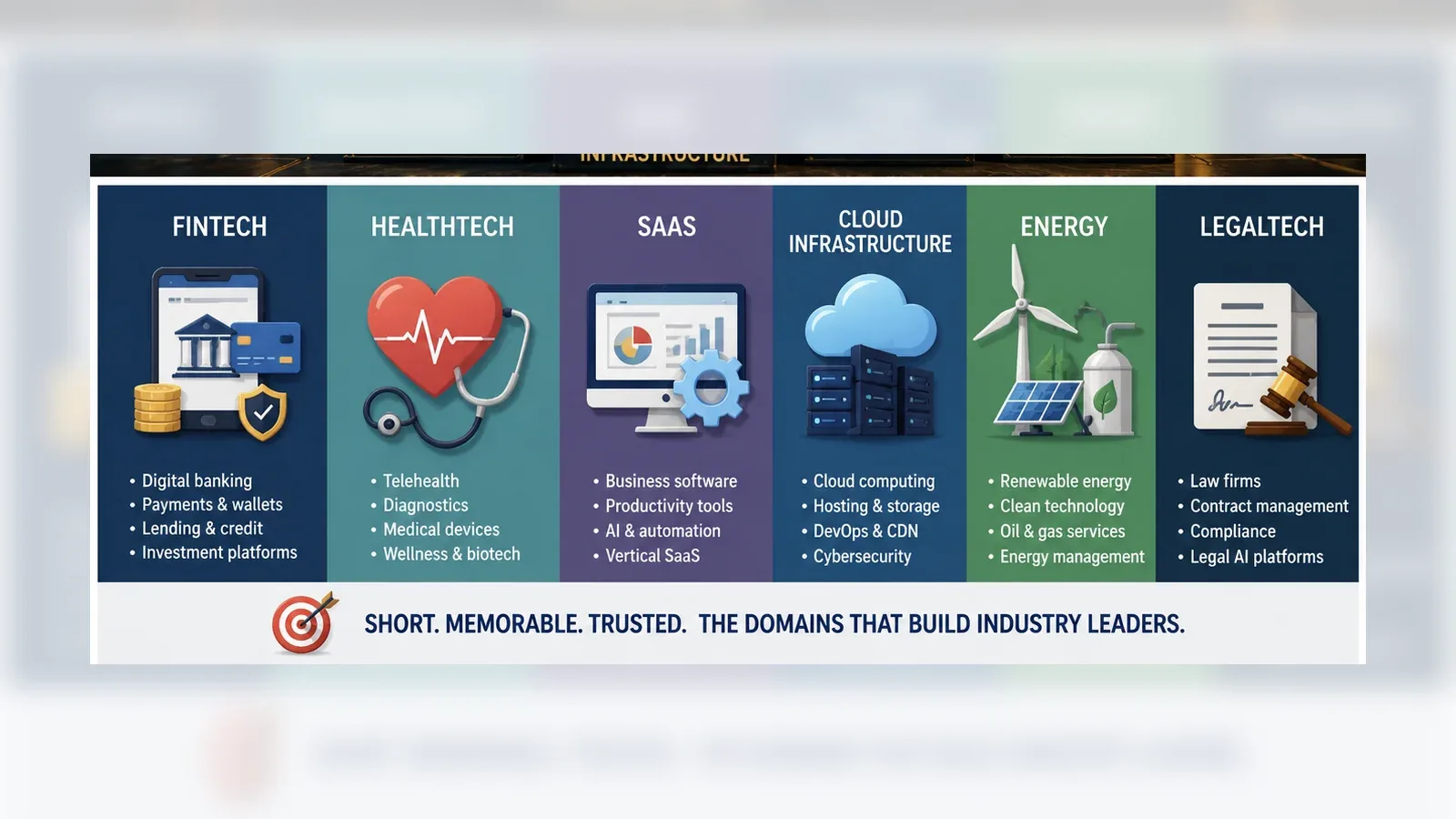
A patient looking for a telehealth product, a diagnostic tool, therapy options, medical advice, or a specialist service wants clarity. A hospital buyer evaluating a software product wants the same thing. Names that sound confusing, promotional, or difficult to spell-soundmatch can cause a lack of confidence.
Demand is also supported by startup and growth-stage companies. Rock Health recorded $14.2 billion in U.S.-based digital-health startup venture funding during 2025. The firm also recorded $4.2 billion across 129 deals during the fourth quarter, the highest quarterly total since Q2 2022.
Tracking healthcare technology domain name prices in the aftermarket requires more than verifying whether the domain name has the word “health” in it. The customer may be building a patient-facing brand or product, a clinical analysis platform, an AI-based diagnostics product, a wellness app, or a B2B hospital management tool. Each of these use cases values language in different ways.
Terms such as care, clinic, doctor, medical, therapy, health, labs, and longevity can work if the complete name sounds professional. Brandable names are also important because many healthtech firms need room to expand into adjacent services without feeling tied to one particular product or niche.
Investors should exercise additional caution in this space. A domain name may be memorable but still not ideal for use because it sounds too similar to an existing medical brand or carries an unsupported implication of professional authority. Trademark clearance and careful positioning are more important in healthcare and biotech than in many ordinary consumer-facing categories.
SaaS and Cloud Naming Trends
Software companies have additional needs when they begin domain name shopping.
A SaaS startup may begin with one specific feature or vertical: scheduling, document automation, analytics, billing, security monitoring, or workflow management. Over time, the company may add integrations, dashboards, AI tools, enterprise controls, and new modules. A name built too closely around one narrow feature can age poorly.
Premium domains sold in the SaaS and cloud markets are often brandable rather than purely descriptive as a result. Short action words, abstract words, clean invented names, and broad infrastructure terms can support a platform story while avoiding locking the business into its first product.
Cloud-related names are especially interesting because that category intersects with AI, infrastructure, storage, cybersecurity, and developer tools. The $600,000 cloud.ai reported sale is one example of this overlap: the keyword itself is commercially broad, while the .ai extension connects it to a modern technology narrative.
Founders also search curated naming platforms to see options that will scale. Atom, previously known as Squadhelp, self-describes as a premium marketplace and AI-native brand platform. Its marketplace focuses on curated brandable domain names rather than solely on raw keyword inventory.
The lesson for investors in this category is not to register every software-related phrase. The better target is a name that could support multiple product directions and still sound credible when the company expands.
Green Energy and Infrastructure: A Selective Opportunity
Energy-transition-related domain names are also interesting, although the market is smaller.
Terms connected to solar power, batteries, storage, charging, energy grids, carbon management, climate software, and efficiency may be attractive to operating businesses. The most valuable names usually connect to a product category or broad brand concept rather than a temporary or passing policy phrase.
Infrastructure buyers and B2B energy companies also have a different decision-making model from consumer-app founders. A new energy company may care more about a clean professional identity, procurement credibility, and a formal brand than novelty.
This is a category where investors may want to prefer quality over quantity. A well-recognized energy keyword or a powerful brandable name can have a visible buyer pool. A long string of green-energy related terms may be very difficult to resell.
Corporate Buyers and Premium Domains: Acquisition Advice
Buyers entering the aftermarket also need a system.
Step 1: Identify a Keyword Footprint
Identify the terms customers, competitors, and investors already associate with a particular sector. Divide broad category words from product features and broad brand concepts.
A fintech company could examine payment, credit, capital, wallet, banking, or security terms. A healthtech buyer may instead examine care, therapy, labs, clinic, or medical terms. A SaaS company may instead prioritize a short brandable identity instead of specific terms.
Step 2: Historical Comparable Sales
Search a historical database such as NameBio and review reported sales with similar keywords, extensions, lengths, and commercial uses.
Avoid pricing a domain name from a single unusually high-price transaction. Compare several sales and attempt to distinguish between investor wholesale purchases and end-user retail acquisitions.
Step 3: Privacy During Approach
Fundraising-backed companies should consider using a broker before they approach the owner of a strategic domain name.
GoDaddy’s Domain Broker Service, for example, notes that it can arrange for the negotiation and purchase of a domain while maintaining the buyer’s privacy. Privacy is important because a seller may raise their asking price once they discover that the buyer is a well-funded startup or an established corporation.
Step 4: Check Trademark Risk
Domain name ownership is not a usable corporate asset merely because it can be sold.
Investigate the WIPO Global Brand Database and local and national trademark systems before completing the acquisition. Investigate similar spellings, phonetic matches, and related products or services. A high-value purchase should receive professional legal review.
Step 5: Secure the Transfer
Purchase via a reputable marketplace, broker, or escrow service. Confirm that funds are secured before the seller transfers the domain and after acquisition, move the domain inside a protected registrar account with strong authentication, domain locking, and documented renewal ownership.
What Investors Should Keep an Eye On
The most expensive domain name niches for business are not static categories.
Fintech remains strong because customer trust and acquisition economics are important. Healthtech attracts value because clarity and professional authority matter in high-stakes customer interactions. SaaS and cloud names benefit from product expansion and AI-related demand. Energy and infrastructure names can work when the buyer pool is more visible.
The mistake is to view an industry trend as a free pass to register weaker names.
A premium domain name still requires scarcity, clarity, legal usability, and buyer fit. The sector creates the opportunity. The name’s quality determines whether the opportunity can actually be sold.