
Summary
ICANN86 didn’t give the internet screaming headlines, but one key outcome could end up meaning a lot for domain owners. The Transfer Policy Review is entering implementation. In practice, that means the rules governing domain transfers between registrars will finally get an overhaul long overdue for reality.
Transfer infrastructure isn’t just details. Transfers are core to domain ownership. Every portfolio buy, every multi-domain consolidation, every registrar migration, every sale on a marketplace, every last minute save after a hack alert touches the domain transfer system. When transfers are slow, opaque, or insecure the whole industry pays the price.
By focusing on ICANN86 deliverables, version 20 draft domain transfer policy, and registrar transfer agent draft technical code, this brief frames the big picture. That angle is correct, but the real insight is found by removing hype from fact. Faster transfers will never mean rash and unsupported moves. What upcoming policy changes mean is the industry formally recognizes transfers need to be quicker where possible, more secure where needed, and just easier to understand across the board.
Why This Matters
Domain transfers have been a museum of legacy internet processes for way too long. Most domain owners still think of the transfer code as some static passphrase lingering somewhere on a registrar account just waiting for action. For many owners that paradigm made sense at one point. Portfolios were smaller, marketplaces less automated, and account takeover attacks far cruder.
Premium domains are now digital assets however. Some will sell using full-service escrow. Some move via instant checkout systems. Others are vital brand property held by larger companies. When transferring a domain shouldn’t be difficult. If system prompts are confusing, timer unexplained, or eligibility checked against outdated rules the problem is bigger than annoyed users. Confusing transfers can actually slow deals, increase overhead, and create opportunities for theft.
ICANN’s Board approved initiating implementation of Transfer Policy Review recommendations on Tuesday 07th June 26 before the ICANN86 meeting opened in Seville. This timing allowed the group to send a message. Discussions were over. An Implementation Review Team will work with ICANN org staff to develop the actual consensus policy language.
Transfer Authorization, Not AuthInfo Code
When outlining key terminology changes between current and recommended policies, registrant->TAC object language might be top of the list. To many this probably sounds like minutia or “policy wonkery.” It isn’t. Give this point some serious thought. Domain transfers involve registrants, support staff, domain registrars, online marketplaces, registries, brand representatives, and tens of thousands of other people world-wide. When segments of that group speak different languages about the same process, confusion enters into any exchange.
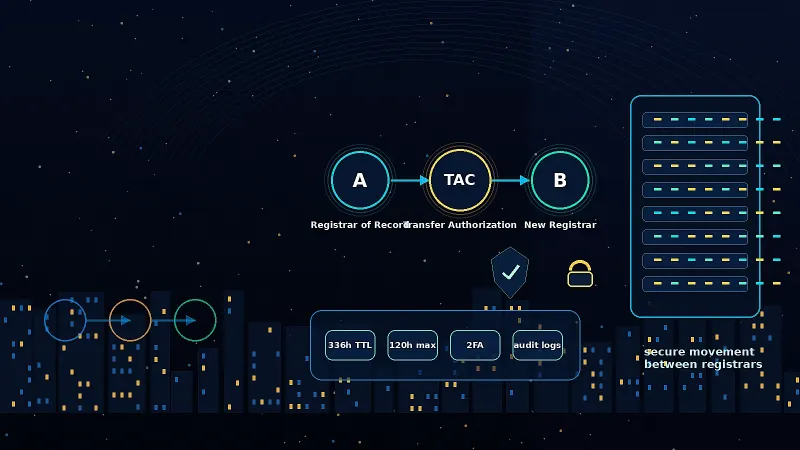
Badly worded, the new TAC is simply a token of transfer authorization generated by the domain registrar of record and provided to registrant or registrant representative upon their request. Emphasis is on user action to request and receive the token. It doesn’t (and should not) live indefinitely on a registrar account’s profile page. It’s created when requested, should be protected while in use, and expires after a defined interval.
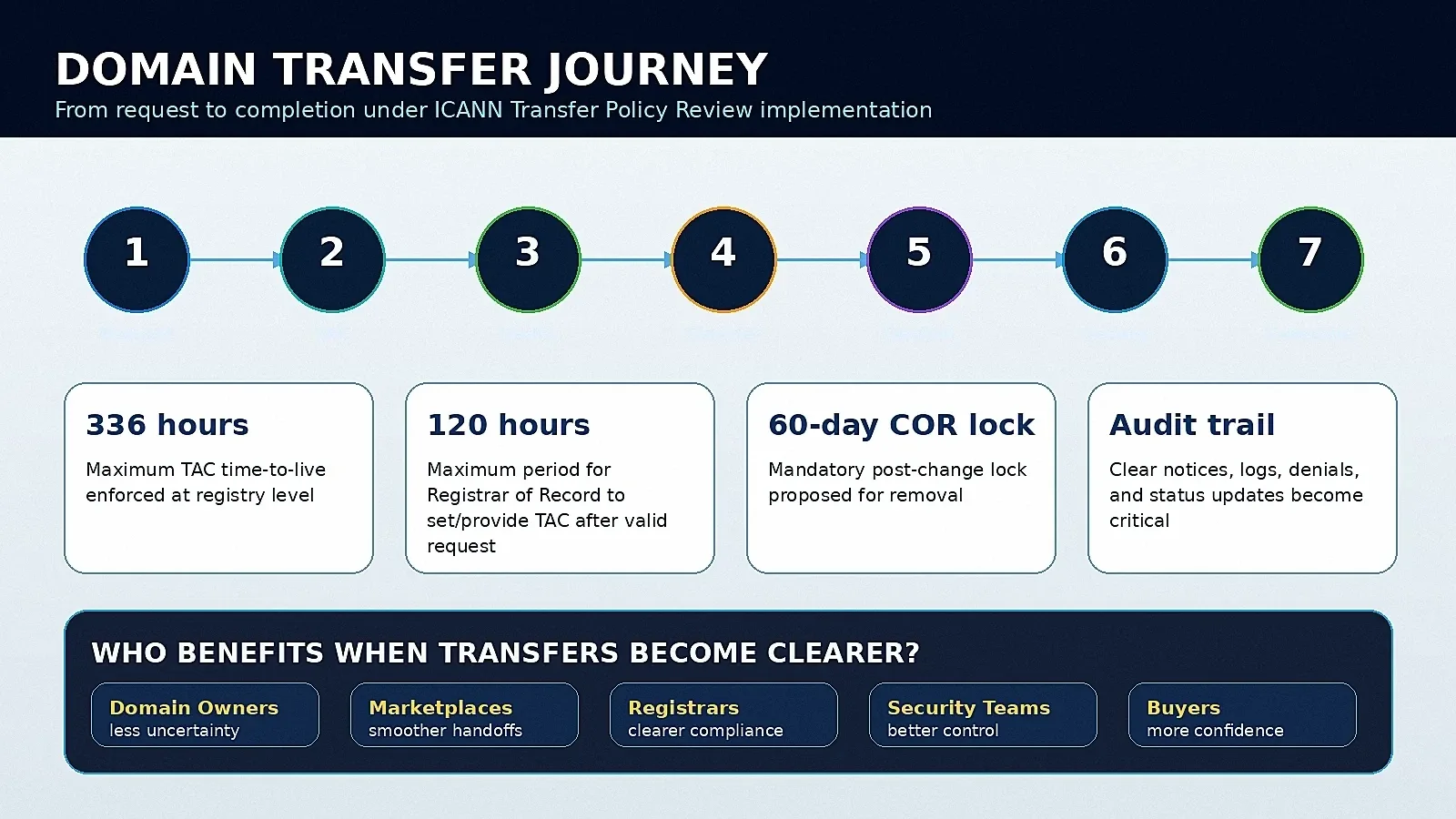
Speaking of which, here is where proposed policy gets far more modern. Recommendations include use of strong composition standards tied to registrar systems, client side verification at the registry level, and finally a strict maximum time to live set at 336 hours. Translation? Guessable TACs are a thing of the past. Codes must conform to basic security criteria. Once a sale conversation has ended a TAC shouldn’t remain usable for weeks.
The Great Five Day Debunking
Much of the circulating commentary will likely sum domain transfer policy updates as killing the five day wait. Sure. But that statement isn’t fully true and also manages to mislead readers. Up to 120 transfer hours are still available for Registrar X to create and provide the TAC after a valid request. Nothing changed other than emphasis.
Focusing on domain aftermarket sales, buyers and sellers shouldn’t have to wait because some industry systems are stuck in the past. As noted previously however, forcing instant transfers on every domain regardless of value or authenticity checks would be irresponsible. High value names often require additional security for a reason.
Clear language states ICANN would prefer the industry move to maximum authorized speed as soon as possible without sacrificing safety or certainty in verification. Registrars who already utilize robust automation can move transfers faster. Everyone else with lackluster identity confirmation, messy customer support queues, or manual issuance processes will need updates.
Escrow Impact
From a premium domain sale standpoint, timed perceptions often equal technical reality. Anyone who has been through a domain sale from agreement to payment to actual transfer understands anxiety increases when countdown timers get involved. The buying side wants to move. The selling side submits a request then refreshes email while waiting on an authorization code. Waiting periods equal uncertainty. Uncertainty leads to risk of misunderstandings.
Cleaning up the TAC request process helps online escrow services and marketplaces design highly predictable transfer experiences. Sedo, Afternic, registrar-hosted checkout platforms, and offline brokerage solutions all rely on smooth turnovers between seller, seller registrar, buyer, and sometimes intermediary account. Standardizing TAC issuance means clearer transaction playbooks which is a big win for automated workflows.
Don’t misunderstand. Bulk transfers and no penny disputes will still experience friction. Validity requirements, registry access rules, intentional account locks, fraud department scrutiny, payment gate holds, and buyer identity verification are all still features of high value name sales. In many cases clarifying the transfer permission layer of a sale dramatically reduces reasons for transactions to stall.
For domain portfolio investors, improvements to overall liquidity are a positive outcome. Buyers have more trust when things are perceived as simple. Premium domains don’t sell as easily when the transfer process is mysterious.
Registrar Implementation Planning
Domain registrars, and specifically registrar engineers, will probably feel the effects of finalized policy language before the average domain registrant. Moving to a more explicit TAC structure means backend changes to how codes are generated, stored, expired, validated, noticed, logged, and communicated on customer facing interfaces. Registry systems also need upgraded logic that consistently recognizes TAC syntax and enforces expiration rules.
TPR recommendations cover more than authorization code structure changes. Proper implementation impacts how registrars control locked domains, what notices are given when a transfer is denied, all types of notifications, howregistrars process Change of Registrant Data requests, and bulk transfer processes. Updating policy means product, compliance, support, and security departments for every registrar will want to study implementation text.
Policy provides criteria public registrars must meet, but leading companies will raise the bar on customer expectations. Transparent transfer dashboards, hard expiration warnings, strong identity proofing steps, and just clear status messaging across the board is future competitiveness. Domain policy becomes truly useful when end users see it translated to better overall experience.
COR Updates and The Inter-Transfer Lock Change
COR stands for Change of Registrant Data. Given time domain sale setbacks related to COR updates will decrease if planned policy recommendations are followed. Ideas still being discussed at ICANN86 around COR would likely require a separate, but related, policy formation. Namely recommendations call for elimination of confusing legacy policy leftover concerning mandatory imposition of a 60 day inter-transfer lock by a registrar whenever a domain registrant data change request is approved.
Domain sales requiring legitimate change of registrant data info updates would sometimes get stuck on this rule. Domain gets sold. Account details, email addresses, legal contact info, or other registrant data changes as part of sale. Buyer now wants to consolidate domain at their own registrar only to hit a lock that wasn’t disclosed as a sales possibility. Average domain buyers often see this rule as an unexpected surprise. Domain professionals see it as a planning hurdle.
Removing mandatory 60 day post-COR lock does not equal allowing every domain to transfer immediately after registrant change requests are processed. We’re changing policy approach from across the board friction to controlled mitigation. Security deserves a round of applause if it can prevent fraudulent transfers without hindering legitimate business transactions.
A Faster Transfer System’s Dark Side
Nothing about a smoother transfer process is without worry. If TAC requests become streamlined attacks may shift harder onto registrar accounts in general. Weak link shifts from hard guessing authorization codes to social attacks against registrar login, email accounts, support staff, and recovery processes.
Upgrade two factor authentication on registrar accounts. Seriously. Broker portfolios depend on it. App generated codes are far more secure than passwords alone. Physical security keys are best when feasible. Whoever owns a premium domain portfolio should run like a bank and not a casual hobby account holder.
Rate limiting, account risk scoring, device identification, employee training, and strict audit logging are non neglesible for registrars. New generation TAC requested by account means security protecting said account must also be strong. Worst case is modernization pushes implemented via poor identity proofing practices.
Preparing For Change
Investors should ask existing registrars how each will approach changes to overall transfer process. Concern arises only when serious investors keep waiting for registrar outreach that never comes. Sticking a registrar with your retirement fund heirloom because “they seemed like a good choice years ago” is poor planning.
Domain portfolio account security should be audited now. Passwords should be unique. 2FA should be turned on. Recovery emails reviewed and scrubbed of outdated addresses. Old delegated user accounts removed. Premium domains locked where offered as a feature. Transfer policy can mitigate some risks, but careless registrant security practices won’t be solved via policy.
Brokers and acquisition teams should review sales workflows. Everybody needs to remember TACs come with expiration dates. Slow requesting a code then ignoring a domain sale for months on end just in hopes no one notices is no longer viable. Likewise requesting a domain transfer code too early and having a buyer’s payment disappear before TAC is ready.
Document portfolio transfers. When domains move between accounts, registrars, owners, or marketplaces document who initiated transfer request, when TAC was issued, expiration details, and who confirmed transfer with sender and recipient. Hope doesn’t plug governance gaps if future disputes arise.
Looking At The Bigger Picture
Simply saying ICANN86 drove real progress towards better transfers is an understatement. Board approval gets years of TPR meetings and discussers into implementation phase. This matters for everyone who cares about domain transfers not being trash fires.
New transfer policy isn’t just changing name on a checkbox. Industry as a whole moves toward time limited authorization, better overall security, improved standardization, and most importantly clarity of process when everybody needs that answered question. Legacy policies that added unnecessarily complicated steps to legitimate domain ownership changes are going away.
Domain investors should see almost everything in this policy push as positive. Quicker and simpler transfers equal greater liquidity, improved buyer confidence, and more seamless aftermarket transactions. Registrars can finally compete on how secure and easy transfers feel for end users. Company domain professionals have been asking domain names be treated like business assets for years. Proper transfer policy helps make that leap.
Domain transfers improving means the industry is maturing. Days of shouting about transfers being someone else problem are over. Buying, paying for, and moving domains between parties should be confident inspiring for the entire ecosystem when rules are clear.
There will be growing pains. Software updates for registrars and registries is coming. Checkout systems need to adjust protocols. Brokers must coach clients on new T&C. Company domain admins must rewrite standard operating procedures. But prices always need to be paid to reach a healthier industry standard.
Closing Thoughts
To quote song lyrics everyone will think I stole from Kendrick Lamar; “ICANN86 ought to be remembered as a sign our universe was knowin’ we wanted better.” Transfer Policy Review work has reached the implementation phase. Daydreaming about instant transfers ends now.
Industry activists, domain investors, corporate asset managers, countless volunteers, and registrar engineers spent years discussing whether transfers needed work. 86 opened with clear direction transfers do need changes. When implementation details are complete domain transfers will look more like something built for today’s domain market and far less like backwards processes invented in the early 2000s.