Introduction: Where AI domain sales data Q2 2026 comes in
The latest worldwide domain name transaction report has pushed AI domain names back to the center of the aftermarket conversation. At first glance, the story looks simple. Buyers are paying big numbers for .AI names, investors are chasing the next big winner, and startup founders want a domain name that instantly telegraphs to the market what they build.
The smarter reading is more nuanced. AI domain sales data 2026 isn’t saying that every name ending in .AI has suddenly become valuable. It is saying that certain names, usually short, clear, commercial, and tied to actual artificial intelligence use cases are starting to attract serious money. That difference matters because a hot sector can create real opportunity and bad speculation at the same time.
The market is not behaving like a random retail mania anymore. The strongest sales are increasingly tied to tech startup domain acquisitions, funded companies, product launches, and brand protection plans. A founder buying a premium .AI name today is often buying a label for trust, recruiting, fundraising, and customer recall, not just a web address.
Premium Pricing Shift
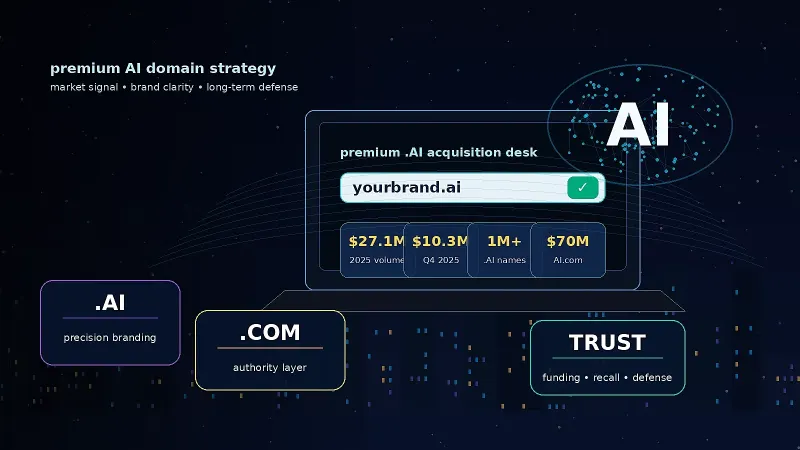
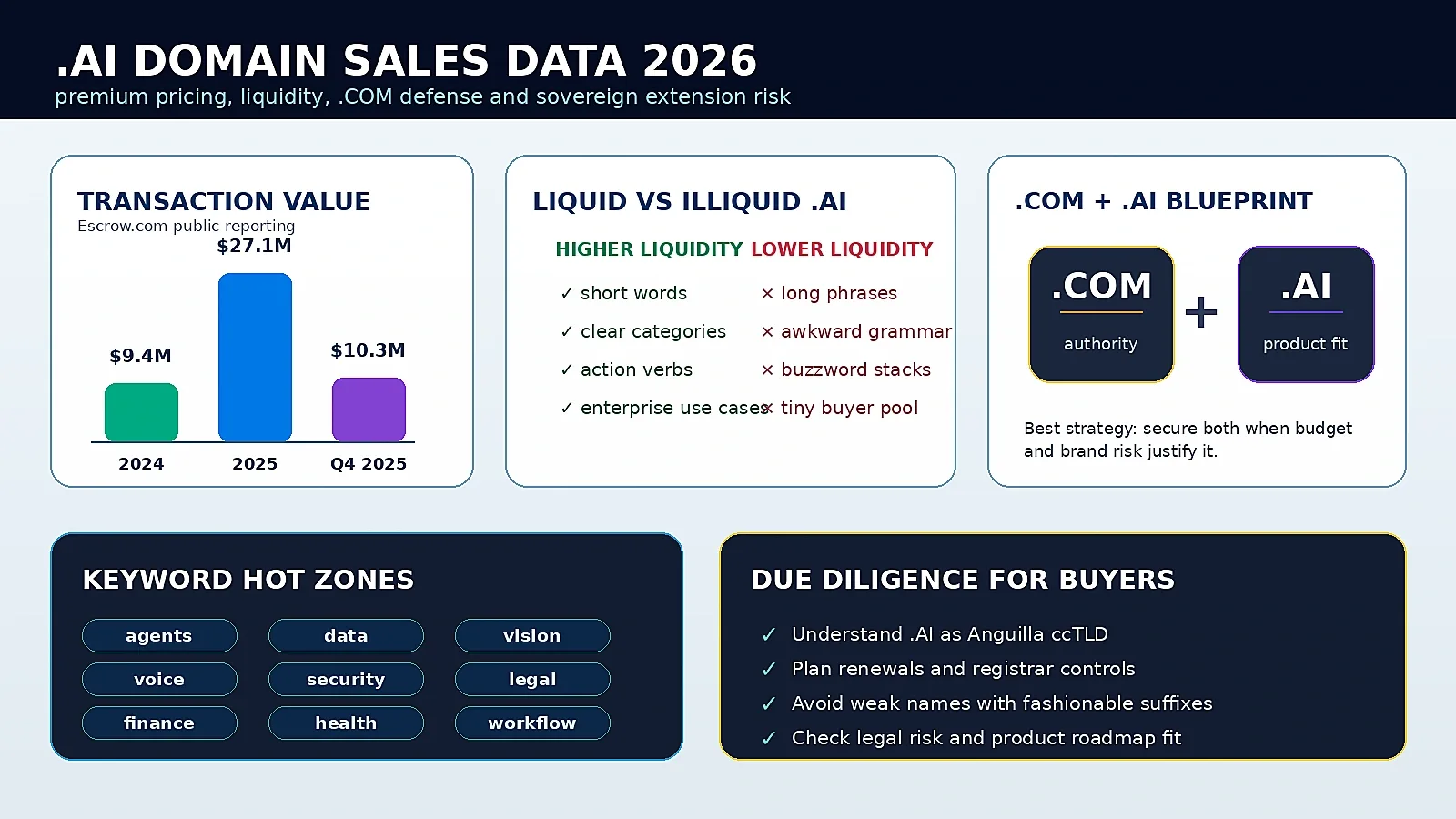
Escrow.com’s earlier public reporting showed how quickly .AI moved from niche interest to serious transaction category. The Escrow.com platform reported that .AI domain transaction value rose from $9.4 million in 2024 to $27.1 million in 2025, with Q4 2025 alone crossing $10.3 million. That is the kind of move that makes investors pay attention but also raises the question of durability.
The useful point is not only the growth rate. It is the quality of demand. When mean transaction values rise and companies begin using acquired names in real businesses, the market looks healthier than a simple registration rush. A low cost land rush can be noisy but a developed premium sale is harder to dismiss.
By May 2026 Domain Name Wire reported that over one million .AI domains had been registered and that Spaceship alone had produced more than $3 million in reported aftermarket .AI sales for the year through NameBio. The same review found that about two thirds of the 49 checked .AI sales through April were already developed. That detail is important because development separates brand demand from pure investor recycling.
Six Figure Anatomy.AI Transaction
A six figure .AI sale usually begins with a very simple question. Can the domain become the natural name for a business category, product function, or enterprise tool? If the answer is yes the buyer is not comparing it with a normal registration fee. The buyer is comparing it with marketing waste, paid acquisition costs, brand confusion, and the cost of entering a crowded market with a weak identity.
The strongest .AI names often fall into practical zones. Agent related names appeal to companies building autonomous workflows. Vision names fit image analysis and robotics. Security, legal, finance, health, data, search, voice, and developer tool terms also carry weight because they point toward real budgets.
That is why premium .AI domain valuations have become uneven. A clean one word .AI name with direct enterprise meaning can deserve serious attention. A four word hand registered phrase with an AI label attached to it may have almost no liquidity. The suffix helps only when the left side of the dot is strong.
AI Names: Liquid vrs Illiquid
Liquidity is the part many new investors misunderstand. A domain can look impressive and still be hard to sell. The buyer pool for a niche .AI name may be tiny. If the right funded startup never forms the name can sit for years while renewal costs keep running.
Short names, exact category words, action verbs, and clean product terms usually have better liquidity because more companies can imagine using them. Long phrases, awkward grammar, mixed buzzwords, and weak invented terms are much harder. The market is generous toward clarity and unforgiving toward clutter.
That is where comparisons with crypto and web3 names are useful. In earlier cycles, many investors bought names because a sector was hot, not because the name itself was strong. Some of those names sold well, but many became stranded when the trend cooled. AI is larger and more integrated into business software but the lesson remains the same. A sector tailwind does not rescue a weak asset.
AI Domains: .COM Defense
The most expensive AI related domain story is not a .AI name at all. It is AI.com. The reported $70 million sale confirmed how powerful a category defining .com can be when the keyword is global, short and tied to a long term technology wave. That transaction is the clearest reminder that .com has not lost its role at the top of the market.
Search traffic around most expensive dot ai domain names sold is useful but serious buyers should also study the .com layer around the same category. A strong .AI name may create perfect product alignment while the matching .com may protect broader corporate authority. When both are controlled by the same company the brand has more room to grow.
This is why the question should tech startups buy dot com or dot ai does not have one answer. For some startups the .AI version is more available, more precise and more aligned with the product. For others the .com remains the best long term corporate foundation. The smartest companies often use both when budget allows.
The multi extension brand blueprint is becoming normal. A startup may build on a .AI address for product positioning, hold the .com for corporate authority, register common misspellings, and protect key names across important extensions. This is not over buying when the brand is serious. It is insurance against confusion, leakage, and competitor mimicry.
The Sovereign Extension Risk
Every serious .AI buyer should remember that .AI is technically a country code top level domain for Anguilla. IANA lists the Government of Anguilla as the ccTLD manager and the official registry site describes .AI as Anguilla’s country code extension that has evolved into a global symbol of innovation.
That does not make .AI unsafe. It does mean the risk model is different from a generic top level domain. Pricing, policy, registry operations and long term governance sit within a country code framework. Large companies can handle this through registrar relationships, legal review, renewal planning, and defensive portfolios but smaller buyers should still understand what they are buying.
The practical concern is not panic. It is discipline. A business putting its main brand on .AI should register for appropriate terms, keep billing clean, watch renewal policy, protect core alternatives and avoid building a brand strategy that depends on one unmanaged assumption.
Real AI Domain Demand: Where It’s Coming From
The healthiest demand is not coming from people who simply want the letters AI at the end of a name. It is coming from businesses trying to explain complex products quickly. Artificial intelligence has become a broad market but buyers are not all building the same thing. They are building agents, copilots, security tools, data platforms, workflow automation, code helpers, research systems, model operations tools, and industry specific software.
That creates keyword hot zones. Words connected with agents, data, inference, robotics, vision, voice, privacy, legal, finance, health, and workflow tend to carry more commercial logic than vague slogans. A name that tells a buyer what the product does has more value than a name that only says it belongs to a trend.
In brokerage conversations one pattern appears often. Founders do not only ask whether the domain sounds modern. They ask whether it will still feel credible after the next funding round. That is a mature question, and it explains why the best domain aftermarket trends for artificial intelligence keywords are moving toward utility, not novelty.
Actual Signal Q2 Signal: What The AI Domain Sales Really Means
The June brief should not be read as a promise that Q2 has created a new permanent price floor for every .AI owner. It is better read as confirmation that institutional buyers are willing to pay when a name removes friction from a launch. That is different from retail excitement. Institutional money is slower, more selective and less forgiving.
A venture backed startup buying a premium name is often calculating more than the domain price. It may be thinking about sales calls, investor decks, conference booths, search memory, social mentions and how the brand appears when a customer forwards a link to a colleague. In that setting, a strong domain becomes part of the revenue story.
This is also why reported sales can distort expectations for ordinary portfolios. Public ledgers show completed transactions, not the thousands of names that received no serious inquiry. A few strong sales prove demand exists. They do not prove that the whole inventory class is liquid.
Traffic Redirection: The AI Domain Use Question
One practical question investors should ask after every big sale is simple. Is the buyer using the domain, parking it, forwarding it, or protecting it? A developed domain usually signals real product intent. A redirect can still be strategic, especially when a company wants to capture type in traffic or protect a product line, but it tells a different story from a full operating website.
Some premium .AI names will become main brands. Others will operate as campaign names, product names, or acquisition funnels that send users into a broader corporate site. This is not a weakness. Large companies often manage many domains around one brand architecture. The important point is that usage should match strategy.
For sellers, that means the pitch should not only say the name is rare. It should explain how the buyer can use it. A good domain sales page for a premium AI name should help a buyer imagine a product launch, a redirect strategy, a defensive purpose or a future rebrand.
AI Domain Investing: What Buyers Should Avoid
The riskiest mistake for startups is buying a domain only because the extension feels fashionable. A weak name on .AI does not become premium because the sector is hot. If the name is hard to pronounce, difficult to spell, legally risky, or too narrow for the product roadmap the startup may outgrow it quickly.
The riskiest mistake for investors is confusing registration activity with resale demand. Many people can register names. Far fewer can sell them at meaningful prices. Carrying costs matter especially in extensions where registration and renewal fees are higher than ordinary mass market extensions.
The AI Domain Investment Strategy Checklist for Flippers
The first rule is to stop buying weak multi word combinations only because they contain AI. The market is already crowded with names that sound like leftover prompts rather than brands. Renewal cost can turn that mistake into a slow leak.
The second rule is to focus on words that indicate action or commercial intent. Names built around build, secure, search, automate, verify, train, agent, vision, data, model, and workflow related ideas usually have stronger business logic than decorative terms.
The third rule is to watch funding announcements and product launches, but do it carefully. A newly funded company may need a better domain, yet a careless pitch can look like spam. Investors should research the company, understand its product and offer only names that genuinely fit.
The fourth rule is to prepare landing pages for corporate buyers. Clear pricing, simple ownership proof, trusted escrow options, and fast transfer expectations matter. A legal team does not want a mysterious negotiation page. It wants a clean path to approval.
Analysis Wrap AI Domain Sales Data Q2 2026
The .AI market is strong, but it is not magic. The best names have become expensive because they solve a branding problem for real companies. They help a buyer look credible, memorable, and focused in a technology sector where every company wants attention.
For domain investors, the opportunity is still real, but the easy phase is mostly gone. The market is rewarding quality, patience, and sharp keyword judgment. It is punishing weak registrations, overlong phrases and blind excitement.
For startups, the lesson is also balanced. A premium .AI domain can be a powerful signal when the product truly belongs in artificial intelligence. A matching .com can still provide long term authority when the company wants to expand beyond one product line. The strongest brand strategy may not be .AI against .com but .AI with .com, supported by defensive registrations where needed.
The positive industry view is clear. High AI domain sales show that domain names remain important even in an age of apps, platforms and social discovery. The skeptical view is also necessary. Not every AI name is a digital asset and not every high sale creates a new floor for lower quality inventory.
That balance is where serious buyers should stand. The AI domain boom is no longer just a bubble headline. It is a selective premium market. The winners will be the people who understand the difference between a fashionable suffix and a name that a real company can build on.