Edge computing is decentralizing the internet once again. For years, much of the internet felt centralized into massive cloud regions, sprawling data centers, and global platforms. Now we’re seeing part of that power pushed out again, closer to factories, highways, stores, hospitals, cars, cameras, endpoints, and local users.
This means opportunity for domain investors. But not quite in the way you might think. I don’t believe edge computing destroys demand for classic .com registrations. Instead, it adds a whole new layer of infrastructure alongside it.
The downtown core of trusted domains is not going anywhere. Instead we’re getting a whole suburban sprawl of local nodes, private networks, device clusters, management zones, edge computing platforms, and service providers that may need naming too.
Uploaded boiled their trend brief down to edge computing domain growth, infrastructure domain investing, and next gen network real estate. That’s exactly the direction I would have taken it. We shouldn’t treat machine generated traffic and distributed systems like enemies. One of their biggest effects on the domain industry could be how they fight to keep the DNS relevant.
A Rush For Edge Real Estate?
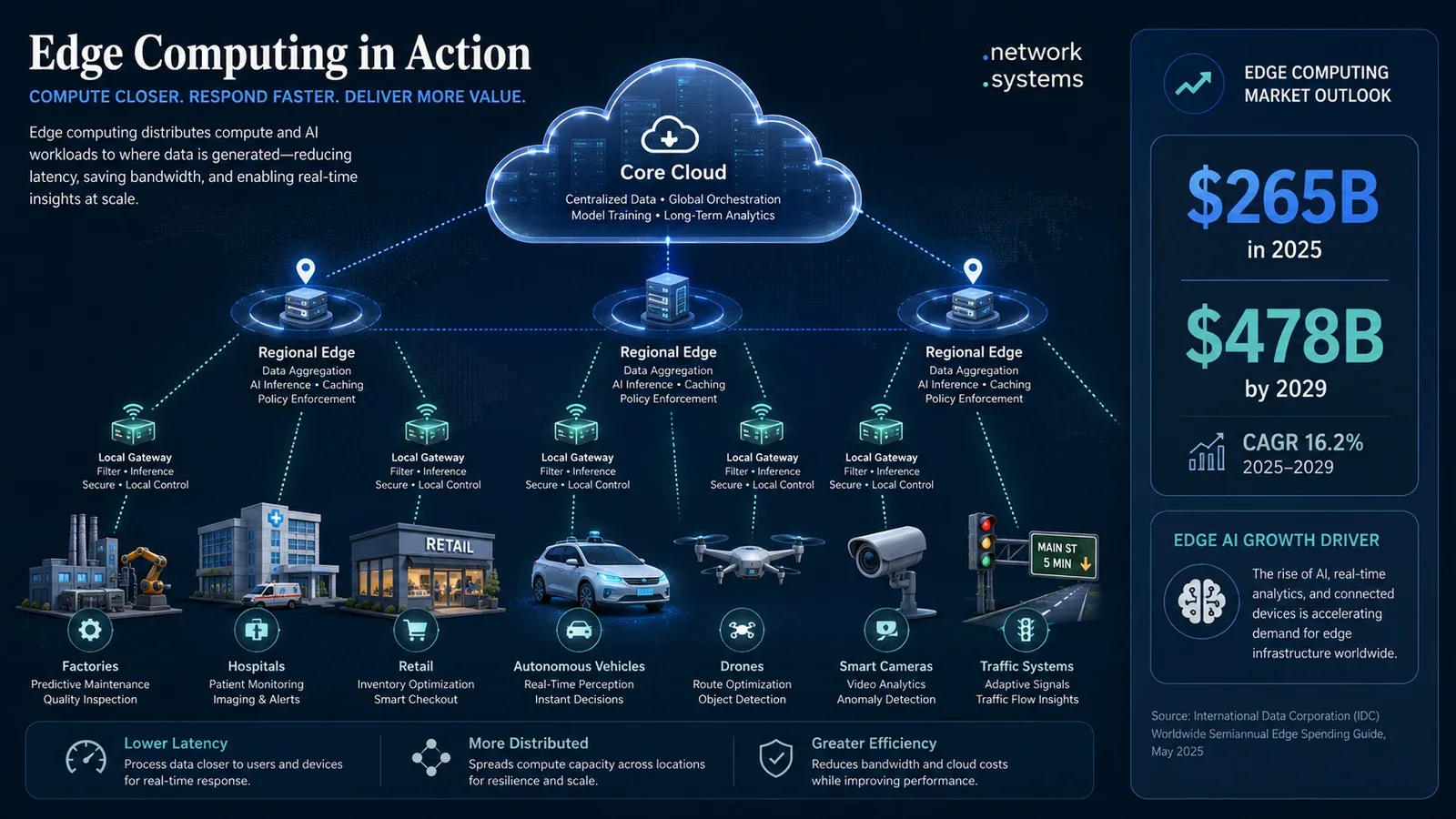
Edge computing in simple terms means moving storage and compute capacity closer to endpoints or users that produce and consume information. Instead of sending all that data traffic halfway around the world to some centralized cloud region for processing, edge computing shifts some of that ability nearer the edge.
Doing that reduces latency, allows faster responses, and can ease bandwidth demand. Networks become less centralized. Processing power spreads outward. Edge platforms act as intermediary routing or compute layers between devices and traditional cloud.
Edge computing matters because the next generation internet contains too many things that can’t afford to wait. Self driving cars, automated factory machines, power grids, medical sensors, video surveillance, drones, connected industrial hardware, local AI/ML models…they all require faster responses. The half-second acceptable on a browser site becomes far too long when your machine needs to brake, swerve, scan for trouble, or send an alert.
All that creates huge demand for naming. Edge endpoints, local gateways, node clusters, internal control software, private clouds, routing meshes, container stacks…behind every friendly brand that the public sees could be dozens or hundreds of internal domain names that help machines locate the right service.
Think Downtown Skyscrapers vs Suburban Expansion
It might help to think of this in terms of real estate again. Owning a premium downtown .com is still like owning a skyscraper. You want it to be seen. It’s scarce. Hard to replace. Businesses large and small will always need trusted core web real estate for their public brand.
Think of edge computing domains as more suburban industrial expansion. It doesn’t make downtown less important. It just means there is now more land surrounding that core city for warehouses, logistics parks, local branch offices, power substations, and service depots. Distribution centers aren’t as sexy as hundred story buildings. But they’re probably necessary for your operation.
That is why I view infrastructure domain names as complementary to regular investing. In fact companies may purchase their main .com brand, then start using logical, descriptive names for their edge nodes, infrastructure software, developer portals, system monitoring sites, private network services, regional deployments, etc. All that infrastructure probably needs naming to function. But the core brand is probably still central to marketing to humans.
Timeframe – Why it’s Already Big Enough To Matter
The edge computing land rush isn’t going to happen overnight. Or rather…it started years ago, but it’s finally reaching critical mass to matter for domainers. IDC reported in February that global spending on Edge Computing reached $265 Billion in 2025. By 2029 that same market is expected to approach $478 Billion. It identified Edge AI as a key growth driver in multiple industries.
Machine generated traffic and distributed system services are going to be a massive land grab for domains if clients adopt them as predicted. All of sudden your basic IT/tech terms and keywords start pointing towards real company budgets.
Buyers don’t need memorable branding when they’re routing between servers or managing machine infrastructure. They want clear. Descriptive. Efficient names that anyone in the company can understand immediately. Safe names that won’t embarrass or confuse the accountants.
Machines Purchasing Naming Infrastructure?
The biggest early adopters might not even be people. Machines are going to need names too. Software updates, config profiles, routing decisions…these things still need description and location. Machines won’t be ‘purchasing’ domain names. But the companies that build distributed networks or industrial automation systems are going to care about how they structure naming internally.
A device may only see one public friendly brand on the internet. But in the cloud that device may interact with hundreds or thousands of services. Some may use internal naming only. Others may communicate across public DNS for verification. Software updates may pull config profiles or certificates from public infrastructure names.
This whole next gen network real estate trend becomes fascinating if you view domains as meaning more than just home pages. The right domain can act as an identifier for product lines, specific gateway services, localized data layers, internal API directories, trusted routing paths…it grows from “ohwww I love that domain, I want my business to use that!” To “we need a stable internal/external naming convention for our devices to interface with”.
All Nodes Should Have Identity
Nodes need identity. Edge nodes need to know what network they’re on. What software they should be running. What configuration profiles apply. What certificates they should trust. Where to pull backups from. Where to route traffic.
Companies could (and do) handle that internally via certs, private DNS, service discovery, internal namespaces, etc. The domain investor doesn’t need to understand the technical evolution to recognize the commercial theme. As systems become more distributed naming becomes more important. Sloppy naming makes systems harder to secure. Harder to scale. Harder to manage.
Someone who used to work for a large data center company told me this in very simple terms. If your engineers can’t easily name a system or subsystem, they generally can’t build or operate it cleanly either. Clean naming can prevent enterprise headaches before day one. That creates real value.
Infrastructure Names Live In Parallel
The last key point is something I’ll emphasize time and time again with this angle. Edge domain names are not generally going to compete directly with your customers’ primary web brand. They’ll most likely exist in parallel.
The public .com may still house the company’s investor facing brand. But internally they may operate perfectly legitimate edge nodes with a short technical name. They may run developer portals or network monitoring services on straightforward descriptive domain names.
Think of infrastructure/domain companies that run massive deployments on custom domain hacks purchased decades ago. If your software needs logical names for edge deployments and internal systems those names don’t have to “compete” with your primary brand…they just live alongside.
Domains like amazon.com are never going to register amazon.network. But Amazon Web Services does make sense on .com. So the Cloud Company could register Aws.network or amazon.cloud and still support its core brand.
.edge isn’t going to replace every company’s primary web real estate. But it gives companies another chance to own utilitarian terms they need for serious infrastructure purposes. For that reason the decentralized node land rush is something domain investors should watch closely.
Technical Extensions Are Real Assets Too
UPLOAD spilled a little too much ink on why .edge is unlikely to achieve traction, so I’ll just say this. It doesn’t matter. Extensions like .NETWORK and .SYSTEMS are delegated gTLDs in the IANA root zone. That means they’re perfectly legitimate targets for brandable infrastructure assets.
Will they ever surpass a company’s desire to own a premium .com brand? Of course not. Most of that top level trust transfers to new generic TLDs like nothing happened. Will certain terms fit absolutely perfect with a .network or .systems extension? Hell yeah they will.
NETWORK could suit connectivity providers, telecom infrastructure, routing companies, mesh services, edge node providers, network analytics companies, or private networking services. SYSTEMS name can suit orchestration platforms, industrial software providers, monitoring services, network automation, or enterprise cloud infrastructure.
Thank your traditional brandable extensions aren’t worthless because they end in .technology or something similarly silly. Just like a “secure” name won’t likely get you trust at .COM…it’s unlikely you’ll purchase amazon.systems and confuse anybody into thinking you’re Amazon.com either. But systemss could suit a company that does management software for edge networks. That begs the question…who sells edge network infrastructure these days that doesn’t use the word system or network in their branding?
Software Sideground Is Real, But Focus On Enterprise Pain Points
When uploading their brief, Sideground pointed towards consumer software companies like Square, Eventbrite, and Zapier.
I don’t disagree these companies could use infrastructure domain names. My counter is that software UI market could be a fad. A client pops up using blockchain based accounting. Then next year everyone switches to cognitive ledger technology. By year three we’re using quantum accounting platforms and nobody cares about what you registered two years ago.
Edge Domain Investing Should Focus On Enterprise Networking Needs
Infrastructure domain investing is less about chumming down memes and more about focusing on durable enterprise headaches. DNS & DHCP probably isn’t sexy to most software startups. But cloud architects, system engineers, and enterprise IT/systems managers care about boring things like routing, network architecture, latency, secure nodes, private clouds, compliance, data integrity…
Hell…buyers in this space are more likely to care about buying .NETWORK domains than startups selling memo pads software.
Related but less important is keeping an eye on industry buzzwords that point towards real enterprise use cases. The biggest shift in technology over the past few decades isn’t specialization. It’s layering. We now have specialists who take individual layers and specialize in those.
Traditionally you hired a web company to build you a website. Now you hire a front end/backend dev who specialize in website front and back ends respectively. Perhaps an app agency for the app. DevOps engineers to specialize in deployment. Separate database/NoSQL admins. Then separate teams who manage infrastructure, monitor, run security, do compliance, create backups, build VM templates, etc.
As digital infrastructure has grown more complex more distinct naming surfaces have been created. Each software/hardware layer needs discovery & description.
Conclusion – Long Live Domain Land Rushes
Edge extension names aren’t sexy or exciting to me either. If buying domains was about ego I’d have given up ages ago. Buying generic keyword brands takes confidence.
Edge domains might not be sexy. But they won’t be hurting for buyers if deployed correctly. Every company, SaaS platform, telecom provider, cloud services firm…is going to have unique infrastructure needs depending on their internal workflows.
Takeaways: The best edge/domain infrastructure domains are short, utilitarian, serious, or map to durable technical requirements. They’re not flashy. They’ll probably never trend on Flipp. But if you buy clean infrastructure words that 500 companies use to describe their network that sells systems…you’re buying way more than domains. You bought entire product lines/network layers vocabulary lock.
The next land rush isn’t about buying every domain with the word edge in it. It’s about watching where the internet goes. Compute is decentralizing and expanding outward. Machine identity is expanding right along with it.